
|
|
BMW Airhead (& some twins prior to Airheads) Motorcycles
Model differences over the years. Technical details of importance.
Including a chart on weights and capacities.
Plus some information to identify the model/year, if you do not have a serial number, etc.
© Copyright 2023, R. Fleischer
https://bmwmotorcycletech.info/models.htm
67B
"Airheads", for the purpose of this website, and this article, means BMW motorcycles with the 2 cylinder boxer-layout engine style with two valves in each head, as produced beginning 12/1969 (as 1970 /5 models). Airheads are generally considered as being in production into 1995; but there were some for 1996. Airheads are not the other boxer type motors that BMW produced, slangly called the Oilhead, Hexhead, etc. Those are considered air and oil cooled, and have a very different type of engine design & all are fuel injected.
Slash 2 is used generically, to mean the models more or less immediately before the Airheads; that is, before 1970. I don't get deeply into them. The official /2 began in 1960, but the previous models (in the mid-fifties) all had Earles Forks.
NOTE: There have been single and twin cylinder "BMW's" produced in the era of, roughly, 1945 to 1956. These motorcycles may be seen with the BMW roundel, or the EMW roundel; and, may be identified by other names, such as Ratier and Cemec. There were also Chinese and Russian "copies". The article below does NOT treat these various bikes. For them, see references on my roundel page:
https://bmwmotorcycletech.info/roundel.htm
Identifying the year of production by serial and/or VIN number:
Up until 1980 and partly 1981, BMW motorcycles were identified by a serial number of, generally, 7 digits. The serial number of the frame and engine were the same. The number for the engine was stamped by the factory at the oil level dipstick area of the engine block (that was discontinued for 1984 and later). Additional serial markings were either stampings at the steering head, or on a riveted plate there, or stamped into the right side lower frame. Charts, books, and other literature are available to identify the exact month and year of manufacture, and in some instances, the exact color and equipment as ordered/shipped. There are websites that supposedly identify such information, many times the information is abbreviated. One can also use dealership website 'fiche' and identify some, but not all, details.
Beginning in 1980, and the process not completed until sometime in 1981, U.S.A.-shipped bikes from BMW changed from a pure serial number to a Vehicle Identification Number (VIN). This method was adopted, at least eventually to some degree, world-wide. This new type of 'number' is a combination of numerals and alphabet letters, and the total length is always 17 characters. The tenth position character (beginning from the left) is the official production year. As an example, for 1980, that was an "A". Each year following was one letter further in the alphabet, except that I, O, Q, U, and Z, were all skipped. Beginning in 2001, a digit was used, with 2001 being 1, 2002 being 2, etc. Non-U.S. models might not use the 17 character VIN number system. In every instance, BMW's factory records can use the last seven characters, which are 'almost always just numbers' to identify the year and model; and, indirectly or directly, the color and how equipped when it left the factory. All brands of motor vehicles sold in the USA since the 1980-1981 transition era use the same 17 character VIN system.
For BMW vehicles, there is common confusion between the year of manufacture and the model year. This has sometimes caused problems with titles and registrations in the various States. The actual "model year" motorcycle could have been produced near the end of the prior calendar year, due to the BMW company-wide vacation month of August and restart of production immediately after that vacation, in September. There are exceptions & anomalies ...most of these are such as when a BMW bike was manufactured even earlier and mysteriously is identified by BMW as the following year's model. This has happened with some Airheads and some Classic K bikes now and then. SOME of this may be due to 'in process' motorcycles when the vacation period began. For 1984 MODELS, BMW stopped stamping the serial number into the oil dipstick area. For the 17 character VIN that came about in 1980-1981, the last 7 characters of that 17 character VIN, is always a 7 digit number, and IT IS the "serial number", and can usually be counted-on to identify the year/month/day of production, and a lot more.
For very considerably more information about VIN and Serial numbers, how to read all 17 characters of VIN's, the sequencing, the anomalies, etc., see the following article: https://bmwmotorcycletech.info/IDnumbrs.htm
This article does not list every year's changes, nor all changes.
Models prior to 1970:
This article you are reading has, in this short section, information on models prior to the /5. BMW made some radically different bikes from 1923 to the end of WWII. Overhead cams, single cams, dual cams, supercharged, ....besides the more commonly seen models, including single cylinder models that paid the bills. For a discussion of of these early bikes, refer to:
1. SLASH 2 information, many photos, some decent technical specifications, etc... A major source and very worthwhile read:3. deleted
4. http://www.benchmarkworks.com/ A major source for technical information, parts, etc. for early BMW's. Owned by Craig Vechorik, also known as 'Vetch'. There are only a few truly knowledgeable folks having a business that specializes in working on or supplying parts and information for pre-1970 BMW motorcycles, Vetch is one of them. Benchmarkworks is at 3400 Earles Fork Road, Sturgis, MS, 39769 USA, telephone: (662) 465-6444 Vetch stocks the special switches and harnesses for the /5 and /6 Airhead's Ignition switch too.
5. The book: Illustrated BMW Motorcycle Buyer's Guide, by Stefan Knittel and Roland Slabon
If you have a /2, you can install a 12 volt alternator and lamps conversion for much better lighting. Coil ignition can be installed (not needed IMHO). Using the best modern partial or even full synthetic oils, you can extend the time between /2 crankshaft slinger cleanings, although just how much is questionable, and depends on engine condition, particularly engine blow-by. A worn engine allows more blowby, more contaminants into the oil, including more carbon, which fills the slingers faster. You surely do not want the slingers to fill totally ...which causes oil starvation to some parts of the engine. Use of a quality oil containing at least 1100 ppm of ZDDP or ZDTP is helpful.
The internals of the wheels of the /2 era bikes are very similar in basic design to those of the /5 and even into /6 airheads, but the /2 era bikes had larger diameter axles and frames that flexed less. This was because the /2 era motorcycles were designed to allow sidecar use. The /2 era ended BMW's practice of "sidecar fittings as standard". This was made doubly so with the abandonment of the adjustable trail Earles leading link fork, ...which had been an option, or standard, depending on the model and ordering by the dealer. The /2 era bikes steering heads had ball bearings, which were not as good as the /5 and later tapered bearings, but those are installable. The /2 series ended the use of the very nice-looking bars-end turn signal housings. If you have, or are contemplating, the ownership of a pre-Airhead BMW motorcycle, be sure to extensively read about them.
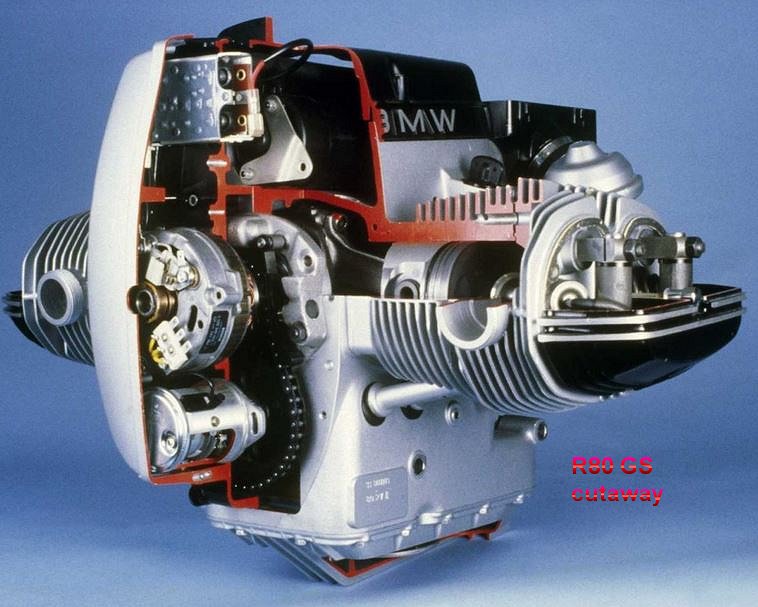
The Airheads, general information:
"Airheads" are twin opposed cylinder air-cooled motorcycles manufactured between the end of 1969 (the beginning was the 1970 year model) and the end of regular production in 1995, and some few made as late as in 1996. Beginning with the 1970 models, the motorcycles are called Airheads by officionados. BMW made huge changes to these new production bikes, compared to the previous models, especially of note was the changes to the motor and frame. They also completely stopped making and installing the type of leading link front fork called an Earles fork. The last such huge changes were arguably in the R5 of 1936.
The new motor for introduction for the 1970 model year had plain bearings lubricated by a high pressure system & there was a pleated paper oil filter located inside the motor. The camshaft position was changed to below the crankshaft. Previous motors had roller bearings for crankshaft & camshafts, low pressure oiling systems, and some form of "filtering" that is generally referred to as a slinger or slingers. The electrical system had major changes. There is a long list of various changes ....and I will get into most of the changes, later herein.
The use of the separate rear frame on the /5 and later (most models) causes fitment problems, not nasty ones though, when fitting a sidecar to a /5 and later Airheads, which was specifically not officially allowed. The separate rear frame structure, on those models having it, do cause some flexing, which was improved over the years of production. The /5 Airheads had a smaller front axle diameter than later Airheads (14 mm versus 17 mm); and some bending had been seen under severe conditions, hence the later factory change from 14 to 17 mm. This was accomplished by BMW by simply changing the internal spacers of the wheels, and the hole size in the fork lower legs. Some information on the front and rear axles is in my hardware article in a separate section: https://bmwmotorcycletech.info/hardware.htm
There are websites and groups devoted to the early bikes. /2, /5, G/S, ST, and R90S owners ....and some others ....also have their own websites. See this page: https://bmwmotorcycletech.info/url.htm
The primary immediate response source of technical information for all BMW AIRHEAD boxer models, 1970-1996, is not the single model websites in the above short paragraph, but the Airheads LIST. See https://bmwmotorcycletech.info/technical-articles-list.htm for information on how to become a Member of the Airheads LIST, which is free.
BMW has tended to find ways to use up old parts bins stocks, and has sometimes shipped various combinations of components; this was particularly so in the 1973-1976 era. That can make getting the correct replacement part a bit of an exercise sometimes. BTW.... It is fairly easy to swap many parts on many or all Airheads. While there is a lot of interchangeability possible on parts & components, this is not to be taken that all can be interchanged or that just because some item will physically fit it is a wise change. There are very specific problems, or concerns, in interchanging many items. Interestingly, the front forks will fit, sometimes easier, sometimes not, on many models. Generally, all Airhead front forks will interchange. Many K bike front forks will fit Airheads.
It is possible to put some items from other BMW bike lines into Airheads. The Classic K-bike front ends & brakes, previously noted, for example. Actually, very substantially-built forks from other makes can be installed, as can alternators from Moto-Guzzi, Ducati, etc. Those thinking of swapping Airhead cylinders, cylinder heads, transmissions, rear drives, etc., can consult the Airheads internet LIST for expert advice, although there is information in my #60-x articles, & information on other things, like drive-shafts, rear drives, fuel tanks & seats, etc., found scattered in the appropriate areas on this website. I also have an article on modifications for performance: https://bmwmotorcycletech.info/mod4performance.htm
Not all models were shipped to the U.S.A. in any given year. BMW stopped shipping R100-engined bikes to the USA for 1986-1987-1988. BMW produced what is known as Last Edition R100 (series) bikes, and most were so labeled, such as on side panels that cover the battery. There was a considerable amount of bad feelings when, in essence, the R100 bikes were again offered for sale, and BMW gave new helmets to owners who felt cheated by the fact that their Last Edition motorcycles were not so. R45 bikes (both versions) were never imported into the USA by BMW. Some of these various not-imported bikes are seen now & then in the USA, including the later R80GS and R80GS-PD with Paralever; the R65GS, R80R, 1995-1996 R100RT Classic (questionable about the importation of those, and note I showed -1996) and R100GS PD-Classic.
Here is a good website page, showing a chronological index for BMW motorcycles with some specifications for each model. If you click on a model, you get a lot more information. Unfortunately, the site does not totally separate out Euro vs USA versions, but, the site also includes the pre-Airheads, and the later models too.
http://www.verrill.com/moto/bmwchron/index.shtml
Now and then you may find folks talking about certain Airheads, and rather often the details quite wrong. It is sort of like someone saying something, and then the something gets passed from person to person, and gets distorted; or, never was correct in the first place. One such is the chit-chat about so-called "Belgian Police bikes". These were produced, but did not go to the police (AFAIK). A large order of bikes was made by a dealership, and, instead of having standardized Police (Authorities) paint work, there were a considerable number of combinations of colors. How this came about would need a lot of paragraphs, so I won't type much of anything about it except this paragraph. In fact, I am not sure of every detail in this paragraph. I think Tom Cutter (Rubber Chicken Racing Garage) may know the entire story. What I think happened, was that the large order was cancelled, and Tom has said that BMW offered the bikes to Butler and Smith, the East Coast BMW distributors. I don't remember any such offer to the West Coast distributor. BMW sold the bikes to B & S at a quite large discount. This led to discounted sales, especially nice when considering the poor sales at that time. Nothing very special about these bikes, except the combinations of colors.
You may see some BMW Airheads with identifications with CFO on them. This stands for California-Florida-Oregon specifications. Except for the CFO marking, there is NO difference in these bikes from the regular not-so-identified bikes.
The Airheads, part 1:
There have been a large number of changes to the Airheads over the years, yet there remained mostly similarities. This article does not show all changes, as there are too many. Cosmetics and finer details like tank shapes & fits; seats fits, etc. ... are generally not included in this article, but covered in my other articles; or, other folks' articles. However, there are two rather short articles on this website dealing with the changes to the instruments, from the start of production of the /5 to the end of production of the Airheads, in 1995: https://bmwmotorcycletech.info/instruments1.htm and https://bmwmotorcycletech.info/instruments2.htm
In late 1969 BMW stopped manufacturing all prior models and began manufacturing only boxer twins, beginning with the /5 series. The /5 was a radical departure from their previous motorcycles. Although BMW had conventional telescopic & leading link (Earles) forks on previous models, now only telescopic was offered. The frame was considerably modified, and no longer wrapped to the rear. A separate bolted-on rear sub-frame was now used. I do not consider the new rear sub-frame an improvement. As the years rolled on, BMW beefed up the frame to improve handling, but the separate rear subframe continued for some time. It contributed to the famous 'rubber cow' effect. Early models exhibited that effect much more than later models, and the Monolever and Paralever models had less of it.
The rear suspension plunger design was abandoned in favor of a swing-arm design. The plunger design is better for sidecar use. The /5 and every Airhead model ...and all other BMW motorcycle models made since the end of 1969 ....were not designed for sidecar use; but most have had sidecars put on them quite successfully.
The new engine design had a considerable number of changes. Mechanically, the biggest change was to move the camshaft location to below the cylinders, this improved lubrication. The pushrod tubes delivered the oil from the top ends to the camshaft lobes by top end oiling draining downward inside the pushrod tubes. The engine internal oiling system was modified. An oil filter was incorporated, where only crankshaft 'slingers' were used before. This new design eliminated the need to remove the crankshaft every 30,000 miles (approximately), for slingers cleaning or replacement. The 6 volt system was changed to 12 volts and the magneto was abandoned in favor of points & coil ignition. A starter motor was added. In general, the longevity of the motor, and mileage between serious service intervals, was substantially increased, even with higher engine output. BMW motorcycles became more popular in the USA and began to get a more and more well-deserved reputation for being quiet, competent, reliable and needing less service and having fewer problems than most other makes.
The /5 came with a 180 watt 3-phase alternator. After the /5, higher capacity alternators became standard with the introduction of the /6 series. Certain early /6 series 280 watt alternators will very easily fit the /5.
The first /5 models had a shorter wheelbase than later models. This is easily seen by a quick glance at the rear area of the black colored driveshaft housing, the short wheelbase model has no welded section a few inches from the flange end. The early /5 SWB (Short Wheel Base) and to a much more modest amount the early R65 (also short wheel base, but production began on the R65 much later, in late 1978) could (not will), have some potential for instability under some specific types of riding. This was particularly so if a fork-mounted windscreen or bat wing type was installed and worse if the rider had considerable weight aft of the rear axle and speed was high. In addition, big saddlebags and a rear trunk made things worse. These instabilities were seen on the /5 SWB, and were extremely rare for the early R65, on them usually due to improper maintenance.
For the 1972 year, only, BMW offered the so-called "Toaster" chrome-panels on the fuel tank and to each side of the battery. These were controversial, and many changed to the larger capacity non-Toaster tank. Many years later, the Toaster tanks became popular for nostalgia reasons mostly. For another viewpoint on the /5 fuel tanks: https://5united.org/history/tanks/
BMW elected to go to the LWB (Long Wheel Base) in mid-1973, and for the R65 that was in the eighties, but no R65 model of any year had the same level of possible instabilities as the SWB /5. There is an article on this subject: https://bmwmotorcycletech.info/instability.htm. You can see the welded-in section, used for many years after it became standard. The LWB (Long Wheel Base) also more easily allowed for a bigger battery. My personal preference is the SWB. It feels quicker-handling. I HIGHLY recommend AGAINST any FORK-mounted fairing on a SWB /5.
There was also the later addition of an internally cushioned driveshaft. The cushioning was provided by smooth-finished two-part mating-cams, whose actions were backed up by a very strong spring. It is better for the transmission to have the "cush driveshaft", but not critical, and not but barely required at all if shifting is done smoothly.
The LWB models have more stability with aft loading; are better able to handle windscreens, and have capability for a larger battery ...the original being small in size. The SWB has a somewhat higher torque feeling if the throttle is suddenly snapped off; this being slightly more noticeable in turns.
While not getting into it any deeper than a mention here, there was no hue and cry about instabilities at speed on the SWB R65 ...which out-handled any stock /5 ...some of which was due to the R65 top triple clamp being very beefy; even though the 18" front tire was possibly a negative. This is all arguable.
The /5 bikes had 10 mm diameter flywheel bolts, and the 1974 /6 also did ...these could be twisted off from serious rider abuse during riding. Some slightly later /6 may have had them ...perhaps into early 1975, after which the bolts were 11 mm. The bolt torques vary, and using the torque information on this website is a good idea.
In identifying a /5 engine block, there is an eyebrow cutout on the front face of the engine block. It is solid from 1974. Obviously, this is not viewable on a motorcycle with the timing chest & outer cover still on the engine.
The /5 SWB bikes and /5 LWB motorcycles use different saddlebag mounts. The early R65 can be fitted with its own bag mounts, or /5 mounts adapted, and vice versa.
The /5 with its 180 watt alternator came with a 40/45 watt non-halogen headlight lamp which used a slightly different mounting. The 180 alternator is capable of handling a higher power headlight, the 55/60 H4 halogen. Upgrading the 180 watt alternator is easy too, with the early /6 280 watt alternator being a nearly plug and play installation. BMW offered a kit to convert to the much better H4 lamp, but the kit is NLA. Converting the headlight, in some good manner, is an excellent thing to do for your /5 motorcycle. You have to change the lens too, or the light pattern is spread about rather poorly. You can easily adapt the R65 headlight parts to a /5. Conversion gives vastly better lighting at night, using a common 55/60 watt H4 halogen lamp as used on later Airheads. Later bikes got rid of the clip method of holding the bottom of the headlight chrome ring ...which sometimes allowed a headlight assembly to fall and be damaged. Modification of early chrome rings to avoid loosing the ring, headlight, etc., is a good idea. My https://bmwmotorcycletech.info/lamps.htm article has information on a H4 type lamp that will work with the original /5 reflector and base.
The /5 models came with a crankshaft rear main-seal that tended to leak after enough mileage & maybe dirty oil helped that along. BMW has made a number of main-seal changes over the years, & considering mileage & servicing, the chances are low to modest that you will find an original type of white seal. With the /6, BMW added an O-ring inside the flywheel bore & with the /7 came a metal cap and the same O-ring continued. The final version of the main seal has a Teflon section, & works very well, & fits all Airhead models. There is a profusely illustrated article on this site about changing the seal:
https://bmwmotorcycletech.info/flywheelremovalwarning.htm
The automatic timing unit (ATU) for the ignition was changed a few times during the /5-/6 era. Prior to 1979, the ATU and points were located in a cavity surrounding the nose of the camshaft, located at the front of the engine. In 1979 and 1980, the ATU and the points were located in a canister, driven by a flat face slot on the front of a new-style camshaft. The final version, from 1981, was located in the canister. However, points were not used in favor of a special type of magnetic field sensitive transistor called a Hall sensor, for use with the new electronic ignition. This canister had a habit of its ATU getting a bit sticky, the result of which was increasing RPM as the engine warmed-up. My ignition article gets deeply into the new style ignition, and I also have a single plug ignition article and a dual-plug article.
Here are a few more differences that you may want to know about, between the /5 and the /6:
Front wheel and brake; headlight bucket deleted from prior speedometer-tach integration in favor of an instrument pod; fuel tank (they look alike but the underside is different to allow for front brake master cylinder clearance); valve gear is modified; transmission went from 4 speed to 5 speed; battery area became larger (first expanded with the LWB /5); starter relay function & internals vastly different; headlight relay installed (and function on early /6 not same for that relay as later uses of it); turn signals changed; wiring harness was radically changed; flasher (Trafficator relay) changed; seat was different, ETC. The /5 original cables did not have the plastic linings of the later cables, thus, if you have originally-shipped /5 control cables, you could oil them as a last resort if they are acting up.
The /5 and into the /6 era may have left-over ignition switch gear and harnesses. This is complicated, so I have not listed all the details. Bench Mark Works, Craig Vechorik ("VETCH") http://www.benchmarkworks.com is an excellent source for information, parts, and technical help, etc. Snowbum disagrees with Vech (Vetch) generally only with his remarks on not using GL5 oil on Airheads and later. Vetch stocks parts for the old BMW's ....and quite a few for the later bikes, including manuals and other literature. Well worth your time to THOROUGHLY browse the site. A must if you have a pre-airhead (before 1970 models). Craig stocks the various versions of the early ignition switch and harness; which can get complicated to explain so I have not included that information here. Vetch is a world of knowledge on PRE-Airheads too. See later, below paragraphs on the switch gear, etc.
The /6:
The 1974 model year introduced the /6 bike, and 1974 was a not-so-good year. This newly introduced /6 bike had carry-overs from the /5 (such as switch gear), ...& new problems. The 1974 still had the 10 mm flywheel bolts; shearing them off could ruin a crankshaft, but often the shearing just messed up the threads at the exit which were usually repairable, many times nothing much was needed. The 10 mm bolts tended to shear off on the R90S in particular. The bolts became larger for 1975, which means that BMW changed the crankshaft & the flywheel.
For the /6, BMW made a LOT of changes to the /5 bikes. I will list SOME in this paragraph. The engine castings were beefed up, and some of that required changes in crankshaft access (the front and rear bearing areas were beefed). The opening for the crank to be installed-in was decreased in size, so the crank balancing method was changed. The cylinders had cast-in liners of cast iron. The alternator output was substantially increased and a larger battery capacity was standard. The fuel tank was larger (6.4 gallons) and made standard size. The braking system (at the front) was extensively modified. There was now a disc brake on the front for the R75/6, R90/6 and R90S models, and the master cylinder for the brake was located under the fuel tank. Carburetion was still a Bing slide type for the R60, but for the R75 and R90 engines, there were Bing CV carburetors. For the R90S, the carburetors were Del'Orto slide types. The valve actuating had needle bearings in the rockers. The clutch throw-out bearing went from balls type to needles type, a change I think was a poor idea.
A 5 speed transmission was introduced in 1974 ....and it had problems. The pawl springs would break, the input kick-starter special gear was soft & wore (don't use the kickstarter on a 1974 unmodified transmission unless actually needed) ...and the metal shredded into the gearbox & damaged the bearings. The shift forks were too wide & gear dogs broke. You can't purchase the gear alone, only the whole cluster assembly ...and the original one is no longer available. That means that you have to install the 17.5° late model items, & that is $$$. Finding neutral was often somewhat difficult, over-shifts also happened, & most problems were not fixed until 1976. As mentioned, some 1974 transmission parts are now NLA, & brand new transmissions or a good later model are often the best answer to trying to rebuild a 1974 transmission. The transmissions are directly interchangeable, that is, they will physically fit and operate OK (including the earlier /5 era 4 speed), all the way to 1980. There is a huge amount more on transmissions here: https://bmwmotorcycletech.info/transmission.htm.
The handlebar controls of the 1974 were a carryover (of sorts) from the /5. Some of these parts were part /5 types and part /6 types, and NLA, although later controls certainly fit. These switches may look like /5, but have different wiring. The 1974 switches are no longer available. The 1974 R90S had handlebar controls that were very much like the /5, and the levers had finger indents....also the S model for 1974 (and most other models for 1974) had 5 ignition key positions (1975 models and later used 3 position ignition switches), solid discs, 14 mm axle; and, only for 1974 there was also a chromed acorn nut on the right rear lower shock absorber position. One interesting tell-tale for the 1974 R90S was the neutral lamp, which was not marked Neutral, but with a 0.
From beginning of the Airheads with the 1970 models, generally through 1974, the switches had black levers. The turn signal switch was on the right side, as was the start button. On the left side were the horn and lights.
The 1975 models through 1978 models used flat rocker switches, and the kill switch was added.
The 1979 models had flat switches, but the turn signal switch was moved to the left side. Also in 1979 came the ignition points now located in a metal canister, which was driven now by a flat nose valves camshaft, with an offset keyway.
Monolever bikes switches had plugs with connectors, not spades.
You might have different versions than I indicate, and many old switch gear items are no longer available and thus there may be substitutions and even wiring changes. Some information is here: https://bmwmotorcycletech.info/misclelectrical.htm ...very specifically, see item (6) in that article on replacing a left side bars switch assembly on a /6.
The handlebar right side assembly is rather involved to convert to a handlebar master cylinder. Use of a smaller bore (piston size) master cylinder is advantageous for better braking, as BMW was overly conservative on the size. The 1974 front axle was still 14 mm, in bushings (the 17 mm axle came a year later, as a full fix for 1976 models). Under some severe usage, the 14 mm front axle could bend. You can make simple changes in the wheels innards to accommodate the later fork lowers and 17 mm axle. The 1974, only, had "strange" fork tubes/lowers (1974 lowers are NLA); the 1974 model (only) had a one-year-only type of lower fork leg, and are NLA, and later versions must be used for repairs. Engines tended to vibrate lightly around 4000-4600 rpm. The frames were a bit weak, with the 1975 being better, and the 1977 better yet with more substantial bracing.
Compared to later models, the 1974 had a somewhat more rubbery feel, due to the weaker frame;...the frame was beefed up in the late seventies. Possibly some crankshafts are marginal, causing vibration. The 1974 retained the 97 mm crankcase port for the cylinders (the 99 mm crankcase port and matching cylinders came during 1975, and the cylinders are also 0.5 mm longer), and new cylinders are NLA. BMW made changes to the cylinders and case so that O-rings could be fitted into a recess at the top engine studs fitment at the case, where the high pressure oil gallery supplies oil to the cylinder head.
The 1976 incorporated many other upgrades as was noted earlier, and these included larger pushrod tubes, pushrod changes, engine case cylinder hole size increase to 99 mm. Later engine's Nikasil cylinders will fit.
BMW made their "Hot-Rod" (or, call it the sporty model) R90S starting with production at the very end of 1973, for model year 1974. Production ceased in mid-1976. The bike was the only BMW that ever came with Dell'Orto carburetors. Partly due to its very fancy and hard to duplicate paint jobs, partly due to its history of racing at Daytona, partly due to the small fairing, etc., the R90S became a cult collectors item. The very first models were the fanciest looking. The R90S had a compression ratio of 9.5:1. Performance was about as good as the Euro version of the later R100S/R100RS/R100RT. During production of the R90S, the factory began deleting things. Fewer chrome fasteners, chrome in the front of the horn, the taped pin stripes became painted. The 5 position ignition switch changed to the standard 3 position type, mirror stalks became straight, no kickstarter (orderable though). There were also some improvements along the way, such as went with the rest of the /6 line, such as drilled brake rotors and a slightly more powerful starter. The R90S has, as noted, become a cult item, and prices have constantly risen for good, even bad, examples.
Because quite a few things were changed for the new S model (R90S), & the R90S has a huge following (as does the early R80G/S), I have a section located just below on the R90S. I continue with the rest of the main article, after the following red-line blocked area.
This section, outlined by red lines, is my, Snowbum's, editing of a page posted for SuperTech distribution, on January 30th, 2019. This page I edited was written by Mac Kirkpatrick, [email protected]. I converted it from Microsoft Word .docx, and then edited it, and posted it here, all by permission from Mac Kirkpatrick. Some minor areas of my editing are not specifically so-identified.
THE R90S MODEL:
Introduced on the 50th Anniversary of BMW Motorrad.
It has been said the R90S is to BMW Motorrad as the Mercedes 300SL Gull Wing is to Mercedes Benz. They are both iconic.
“FIRSTS” FOR BMW with the Introduction of the R90S:
Designed by a designer, Hans Muth, not engineers (Note by Snowbum: visuals, over-all appearance, and had some input to engineering to get what he wanted).
900 cc engine (up from 750 cc).
5 speed trans, was 4.
Dual front disc brakes.
No fork gaiters, the fork tubes were exposed for visual appeal.
No stays on the front fender, again for visual appeal.
Steering damper.
Separate tachometer and speedometer in same housing (note by snowbum: see /6 models and later).
Polished float bowls.
Seat cowl.
Smoked paint (Silver Smoke only in ’74, Tourist Trophy Silver Smoke & Daytona Orange in ’75 & ’76). Daytona Orange was meant to mimic the sunrise at Daytona Beach.
Factory fairing.
First Superbike win, at Daytona in 1976, then won “Superbike Championship” for the full year.
Only Airhead model with Del’Orto carburetors.
Visual Differences For the 1974 R90S Compared to Later Model Year R90S:
The ’74 had many nice features compared to later R90S versions, which were modified to lower costs. This was never stated but note the differences from ’74 to later, many are cheaper alternatives. But these changes are not easy to note, one really must look hard to notice the differences. (note by Snowbum: some later details actually cost a bit more).
/5 handlebar controls, in looks only; the wiring was unique for this year and different from the previous /5 models.
Aluminum gas cap, later chrome casting.
Smaller diameter front axle. (Note by Snowbum: the later axle was better for rough usage conditions).
Aluminum turn signal bodies.
Hand levers curved with finger detents, anodized, they naturally turn purple with age.
Seat was “smooth”, fewer indentations compared to later.
Chromed right rear lower shock mount, an acorn nut.
Speedo/tach read “0” for neutral, later “NEUTRAL”.
Five position ignition switch versus three later.
Carb to airbox clamps had dull finish, later were chromed.
Smooth swingarm black plastic covers, later crinkle finished.
Brake master cylinder diameter went from 16 to 17 mm for ‘76.
Brake caliper went from 38 to 40 mm for ’76.
Tape stripes (wallpaper), painted stripes came in ’75 & ‘76.
Mirror stalks smaller diameter and curved (more elegant).
White line around the speedo and tach glass diameter, inside the glass.
Solid discs, later drilled in a 3/2 pattern then 2/2 pattern.
More chrome fasteners than later.
Last year for kick starter being standard.
Some early fairings had two holes in the bottom as access for removing the headlight bezel.
Early throttle tubes were bent, later were straight.
Later transmission cases had exterior “lines” added for strength, getting ready for the 1,000 cc engine (note by Snowbum, these were casting differences).
Early front axles had one pinch bolt versus 2 later.
Horns had a chrome center, later flat black.
Not all these “visuals” were strictly for the ’74 model because “running changes” were the norm.
As parts were used up newer style parts were installed, sometimes.
There is no such thing as “always” or “never” in the R90S world. As soon as you say either, it always seems an exception pops up. Even when an original owner says, “I picked up my R90S from the dealer, so I know mine is how it came from the factory.” What about transit damage? Did the dealer alter the bike or fix a problem before turning it over to the original owner? Did the dealer swap parts to please another customer? Is your memory that good after 45 years? How many owners has your bike had?
After the Superbike win at Daytona in 1976 on Daytona Orange bikes, it is documented that some customers had dealers take off their TT Silver Smoke parts and install Daytona Orange parts. So maybe your Daytona Orange bike was originally TT Silver Smoke? BMW “might” be able to verify that as some records were lost.
Just because the current "official" BMW parts fiche says something (Max BMW, etc.), that is NOT necessarily how BMW originally assembled any or all R90S models.
BMW made numerous other running changes to the starter, alternator, transmission, front end, ....really seems like everywhere. The ’76 model is thought of as the best example since it had all the upgrades.
Transmission in the ’74 model:
Oak Okleshen's advice was to swap it out for the trans from a later year (Note by Snowbum, IF there were serious problems, and considering many parts were NLA for the '74). However, many were repaired and continued in service.
When BMW employees first saw the Daytona Orange color they referred to it derisively as “egg yoke”.
Colors?
TT Silver Smoke is Elegant. Daytona Orange is Stunning.
Daytona Orange for going to the beach, TT Silver Smoke for the opera?
Some R90Ss had cloisonné (enamel) emblems, some did not.
Early fairings had two holes in the bottom for access to remove the headlight bezel.
The R90S came with 3 keys; metal, with large black round fob, folding gray plastic.
The very last of the R90Ss had flush gas caps like the /7 models, and for years replacement gas tanks had flush caps, which upset (some) owners.
Upgrades (?) to consider:
14 mm brake master cylinder with 40 mm calipers (optimal braking ratio). (lengthy note by Snowbum: BMW has always been very conservative with its brake slave cylinder bore sizes for all bikes. The result, in many instances, is the large hand pressure required for hard braking, and the lever may feel rather wooden, with little modulation feel, assuming a good and proper system bleeding. BMW used an under-fuel-tank master cylinder for the early front disc brake models, this continued for quite a few years; and while there are some anomalies, the final change away from the ATE swinging calipers, was in 1981. While one can convert to the better on-bars master cylinder, and even convert to front dual-disc Brembo slave cylinders, at some effort (and, see my brakes article) the motorcycle is no longer stock appearing. If the existing under-tank brake master cylinder is converted to a smaller piston size, the hand pressure needed is less, with the caveat that the lever movement will be a bit more. BMW used inch sizes of master cylinders, but the metric sizes shown are rounded numbers, which is common custom. BMW used "16" mm master cylinder on the 1974 and 1975 R90S. BMW used a "17" mm for 1976. Using a smaller master cylinder piston bore size will improve braking for the average rider. Note that the 'swinging' ATE calipers must be carefully adjusted for optimum performance, the pads are angled, and 'look weird'; and, I am not making definitive master cylinder size recommendations HERE).
1,000 cc kit from Siebenrock.
Nikasil coating of cylinders from Powerseal USA.
Transmission “shift kit”, as BMW installed later.
Driveshaft with Cush system components.
Chrome plated stainless spokes for longevity and originality.
Higher output alternator (up to 600 watts is available aftermarket that fits into the timing chest cavity).
Kick starter.
Nippondenso starter motor (stronger, less draw). (Snowbum: or, later version of Valeo with the field magnets fix.)
Kat Dash instrument lighting (snowbum: if the original flexible material is or has failed).
The R90S almost did not see the light of day; Bob Lutz is considered the Father of the R90S, see the book “BMW R90S” by Ian Falloon, page 33.
Interesting R90S article:
https://www.rideapart.com/features/248625/the-bike-that-saved-bmw-again-online-find-panjo-edition/
1977: BMW made a R75/7 model, the last of the 750 cc Airhead models. Production was between the end of 1976 and end of 1977. This was a very good motorcycle with good horsepower output & good torque. The R90S was replaced by the R100S, and the 1977 USA version came with the "S" fairing. Last year of any Airhead having the inner cap and its single bolt, in the oil filter chamber.
1977-1978:
BMW had already incorporated wiring for an electronic tachometer (to replace the mechanical tachometer), and phased-in the electronic tachometer generally in the 1977-1978 calendar years, and information on serial numbers and models is very sketchy. For 1978 into 1980 models, BMW installed a beeper/buzzer to indicate that the turn signals (trafficators) were in use. The added relay can cause problems if you are using LED lamps, and some find the buzzer very annoying. The fix for these situations is to unplug the relay.
1978:
The transmissions had gusset reinforcement running only from front to rear (none left-right). Changed was the shift linkage. It was now pivoted from the footrest and was more positive. The pistons now used the EXternal type of piston pin clips, which are much easier to R/R (in some instances, this was for 1979). Camshaft timing changed in this 1977-1978 change era, by changing the camshaft sprocket keyway, amounting to a 3° advance in the cam, which means 6° advance in reference to the crankshaft. This was the beginning of the emissions changes, that were not all incorporated at the same time ...more happened later-on. For the 1978 model year the R100S came with Snowflake cast wheels and a rear disc brake. Butler and Smith, the importer-distributor, added a rather overly large and sort of ponderous "Luftmeister" fairing.......and Krauser bags, probably to try to help sales, as the Japanese imports were definitely making headway.
1977-1978 era:
For the USA, most 1978 models were built in calendar 1977. Some irregular things happened in this period, and there is a fair amount of mis-information in existence. The factory sales literature is incomplete.
Not part of the irregular 1977-1978 era, are these things: For 1978 there was a R80/7. A shifting linkage change came out, phased into all models slowly, the linkage now pivoted on the footrest. There were phased-in cam timing changes, piston pin clips changed, single key locks, and other small changes.
1979:
Beginning in 79 the gusset reinforcements at the bottom of the transmission case were a cross hatch like a crossword puzzle. BMW changed the internal driveshaft to a 'cush' type, incorporating a very stiff short spring and a dual cam, that made shifting much nicer. The driveshaft housing was still the tapered type, which lasted until 1981, when the housing changed to a straight tube. At one time, BMW offered a 'kit' to incorporate the cush driveshaft into earlier models. Note that if you try to install a 1980+ driveshaft into the earlier style of driveshaft housing, a bit of grinding on the shaft will be necessary. The piston pin 'keepers' were all now external clip types. The handlebars got the padded centers on all models, as of 1979, as previously it was just on the R100RS. Note that the RS and RT received Brembo rear disc brakes, but the front brakes remained ATE swinging calipers, for now. The RS and RT also received the oil cooler as standard. BMW modified the cylinders base area to accept a very large rubber O-ring.
Also in 1979 came a different system of driving the ignition points, this was the "canister"; sometimes called 'the bean can'. The new system used a modified valves camshaft, with a flat nose and a female slot. The canister drive was male, to fit that slot. The slot was offset from center, so it was not possible to have it 180° out of proper fitment (contrary to some literature). This type of drive is much more positive and with less timing irregularities from slop, and not affected by any very faint bending of the older style camshaft nose shaft. The Oldam Drive design also eliminated the very troublesome situation wherein someone over-tightened the nut on the early camshaft nose, breaking the camshaft nose. The canister contained points for only the 1979 and 1980 years, and worked well. In my opinion, the lack of a lubrication felt was not a good idea and owners should be sure the points cam is very lightly greased with a high temperature grease, such as the special Bosch grease that is designed for this purpose for the earlier models. For the nerdy amongst us here, the points dwell angle was changed for the canister models, and so was the effective dwell for the 1981+ electronics version of the canister.
There is nothing wrong with any of the points-types ignitions BMW used. The points ignitions are cheap & generally easily fixable anyplace, but you do have to check the points every 5000 miles for gap, lubrication of the cam/felt on the early model (no felt for canister models), and engine timing setting ...all relatively easy to do. Points last about 15,000 to 20,000 miles, then must be replaced. Aftermarket points amplifiers or boosters are available that reduce the current through the points, and I recommend them, as they extend points life very considerably. If the points are installed carefully, and kept quite lightly lubricated at the felt pad (pre-1979) and at the points cam, then with a booster or amplifier, points life can triple, yet be easily field-repairable in a few minutes, even if the booster-amplifier should fail. Many a discussion has happened over reliability and repairability of points versus Hall device electronic ignition; particularly, for world travelers.
The 1981+ electronic ignition is very powerful, especially helpful with the eighties and later leaner carburetion; and the electronic ignition is generally quite reliable; but, you must not ever pull off the spark plug caps whilst running (or, ignition turned on). It is also a bad idea for any 1970+ model. Some literature is flat out wrong about it being OK to do that on 1970 and later models.
Some BMW models such as the R80ST and R80G/S had a single 12 volt coil with dual towers, instead of the prior two each 6 volt single tower coils. These early gray plastic bodied dual tower coils tended to visibly crack & fail. All very late BMW airheads have a single, 12 volt, dual output coil, but the later versions are much more reliable than earlier ones. Some models in the early 1980's had two separate 6 volt coils in series, just like much earlier models, and these are also considered quite reliable. You can read all about these things at these articles:
https://bmwmotorcycletech.info/Ignition.htm
https://bmwmotorcycletech.info/dualplugging.htm
https://bmwmotorcycletech.info/ignitionsingleplug.htm
https://bmwmotorcycletech.info/ignitiontheory.htm
As noted, in 1981 the same metal canister was used to house an electronics trigger, called a Hall device, which is a special type of magnetically sensitive transistor, needed for the new electronic ignition.
From 1980, BMW made a change in the oiling system that is cast into the block:
https://bmwmotorcycletech.info/oilsketch.htm. There is more than one sketch on that page to look at. To identify the engine block you must remove the transmission and clutch, and stamped into the rear of the engine block is a triangle with a N in it.
BMW made various changes to the valve gear over a long period of time. The /5 had sleeve bushings in the rocker arms, the rocker arms were not positively located, and more care in adjusting the rockers squareness to the rocker blocks, etc., was needed. BMW made changes to more positively locate those rocker blocks, and installed needle bearings, and in 1985 came the last big change, to a shim method of setting rocker end play, which helped reduce valve noise even more; but the rockers were narrowed. BMW also added 24 small black rubber inserts into the head fins, to eliminate fin ringing. All valve gear changes, with a few exceptions, can be installed in part, or in total, in any earlier model. These updates are not mandatory.
In 1980 BMW lowered the compression ratio of the bikes coming to the USA, and, the air cleaner housing was changed to the rectangular type, and Pulse Air emissions controls were incorporated. All these things did not happen in the same models and at the same time for the Euro machines; and the Euro machines usually maintained a higher compression ratio. For the USA, 85 mph speedometers were fitted; which were often quite accurate in speed indication (odometer readouts have always been accurate). The carburetor and choke cables, previously twinned, were now single cables at the bars, and a T junction in cylindrical form was incorporated, located under the fuel tank. Contrary to what some believe, it was a good change, enabling better cable synchronization, and more stable synchronization, even when the bars were turned.
I suggest you read this: https://www.motorcyclistonline.com/genesis-bmw-r80-g-s/
Because of its importance to BMW, I am placing this section here, between red lines. If not for the introduction and huge acceptance by motorcyclists of the R80G/S, we might not have had any BMW motorcycles after the early eighties. This section, only, is a direct copy of a posting by Tom Cutter, on 08/27/2018, to the Airheads E-mailing List (Internet), with only very minor typos and punctuation changes:
The R80G/S came to America just as Butler & Smith relinquished US Distribution to BMWNA in a rather acrimonious exchange. BMW AG was not at all forthcoming with any technical news or information on future models in 1980 before the changeover. I opened a new BMW Motorcycle dealership in Staten Island, NY, in partnership with the existing BMW automobile dealer there, Bel-Aire Motors. Our shop was BMW of Staten island, and it was the first "Corporate Look" BMW motorcycle dealership in the USA, because we did new construction and BMWNA had just issued the demand for Corporate Look stores. When the R80G/S arrived, I took the first one we got and made it a demo bike. New York city riders LOVED it, and they came at me with suggestions for making it the perfect Urban Beemer. We started swapping the front wheels with 19" spoke wheels (how we got access to 100 of those is another story) and we installed R65 (US) handlebars and front fenders. Then we gave the ugly white bodywork (tank, fenders and sidecovers) to our in-house body shop, who painted them in any BMW Automobile color the customer requested. New Yorkers LOVE stuff that is specialized for their desires, and we sold loads of the G/Ss. I think (if memory serves me well) that we sold almost 70 of them in 81 and 82. The conversions we were doing led to the creation by BMW of the parts-bin-derived R80ST for the 83 and 84 US model years. Those didn't sell nearly as well as the longer-suspension-travel G/S did, so we kept doing conversions. In 1984 BMW offered a Paris-Dakar Kit for the G/S what would also fit the R80ST. The whole kit cost the dealer about $280. We bought ten kits, painted some of the tanks for customers with our earlier G/S conversions, to give larger fuel capacity and a better solo seat, with rack. Those were fun days. Lots of bikes going out every week, making money, & things were good.
"
1981:
A fairly radical change was made to the clutch in 1981, together with installing the much better Nikasil cylinders. The clutch, including the 'flywheel' which was renamed a Clutch Carrier, was now much lighter over-all, and changes made for a much easier handlebars clutch lever pull. Prior to 1981 clutch lever pull was fairly stiff, many folks with less strong hands would complain. There is a Easy Clutch conversion kit that is very simple to install for the early heavy clutch, see the above Craig Vechorik's website. Installation of that is a tradeoff. Note that the 1981 (only) clutch was weak, and some had problems. Since model years crossover with production time, it is usually called 1981, but I consider it the 1980 and 1981. The earliest diaphragm springs were weak for hard use and discs were poor and blew up. Anyone with an original 1981 clutch being worked on should update to the later parts. There is an extensive clutch article on this website. Note also that there were some soft splines on these clutch discs, which can cause failure of transmission input shaft splines.
https://bmwmotorcycletech.info/clutch.htm
Pre-1981 and 1981+ transmissions have different input shaft lengths, so take this into account if substituting transmissions. Shafts can be changed at $$$ cost (or, much more cheaply, shortened on the longer shaft on earlier transmissions) of course; as can clutch parts, to provide even more interchangeability. Another problem to be considered is that Paralever bikes have different transmission mountings.
Nikasil or Galnikal:
These mean a special coating in the cylinders, which are also no longer 'linings' (sleeves) cast into the finned barrels. The coatings, which are extremely tough, wear extremely slowly. This change mean that the cylinders could now be all-aluminum, the older iron sleeves eliminated. Cooling was improved; the new cylinders last almost forever, oil burning is reduced by not only the minimized wear but that the cylinder roundness and taper is easier to control tightly, compression stays higher over time; and every aspect of roundness, taper, etc., is improved for the long term. These new style cylinders can theoretically be bored to a larger diameter and may possibly be reclaimed by one of several specialist companies. I do not recommend boring (or other machining) and plating unless by such a specialist. Information in my
https://bmwmotorcycletech.info/references.htm page, which has listings of who does that sort of work. If you can obtain oversize pistons, you might be able to machine and recoat oversize. BMW does not offer over-sizes, only fitted sizes for these cylinders. Other manufacturers may; particularly from Germany.
For the earlier iron cylinders, many kinds and sizes of pistons are available, and the cylinders can be bored conventionally ....preferably by someone who knows BMW airhead cylinders! ...as boring can be tricky to do correctly on the older iron sleeved cylinders, and pressure plates are a must for the boring jig. These old iron cylinders can be bored and Nikasil applied in some circumstances, but I don't recommend boring the early R100 cylinders, as the material will become thin enough to possibly give problems with out-of-roundness, etc. Individual cases will vary however, and in some instances the Nikasil or similar process will work.
1981:
It is unclear, but it was probably with the 1981 models that BMW first began incorporating a 'step' in the cylinders, just inboard of the groove for the large O-ring that was incorporated earlier (1977). Matching that 'step' was a chamfer of the engine cases. Because of the cylinder 'step', incorporating a later cylinder into an earlier motorcycle requires some minor machining. A few of the early Nikasil cylinders had coatings that peeled off.
BMW changed the ignition from a points type, to a full electronics type, incorporating a Hall element inside the canister. The ignition is very powerful, and use of 5000 ohm spark plug caps is mandatory or the ignition can fail. Like on all Airheads, the ignition must never be on if the spark plugs and caps are not in place. This caution does not apply if the inside connection of the caps are grounded. A few of the early electronic ignitions failed early-on.
The oil pan was made deeper, and it could hold a bit more oil, and now incorporated a surge-baffle.
The exhaust pipes became 38 mm, and a second crossover pipe was added to twin shock models.
BMW changed the internal design of the front forks; and, IMO, not for the better. The first fork changes tended to give lots of noises, and BMW did numerous change over time to fix that, ...and other things. By 1983, the problems went away, but the forks were still not as sophisticated, and not in operation either, as the ones from the 1970's.
There were frame changes in 1981 and transmission internals changed again. Some of the input shaft gears in the transmission broke, or otherwise failed. This problem was fixed in stages by BMW.
The 1981 model had a poorly designed center-stand, and it took a lot of effort to use, some of this was fixed in 1982, and a kit was sold by BMW to fix the center-stand problems of the early eighties.
Sometime in 1981 BMW redesigned some of the transmission internals; the most known of which was the incorporation of a 'Shift Kit', which fixed problems of overshifting and false neutrals mostly due to the lighter clutch assembly, but there were reliability improvements too. The kit is NLA, but the $$$ parts are available. The kit was phased in by BMW, and all Airheads probably had the FULL kit by late 1982. Complete description of details are in my transmission article https://bmwmotorcycletech.info/transmission.htm
****Note that a few rare engine (or transmissions??) castings did not have correct dimensions, and the input shafts would continually fail. There has never been a fix. If input shafts and clutches continually are having a problem, you may have that situation.
In 1983-84 (1982 in Europe) an R80ST model was produced with a single sided rear drive called a Monolever. There was a G/S model which was similar, with a bash pan and larger 21" front wheel, meant for on/off road, produced from 1980, continued to 1988, which also had the single sided rear end. Monolevers are relatively easy to fit to twin shock bikes, although not totally a simple bolt-up. Single sided rear ends have both advantages, and disadvantages. They use only one rear shock unit (aftermarket shocks are usually much better than the stock BMW ones), and tire/wheel removal is vastly easier. Wheels of both 3 and 4 bolts were offered, depending on year and model. The forces are applied more forward, and handling is considerably improved, particularly when quite aggressive. The rear subframe on other models is no longer a rubber-cow "problem". There is no wheel bearing as such, that function taken over by the crown gear bearing inside the rear drive; the disadvantage to that is that forces are applied to the bearing/type that cause wear; while the tapered wheel bearings of the twin shock models can last near forever. When that Monolever rear drive bearing does wear enough, it is more costly to replace, and a rear drive overhaul is usually done. Another disadvantage is that a twin-shock rear end is theoretically better suited for use with a sidecar, but many a Monoshock or Paralever bike is pulling a sidecar, with few or no problems.
A few Monolever rear drives were not produced correctly, and failed early. Some were also assembled with the cardan cover sealed by a sealant and not a paper gasket, and unless the rear drive is re-shimmed, the same method must be used.
All the 1981+ to 1984 models had problems with the valve seats. This was different than the earlier models, which, upon using only unleaded fuels, tended to start having problems, which resulted in closing-up of valve clearances (particularly the exhaust). This same closing-up occurred with the 1981-1984, but this time it was not the unleaded fuel, but the wrong material selected by BMW for the new exhaust valve seats. The BMW fix occurred in 1985 with another new type valve seat material, which is how all models should be fixed, in my opinion. Mostly the problems were with the hotter-running R100 series models. Fewer problems were seen with the cooler-running R80 series models, and fewer yet with the R65. Note that the valve problems do not occur with the pre-1980+ bikes if a small amount of leaded fuel is added (quite small, actually). There is information on this site about that, see the valves article.
For the most part, the 1983 & 1984 bikes are mechanically the same, with only a couple of very subtle changes, usually totally overlooked even by experts.
Faired models were produced from late 1976 but did not come to the USA for several years, when the R100RS finally arrived. The R100RT was first fully faired model to come to the USA (although some describe the RS as fully faired), and made quite a splash in the U.S. in 1979. This 'splash' was all over the print media; the wind-tunnel designed fairing added a lot of weather protection, etc. The RS and RT were very unique for the era, compared to the naked bikes in production, or ones with aftermarket-added bat style front part-fairings/windscreens. The Avon fairings had been available for BMW bikes as early as the /5 era, and fairings for other BMW bikes were available for even the 1950's and 1960s, but not from the factory as an integrated motorcycle. The RS/RT fairings were designed and tested using a wind-tunnel; resulting in a rather low-lift, and relatively low drag too .....so high speed cruising was fairly nice. The later-available Hannigan STe fairing was slipperier, that is, it had less drag (and less lift too!), but was only available as an aftermarket item.
The front brakes and master cylinder were all changed, and Brembo brakes were installed and the master cylinder was a Maguro type. Due to how the calipers were mounted, etc., the assembly, over-all, was lighter, probably improving handling ....but the brakes had better stopping power too. Asbestos was not used in the pads, which were a metallic-containing type, which had a very long life & worked well in wet weather. BMW kept its own SS perforated discs.
In the 1980 to ~1985+ era, the Euro versions had some changes I have not set down in detail here, such as some models having a different compression ratio, changes in the controls switching and wiring, etc. I have already mentioned that the Euro bikes did not get the full-blown emissions setup and same rectangular airbox ....in the very beginning (1980+-). In addition, certain models did not have the same changes incorporated at the same time (example: R80RT versus R100RT). There were changes that were done, such as the R65 model going to a MONOLEVER, and the larger frame, in 1986 models.
1987:
The Paralever model was introduced in 1987 or 1988 depending on who is saying so, mostly due to the typical reasons such as the factory vacation period. Most just accept that the R100GS came with it (yes), and it also went on the R80GS. The not officially imported and fairly rare R65GS was produced from 1987 to 1992. The Paralever was supposed to be an improvement on the Monolever, adding a link to the rear drive that eliminated the on/off/on jacking effect of the rear drive that the Media complained about (and, of course, lessens the nose diving, if you believe all that is said); and, actually provided an actual improvement in handling. For the most part, any jacking was not really all that detrimental during even fairly hard riding, but the magazine press had disliked any jacking (and excessive, in THEIR estimation, nose diving under hard braking, etc), always having previously faulted or looked down upon the reliable BMW shaft drive bikes with the jacking effect. The Paralever driveshaft bearings and U-joint are not nearly so long lasting as the lasting-nearly-forever prior versions. This is particularly so on the GS, which has quite an acute angle in the Airheads driveshaft angle. For some interesting charts and information on the Paralever U-joints angles versus forces, and including charts and information on shock absorber length, etc., see:
http://largiader.com/gs/shaft.html While I agree with what that article shows/describes, I think there are errors in the chart on the angle/forces, but that hardly is of what is really important, and you SHOULD read that entire article.
Shaft failure problems on R100GS, have not ever been fully solved ...although work on that by private folks was done in the early 2000+ era...but worked stopped due to lack of funding. There were changes in the last Paralever models that reduced the angle, but these are nerdy points. Here are two more references articles:
https://bmwmotorcycletech.info/url.htm.
https://bmwmotorcycletech.info/references.htm.
There are 'fixes' that involve rebuilding the driveshaft U-joints; 'fixes' that eliminate the sometimes troublesome rubber section (which can get the driveshaft ends out of perfect synch), ....'fixes' that add grease fittings with a different U-joint, and so on. The shaft from Emerald Island (Jeff Lee) seems quite good, to me. Ted Porter's Beemershop (beemershop.com) sells these nice units.
It is my belief that reducing the angle of the Paralever U-joints will greatly increase their life. This can be done by increased loading, including being obese!.....but also by changing shock eye to eye length, spring strength.....ETC.
The Paralever bearings can be 'upgraded' (IMO this is market hype) with an aftermarket solid tapered bearing assembly that looks quite sturdy; yet, in my opinion it is not really an improvement, and, again IMO, can create new problems. I do not recommend them. Yes, I know that this means I am at odds with dealerships and some aftermarket independent servicers (who sell them for, of course, a profit).
The Airhead Paralever bikes occasionally have rear drive troubles. Opinions differ on why and how these occasional troubles come about. Opinions are such as improper shimming of the crown gear and/or use of overly high viscosity oils. There are also those who think that the Paralever design puts extra forces onto the transmission output shaft, making worse the circlip-less versions of the transmission. That is also my belief.
In the late 1980's, BMW made some subtle changes. One such is the incorporation of a "step" on the cylinder spigots, with matching machining on the engine casting. It is nothing at all critical, unless you are putting late cylinders on an early bike, etc....and you will need to machine the area off (an easy job on a lathe).
Last of the Airheads:
Some models were produced into the 1990's. R65GS to 1992 and mixed years for the R80GS, R80, R80RT, R100RS, R100RT (to 1995). New models, the R80R and the R100R, were produced in versions R80R, R100R, R100R Mystic, and R100R Classic. Produced between 1992 and 1996. There was also an R100RT Classic produced in 1995-1996 that was never imported to the USA. The R100RT Classic is not the same as the 1995 R100RT that WAS imported to the USA. There were some Authorities bikes (Police bikes) produced in this period, and possibly for some months later. Some of these various bikes, besides as noted above, but see early in this article, were also not imported by BMW into the USA. The R100R bikes were imported to the USA, all supposedly had the latest fixes, of which there were not many. These "R" bikes had unique instrument pods; and, in several ways, the motorcycles were similar to the GS models. Tubeless GS style wire wheels and a unique instrument pod, and other things were standard. However, see the next paragraph!
It is possible for Airhead models of 1984 to 1995, no matter what BMW says in its literature, to not have a circlip at the 5th gear in the transmission. This can be serious and costly to fix if you have a problem with the transmission. See this linked article which explains it all, in depth:
https://bmwmotorcycletech.info/transmission.htm.
The article also has a listing of transmissions, serial numbers, testing, very full description of problems, & lots more, besides being a transmission repair article.
The Airheads, part 2:
BMW Airheads have a nominal displacement, with the actual displacement being slightly lower than their model number indicates, this likely was done on purpose, so the displacement is always just barely under the next level for countries that tax by displacement; and, perhaps to allow for slight overboring. This is common for vehicles from all manufacturer's.
The /5 bikes were produced as R50/5 (500cc); R60/5 (600cc) and R75/5 (750cc).
Other BMW twins are: 450 cc (R45 series); 650 cc (R65 series); 800 cc (R80 series); 900 cc (R90 series); 1000 cc (R100 series).
All the twin cylinder engines until production ceased in 1995 had two "opposed" cylinders. The cylinders are not directly opposite, but offset slightly, the right cylinder is more rearward, as the piston rods are located side-by-side on the crankshaft. For this reason the engines can not be 100% balanced, contrary to popular belief that the engines are 'inherently' perfectly balanced.
The /5 bikes had the BMW-classic black bullet headlight and instrument shell and used a 'stick' one-key-fits-all type of ignition/lights key. Thus, the only real locking security is a standard type of key lock located in the steering head area, although most bikes (including later ones) were shipped with a cable lock, kept in the upper frame backbone that runs beneath the fuel tank. The key to that cable lock was different from any other key BMW used.
The speedometer/tachometer unit inside the /5 headlight shell is a fun and games job to remove for service. After the /5, the lovely bullet style headlight shell that contained the headlight and the combined tachometer-speedometer was abandoned, in favor of one of two basic styles of instrument pods. There is something very special about riding behind that headlight shell (and mostly similar to the /2 series too).
The /5, only, had a starter relay, mounted under the tank, that was specially designed and wired to prevent the starter from being energized and thus engaged, if the engine was running at idle ...or a bit above (it was wired to the alternator output). That /5 relay had a transistor circuit inside it that gave problems that could seem to indicate that the battery was near dead, and the sound produced is called 'the cricket'. This could happen when that relay was cold, or with even a slightly discharged battery, or both. A simple modification to the relay innards will cure the problem. There is an article on this website covering this in considerable detail, https://bmwmotorcycletech.info/slash5cricket.htm. Later Airheads had a more conventional relay, without the transistor, and there was no similar protection against running the starter motor with the engine running ....although a combination of a switch on the handlebars that was part of the left-side clutch lever assembly; and, a two-terminal neutral switch that had multiple functions, tended to keep one from using the starter at the wrong time.
The Bing CV carburetor was introduced on the R75/5. The earliest CV versions, BING model number ending in /1, /2, and the more commonly used slightly later one on the R75/5, the /3 and /4, had many problems. There is an article devoted to those early carburetors on this website: https://bmwmotorcycletech.info/earlybingR75CV.htm
The next carburetors, the /9 and /10, were much better. The later carburetors as used on the R75/7 would be very good.
As earlier noted, the /5 production started with what is called the Short Wheel Base models (SWB). Under riding in specific circumstances, which you'll probably not figure out how to duplicate (unless you have too-loose steering head bearing preload; and/or also have a steering mounted fairing and maybe some rear area large items or weight), .....instability was noted. Thus, in mid-1973 BMW lengthened the subframe and the driveshaft/driveshaft housing (with a very noticeable welded-in 2 inch section). That welded section was kept for some years, even into the /6 production, until, perhaps, motorcycle production used up the old welded ones. The early SWB bikes use a smaller battery and a different saddlebag mounting (not all that different from the later-introduced R45 and R65 which were also short wheelbase but hardly exhibited the instability).
The /5 came with a conventional incandescent lamp which was 40/45 watts; and while the lens and reflector worked well with that lamp, the light output was generally thought to be insufficient. Halogen H4 headlamps came with the /6, but the /5 can be converted, most do this with R65 parts, the official factory kit being pricey and no longer available anyway. There is a halogen lamp that will work with the original /5 lens and reflector assembly, see
https://bmwmotorcycletech.info/lamps.htm. While on this subject, please take note that the outer lens used on all motorcycles is NOT the same for right-hand-drive countries, as for left-hand-drive countries. The proper combination of metal shields of the lamp itself, and the lens and reflector, are what is necessary.
The /5 had a 4 speed transmission with a kickstart (as well as electric start, common to nearly all BMW bikes after 12/1969). Later in production BMW phased out the kickstart, but kickstart transmissions were available on some models as standard, and on special order or on Euro models, and can be retrofitted. Many later models are seen with kickstarters, although this is possibly more so with the 'off road' G/S and GS models. As mentioned much earlier in this article, the 1974 kickstart transmissions were weak, and the kickstart on them should not be used except in emergency. The kickstarter shaft on the /5 could move inwards (forward), and a simple fix is available, see https://bmwmotorcycletech.info/transmission.htm.
Many early SWB bikes were converted to LWB (which came in 1973-1/2), and there is often no big reason to do so. Considerations include battery size, stability, saddlebag mounts, & if the motorcycle has a fork-mounted windshield; and, perhaps, if heavy rear loading (esp. on a rear rack) is used.
The pre-1981 5 speed transmission can be installed directly in earlier models. The pre-1981 transmissions had a longer input shaft than later transmissions. Installing a 1981 and later transmission into early bikes requires a change of input shaft, which is pricey; or, machining work; or, the new style flywheel (clutch carrier) and clutch. In many instances a pre-1981 transmission fits into a 1981 and later bike, and you need not change the input shaft, just cut it. There are various methods of doing these various things. For example, in some instances, depending on what you want to do, installing a late or early clutch and flywheel (or clutch carrier as it is called from 1981) will enable a particular transmission to be installed.
The 4 speed transmission parts are now very pricey, and few know how to properly overhaul these 4 speed transmissions. I suggest Tom Cutter or Ted Porter or Bob Clement. There is a comprehensive transmission article on this site that covers both the 4 and 5 speed transmissions: https://bmwmotorcycletech.info/transmission.htm
The /5 models came with a 180 watt alternator, adequate for its purpose, but having little reserve for more than an upgrade to the 55 watt H4 headlight and a bit more, such as a heated vest. In 1974, and into 1975, a 280 watt alternator was installed by BMW, and one specific version was such that the 280 watt parts will fit the 180 watt equipped /5 motorcycles, as almost 100% plug and play. After sometime in 1975, the alternator stator parts no longer fit into the /5 timing housing. To install the 280 watt alternator into the /5 bikes, the stator must be 105 mm, not 107 mm. There are a number of aftermarket alternators available with even more output, two articles covering most of them are on this website.
***At least one true 1976 model (99 mm cylinder bore in the crankcase, for example) has been seen with 105 mm alternator hole, so be cautious here; but that would be very rare. In any event, all 105 mm alternators fit the /5.
Expanding the information:
The 180 and early 280 watt interchangeable (physically) alternators both had a 105 mm stator MOUNTING AREA outer diameters, the later ones that cannot be retrofitted to the stock timing /5 or early 105 mm /6 timing chest are all 107 mm. The alternators varied in output over the Airhead production years, with 180 on the /5, 238 on the R90S and 240, 250 or 280 on all the others. The 238 watt R90S had a very slightly changed inside diameter stator, which was done as crankshaft whipping was believed possible on that model and the larger air gap is responsible for the slightly lowered output. Rotor diameters were changed slightly at times. Alternators over 180 watts use a different diode board, but the later board can be used on the /5 models but not the reverse, except in emergency, where power output would be a bit less. The early rotors, such as on the /5 or into the /6 with mechanical voltage regulators, were ~7 ohms, and succeeding generations of rotors had less ohms. Many BMW's had rubber-mounted diode boards which were troublesome and caused charging problems, breakage and aging problems, etc. .........and should be changed to aftermarket solid mounts. There are several article on this website dealing with diode boards, grounding wires, and other allied items.
The battery physical size and capacity has changed over the years. There was supposedly a small 9 amp-hour battery used on the non-electric start G/S, I've never seen one of these. While battery sizes are listed in BMW and other literature on all the other models as 15, 16, 28, and 30 ampere-hours sized ....in truth two physical sizes and ampere-hour sizes cover what is needed by all the Airheads. Generally those are known as the 20 ampere-hour (or 17) and 28 (or 30). The early SWB /5, and some few other models, cannot be fitted with the standard larger size battery used on other models, as there is no space for the larger battery, although some modifications have been done to accommodate a larger battery.
The 500 cc engine was eliminated in 1973, but a 450 size, the R45, rarely seen and never officially imported and sold in the USA, was produced from 1978 into 1985. The R45 was made in two versions, one had 26 or 27 horsepower, depending on what literature you are looking at, and the other had 35 horsepower. These bikes varied in not only compression ratio but in carburetor size and rear end ratios. There was a definite reason for the differing horsepower/performance ....license classes of expertise for motorcyclists in Germany and elsewhere's had associated changes in vehicle insurance costs and requirements for beginners. Thus, with the proper R45 (see R45N), 'beginners' could legally ride a big bike, but with a lower output engine. For a comprehensive article on rear drive ratios, speedometer ratios, etc., see https://bmwmotorcycletech.info/ringgears.htm.
The 600 cc R60/5 and R60/6 bikes were eventually eliminated in favor of a 650 cc engine, the R65. The early R65 was on a short wheelbase, something like the /5 SWB models; later R65 models (1986) used the larger engine-sized frames. An R65LS model was produced with compound construction wheels and it had many differences compared to the R65 mono model. The R65 650 cc bikes perform favorably compared to the larger 800 cc R80 bikes. The R45 and R65 are the only boxer Airhead motorcycles that BMW produced from the /5 era onward that use a shorter stroke, compared to the larger engines. These smaller engines are designed, and geared, to run at a somewhat higher rpm. Like all Airheads, the engines are designed to be capable and reliably able to be run for enormous mileages continuously at high speeds and high rpm. The R45 and R65 should not be heavily 'lugged' however ....(such throttle use is bad for any gasoline engine)....because the shank size of the valves are not as large, so they might overheat if lugged too much.
The R50/5 is not adequate for two-up freeway riding. Neither is the R45N and R45. In fact, they are marginal for freeways even without a passenger. The R65 is far better than many think, and will carry two-up on the freeways quite decently, especially if a 'slippery' frame-mounted fairing is installed.
Pinging (Pinking) on lower graded fuels (even with 91 octane) is a problem with the R50 and R60 models, and can be dealt with. Much of the pinging problem is due to the extremely mild camshaft profile which raises the effective dynamic compression ratio. Often the problem includes excessive carbon deposits in the cylinder head and on the piston.
Some Airheads came with 18 inch front wheels such as the R45, R65, ....and many models from 1985. Most older Airheads had 19 inch front wheels, although the G/S models had 21 inch. Certain early "cast snowflake" wheels were recalled in ONLY the 19" size, and the recall still exists, and the factory will provide labor and a new wheel, although the silver wheels are NLA. That leaves the gold wheels. Details: https://bmwmotorcycletech.info/19inchrecall.htm
All Airheads had 18" rear wheels, except: some GS, and the R80R and R100R had 17 inch. The various wheels came in different rim width versions, and three styles of internal rim shape; one version in particular was for tubeless tires and had safety humps. BMW also made some very clever spoked GS wheels that had the spokes outside the inner portion, so tube or tubeless type tires could be used. 18, 19, and 21 inch wheels were used on the front.
The Paralever came on the GS models in approximately 1986/1987, but all the models were not so fitted; such as the RT. All Paralever bikes are mono (single sided) rear, but not really the same as 'the' Monolever, although there were many similarities.
The Monolever can be swapped relatively easily into a twin shock model.
/6:
The /6 began in 1974. BMW introduced a wider spline on the rear drive, so the spline held up longer. The bullet headlight unfortunately went away. A new size engine was added, the 900cc, the R90/6. Also added was the famous sporty (S) version, the R90S. It was the only Airhead ever produced equipped with Dell'Orto carburetors. The 1974 had the first 5-speed transmission, and into some of 1975, had problems, as has been extensively noted, well above. In 1976 BMW enlarged the case cylinder hole to 99 mm; previously it had been 97 mm. The pushrod tubes also changed to 18mm. The alternator stator mounting bore in the case was 107 mm from 1976, although some early 1976 models still had the 105 mm timing chest cavity. In 1975 the front wheel spindle (axle) was increased from 14 mm to 17 mm. As typical with BMW, one can fit most things interchangeably if one knows how. ...( for the wheel one changes the lowers and wheel innards).
/7:
Production began near the end of 1976 and the 900cc model was abandoned in favor of a new 1000 cc model. In September of 1976, BMW introduced a radical, for the era, faired motorcycle, the R100RS. It had an integrated instruments in the fairing, and its various engine items, such as carburetors, exhaust size, compression ratio, etc., produced enough power to cruise at very high speeds, with weather protection and increased comfort. An 800 cc model was introduced for the 1978 model year. If the the stock engine has the sloped breather housing opposite the starter motor, and a recessed oil filter cover, then it is a 1977 and later model. The recessed area on the oil filter cover is on the non-oil cooler outer covers, and it is a fairly large round area. The rear of the clamshell air cleaner on the 1977, 1978 R100S, and R100RS, had holes drilled at the factory for better breathing, probably helped with the existing hot air intake too.
The early R65 (and R45) models were SWB, and in the mid-eighties, the larger frame of the larger displacement models was used, and the R65 always had a very nice thick casting for the top triple clamp ...a handling improvement ...and 18 inch front wheels.
BMW installed tubeless rims and tires on very late models. BMW also designed some clever spoked wheels for the GS, which allowed tubeless tires, as the spokes were located outwards on the rim.
The R65LS was produced from 1982 into late 1985. It had a few things thought of by some enthusiasts as a 'cheapening'. It is not really that bad. They did have compound wheels. Earlier and non-LS models of the R65 were very similar to the larger Airheads of the same year, except for the short wheelbase type of subframe (which is somewhat like a /5). The early R65 had a smaller clutch, the later ones (1980 or 1981+) had the same clutch as the larger engine models. The relatively beefy front forks top triple clamp is one of the things that was quite nice about the R65. The R65 also used a type of instrument pod which was common to the G/S and ST.
The later bikes basically had two styles of instrument pods, variations on the original /6 type; and, the early G/S-ST-R65-R45 type. There were some weird technical things with those R65 instruments, but nothing of great note. Later R65 had the larger frames, as BMW standardized, as I noted. A very differently styled instrument pod was used on the R80R and R100R, which Airheads, owners of those R bikes...or not...seem to have like/dislike opinions on.
The early 19" front snowflake cast wheels were recalled. The recall is possibly still in effect, although only the gold-colored wheels are possibly still available.
https://bmwmotorcycletech.info/19inchrecall.htm
The ignition system was changed in 1979 on all BMW Airhead motorcycles. The ignition trigger was still points, but was now contained, with a similar to prior models ATU, in a metal canister with a considerably better mechanical drive method off the camshaft. In 1981 the ignition points were eliminated in favor of a Hall transistor device used with full electronic ignition; the control module being placed under the fuel tank, on the pedestal previously used to hold the front brake(s) master cylinder, which was moved to the handlebars. The front brakes became Brembo, and no cable-to-master cylinder was used. The brakes became considerably improved by these changes. The points bikes (1970-1980) are reliable, but like all points do require regular maintenance. As I noted, the 1981 and later ignitions have the solid-state (semi-conductor) Hall device & have an electronic ignition module located underneath the fuel tank; and for the early years of this change, the module occupied the same place as the prior used cable-driven brake master cylinder that the ATE front brakes with the swinging caliper types had. The electronic ignition bikes must have 5000 ohm spark plug caps, or the system can fail.
No BMW airhead bike from the /5 onward must ever have the spark plug caps lifted while the ignition is on. I am well aware that some owner's booklet may say differently! All Airhead models can have coil failures (and even condenser failures, etc.) from that abuse, and the 1981 and later models can have additional electronics failures from that abuse. BMW used two single output 6 volt coils in series primary winding connection on many bikes from the /5 onward for many years. BMW also introduced a single 12 volt coil with twin outputs on the R80ST and the G/S. Eventually that became standard for Airheads. Early gray-plastic two-tower coils tended to crack and then fail, especially with moisture being present. There is much to know about the ignition, and I have several articles on it.
For 1979, and continuing to the end of Airheads production, BMW changed to a single roller timing chain which is just as good as the prior duplex chain, and possibly a bit better, considering the improved, but not really perfect, associated chain guide and tensioning method changes.
There can be confusion about the /7 and later bikes. Some feel that after 1976, all the bikes were /7, but this is not so officially, as the /7 production stopped in early 1979, except that some R80/7 were produced into late 1980; & much later for Authorities use. A frame might be identified with a xxx/7 tag at the steering head, yet not really be a /7 motorcycle. This has been a point of controversy and argument for silly reasons. Basically, BMW stopped adding slash numbers, and this confused people.
The fully faired RS and RT models were quite an innovation when they were introduced, and they became the long distance touring bikes of choice. BMW did extensive wind-tunnel testing during the design of these fairings. The faired bikes made a big impact upon the motorcycling world. The RS was introduced in 1976, but there are few of the earliest ones. The RT came to the USA in 1979 and caused a sensation in the bike press. A few aftermarket fairings were also available for some years; and, one, the Hannigan STe, was very good at slicing through the wind.
For the USA, the early RS and RT bikes had 40 mm carburetors and slightly larger diameter exhaust systems. BMW eventually incorporated a second exhaust crossover near the transmission, and this was used on both 40 mm carbureted and later 32 mm carbureted models. In the final years, a completely different muffler system was used on some models.
After the late seventies, all USA-shipped models had a reduction in horsepower, but could be operated on Regular grade gasoline's, but the torque curve remained excellent, so they remain excellent touring bikes, but with somewhat less acceleration, and a reduced top speed.
The highest power output motorcycles were the R100 series of the late 1970's (and somewhat up into 1984 for foreign-shipped bikes). At the end of the seventies BMW began to make changes of various types, including camshaft timing with regards to the crankshaft, exhaust, valve size, carburetor size, and compression ratio, to comply with emissions requirements and at the same time continue with similar characteristics for torque flatness, etc. Earlier USA bikes usually needed premium fuel, later bikes can usually use regular grade. There is a lot to know about various valves area problems, an extensive article is on this site:
https://bmwmotorcycletech.info/valves.htm
Earliest brakes on the front wheels were drums, and they are fine, except that they can grab on a damp morning for the first stop, and will fade under severe use. Disc brakes were introduced with the R75/6 and R90/6, & the R90S received dual front discs. ATE swinging calipers were on the early bikes, and they take more effort to adjust properly, and more work to bleed of air bubbles, particularly at the under-tank master cylinder; while the later Brembo brakes and late seventies ATE non-swinging brakes, of such as the R65, have no adjustments at the caliper area. It is possible to improve braking by various means, particularly the size of the master cylinder. A single disc brake is not always more powerful in initial braking than a properly set up drum brake. That applies to both front and rear. BMW front drum brakes, used only on the earliest Airheads, are of the twin leading shoe type. Properly set-up, they can work quite well. "Set-up" is not just the external adjustments. The ATE 'swinging caliper' brakes can be OK, but one needs to know how to adjust the eccentrics and bleed the system, etc, and they still are not as good as the later Brembo's. There may still be an article on the Club website, www.airheads.org, about that. I have a brakes article too, link at the end of this paragraph. It should be noted that every model with a single front disc can be converted to a dual-disc. BMW offered slightly thinner discs on some models, particularly with dual front discs. I think they were trying to keep good handling by keeping the weight down; or, possibly BMW put a single disc on the ST and GS models to help front end handling. ATE made a type of brake caliper that is similar to the Brembo, it is not the ATE 'swinging adjustment' type, and looks much like the Brembo, except for ATE cast into the outer area, and its color, until you compare more closely. The 1979 R65 had one of these. These are excellent brakes. A 1979 R65 bike converted to twin front discs with this ATE non-swinging caliper and proper master cylinder piston size (original works fine too) can stop very well; you will think you almost have 4-spot brakes. When converting from one to two discs, one may want to keep the original single brake disc master cylinder size ...that usually works out quite well. https://bmwmotorcycletech.info/brakes.htm has nearly everything regarding brakes, and also a lot about various modifications.
The rear disc brake with Maguro-built master cylinder was introduced on the R100RS in 1978, and it had a Brembo caliper. It was installed on the R100S and R100RT in 1979. It is generally believed, with considerable reason, that the REAR disc brake was installed for marketing purposes, as it is not as good as the rear drum brake. BMW went back to a drum brake at the REAR, in the mid-eighties, on all Airhead motorcycles. The Brembo front caliper(s) and the Magura on-bar master cylinder came in 1981 for all Airheads; which was an improvement over the under-tank MC, with its problems and with the associated cable. Prior to using Brembo front brakes, the front brakes were either the swinging type made by ATE, which had an under-fuel-tank master cylinder operated by a cable to the handlebars lever; or, were ATE single spot calipers that were fixed, and looked something like the Brembo's, and actually worked better than the ATE swinging brake, for practical purposes. Every Airhead that came with single disc brakes can be converted to dual-discs. There is a fair amount to know, so, again, refer to https://bmwmotorcycletech.info/brakes.htm.
After 1981 linings were non-asbestos.
Squealing of disc brakes is fairly common, and my brakes article discusses that and how to fix it.
In the early eighties, the rear drum brake had narrower shoes, and some other things were changed such as the O-rings, etc., on the brake actuating shaft. All is described in the brakes article.
As previously noted, BMW stopped production and importing of the R100RT and most other R100 engine'd models to the USA for a period of time between 1984 and 1986. Initially, and simply-put here, BMW sold and imported into the USA a supposedly last model series known as the "Last Edition"; and then, due to screaming by enthusiasts, re-started production for the USA, for 1986-7-8. It was a messy situation for everyone. During this period, which is a bit complicated with models, etc, these were not officially produced for the public (some police models, known as Authorities types in BMW literature were produced). BMW tried to placate those who had sometimes paid a premium price for Last Editions, by offering free helmets. It all became somewhat of a public relations mini-nightmare between BMW and die-hard BMW traditionalist owners. This so-called Last Edition has nothing to do with any similarly named bikes in the mid-nineties.
The R100 cylinders won't fit the R90 cylinder heads. If you contemplate making piston/cylinder/head types of changes, see:
https://bmwmotorcycletech.info/technical-articles-list.htm, including parts of the articles in #60-x.
Between 1979 and 1980 the swing arm housing size got larger, and the driveshaft design was changed to a driveshaft with the torsional stress relieving spring and cams, often called a cush driveshaft. In general, parts will interchange with or without minor work.
Fitting of oversize tires on the early bikes can be a minor problem and this has been most often seen when using metric sizes of tires. The front fork brace on some models might need to be replaced with a later version. For the rear, particularly if prior to 1981, you may need one spacer changed, not expensive and very easy to change; and BMW sells the wider spacer. Still, some 120 size tires of some manufacturer's will not fit properly. Oversize tires change handling, not necessarily for the better ....and the removal of the rear tire may be more of problem if you get a flat tire ...if you have tube type tires. Most 110 x 18 tires fit fine with the spacer change, but some 120 x 18 are too wide. For the twin-rear-shock years with rear DISC brake, a minor modification on the rear disc brake stay, and adding a left side washer spacer, and using the wider right side BMW spacer, will allow most all 120-18 road tires to fit OK. After approximately 2010, more tire manufacturers began to produce original inch size tires that fit both rear and front, and with new rubber and tread designs, even radial tires are being produced. These are proving to be very good. Most all of these newer...and many of the older tires.... are gotten into, in depth, with testing, here: https://bmwmotorcycletech.info/section5.htm
The front forks innards were substantially changed in 1981, and not for the better, in my opinion. At the same time the rear drive housing casting was changed, & the side-stand modified. In place of where the under-tank master cylinder was located, was now installed the heatsink mounting for the electronic ignition module (module needs to be removed & heat sink paste renewed every couple of years). The heat sink was moved to the right side of the frame backbone considerably later, still needing the heat sink paste renewed now and then. Ignition module and coils versions are a complicated subject, see my ignition article, https://bmwmotorcycletech.info/Ignition.htm. The last versions of the electronic ignition module used a permanently riveted module/heatsink, that does not require heat sink paste renewal.
In the U.S. models from 1980, the compression ratio was lowered, to allow lower octane fuels and as part of the coming change to unleaded fuel. It is possible to raise the compression ratio with different BMW pistons, or to mill the head, or even turn (on a lathe) the cylinder base. The result is more power, and if not overly done, the use of non-premium fuel works OK. If one mills the head, one must also do something about the recess area of the head that the cylinder lip fits into. It is relatively easy to modify head or cylinder or both, depending on the situation. Several folks on the Airlist will do this type of work properly. Be sure to get someone with considerable experience and knowledge. Milling is OFTEN done at the time the heads are converted to dual-plugs and/or piston change for higher CR ...all of which are of some advantage for fuel mileage, ease of starting, and the dual plugging itself (without CR increase) lowers octane requirements, etc. Going to different intake spigots and carburetors (from 32 mm to 40 mm) can further improve power. Going to the larger cylinder head valves is of lesser help, but does increase power somewhat, as does the stock larger exhaust system.
1981 brought about major changes, some of which are already noted herein. Electronic ignition, Nikasil/Galnikal cylinders, heads modified, major changes to the clutch/flywheel, changes to the transmission, frame beefed-up, ETC. In 1981, the simplified newly introduced front forks were noisy (some modifications, at intervals, came soon), and I think they did not work as well as earlier forks. The forks were modified some several more times. The 1981 frame was not exactly the same as the 1982 and later twin-shock models ....and the 1981 and somewhat later years to 1984 were particularly hard to put on the center-stand ....a kit is, or was, available. The 1980-1981 clutch/flywheel ('clutch carrier') was not overly strong and some of them blew up, and could damage the transmission input shaft at the same time; this was fixed in 1982. The transmission on the 1981 were having neutral and over-shifting problems due to the lighter clutch assembly reducing inertia in moving parts during shifting, and BMW began phasing in the so-called Shift Kit, really an updating modification to the earlier version....all of which should have been completed by late 1982. Whenever BMW introduced radical changes, it seems there were bugs in them, witness the 1974 and the 1981 bikes. Oak told me that some 1981 castings for engines or transmissions had incorrect dimensions, which could cause perpetual failures of the input shaft of the transmission. There is no fix for that, I think. I personally have never seen this, but I trust Oak's information, and he likely measured, with quite some difficulty I would think, many castings.
From late 1980 to 1984, the type of valve seat material was changed in anticipation for the use of only unleaded gasoline, and the change, using the wrong type of seat material, gave serious problems, especially on the hotter-running R100 engine models. Prior to 1981 models, using unleaded fuels was bad for the valves and seats. 1981-1984 bikes had a serious problem with the valve seats in the cylinder heads that caused exhaust valve overheating. There is an article on the valves/valve seats on this website, detailing it in great depth, a must read! BMW had serious exhaust valve problems with use of unleaded gasoline's for the early models prior to 1981, and from the valve seats from 1981-1984 ...>>>until 1985, >>>when they made a final fix for the valve seats. Note that the full final fix for the valves/seats problems was supposedly done for the 1985 models, but some 1985 and 1986 have been seen in which the changes were not done by the factory. All the valves and seats problems have been discussed in depth, many times, in AIRMAIL, the monthly publication of the Airheads Beemer Club, and I have done an article that is posted at https://airheads.org. This is worthwhile reading but the information is considerably expanded on the website you are presently reading, at https://bmwmotorcycletech.info/valves.htm; where you are advised to get all the information. That and my transmission articles are likely must reads.
1982:
Some gears in the transmission were changed, from a 15° angle to 17.5°. You can't, in overhauling a transmission, mix 15° and 17.5° parts, but a transmission can be converted. I fail to see any reason to do that ...unless ...one is changing to an aftermarket higher ratio 5th gear ...a long messy story, that. If you have a 1974 transmission with serious problems, you may be forced to upgrade ...see prior information on this page. The
https://bmwmotorcycletech.info/transmission.htm article is very much more extensive in describing all these things.
There are rumors that the later model's crankshafts were designed and balanced for the R80 engine, and therefore the R100 engine is not as smooth. This rumor can probably be discounted. What is true is that when the R100 appeared, the pistons were very carefully designed to maintain the desired original balance weight. It is also true, for more than one reason, that the R80 engines tend to be very smooth. It is also true that some R80 and a few R100 engines were made in the later eighties that badly vibrated, and there is no good fix, although careful balancing and shimming the crankshaft will help ....and some complained loudly enough to get crankshafts changed....and a few engines were changed too.
The Airheads, part 3:
While it is possible to fit almost all the latest model Airhead valve gear parts to most earlier models, with less convertibility on the /5, you might like to see some photos and descriptions of the various gear. I suggest: http://www.largiader.com/tech/rockers.
If the flywheel is removed, the rear face of the engine is then exposed, and you can see casting information stamped (cast-into) the area. Typically there is a two digit number signifying the year of manufacture; and that number is surrounded by 1 to 12 raised dots which signify the production month of the casting.
Some engine blocks for replacement purposes were made without any serial number of the type located at the dipstick area as normally seen on the pre-1984 models. The dealer was supposed to transfer (stamp into the metal) the old engine's number, and destroy the old engine and/or ship it to BMW (or Butler and Smith ...which was the importer/distributor before BMWNA). Some dealers did not apparently have metal punches and there may be no stamped serial numbers on those replacement engines. Note that 1984 and later engines did not come with serial numbers at the dipstick area; and, in fact, the engine block serial number is nothing like the earlier models, and you should refer to my id numbers article for information in depth: https://bmwmotorcycletech.info/IDnumbrs.htm
1977++ (and a few in 1976):
Valve covers can not (well, should not) be reversed anymore; or the fins don't look right. The first full year, 1977, of these new valve covers had left and right sides identified internally; later, there is a L and R on the outside. Alloy pushrods with steel ends quiet the valves a bit, fit the area for them better, and make clearances a bit more constant with engine heating; crankcase is made stronger; cast-in breather housing area; deeper sump...& changed again in 1981. Most of the cylinders, and eventually phased into all production, now had a large O-ring at the base (the cylinder base now had a machined groove) to ensure positive sealing to the engine, hopefully to prevent oil weeping and one does not have to use a sealant like Hylomar. Hylomar is no longer recommended by me for this particular purpose. I have an extensive article on sealants, chemicals, cleaners, waxes.....etc:
https://bmwmotorcycletech.info/chemicalsetc.htm
Instruments still had white numbers, but red needles. The area below the steering head is strengthened; RS is introduced and gets a larger diameter exhaust pipe system and 40 mm Bing CV carburetors. The cast wheels called Snowflakes are introduced.
The 19 inch cast front wheel only, of production before 10/82, have all been recalled...see: https://bmwmotorcycletech.info/19inchrecall.htm
1978: linkage type gear shift lever arrangement introduced; electronic tachometer; R80 engine; RS with Brembo rear disc brake (and both RS and RT from 1979). Valve Covers have L & R information on the outside. In ~mid-1978 BMW begain installing a larger 2-bulb tail light assembly. The wiring was no longer in the frame tubing but alongside the tubing.
In 1977-1978 the piston pins clips changed from internal to external type. Not all 1978 had this change. Some had the pistons re-machined.
1979: Points in a canister; single roller timing chain with hydraulic tensioner; spring/cam shock absorber system added to the driveshaft. RT introduced to the USA.
1980: Lowered compression ratio to the U.S.; modified oiling system routing inside the engine; rectangular air-cleaner (two types, depending on Country); pulse air system (not all countries); 85 mph speedometer (U.S.A.); single upper throttle cable at throttle and same for choke, which is located at the left bar. BMW began to put various numbers and letters on a raised flat boss of the crankcase, located below the left cylinder, slightly forward. Interpreting those characters is in an article on this website: https://bmwmotorcycletech.info/IDnumbrs.htm
1981: The old heavier clutch/flywheel assembly eliminated in favor of lighter 'clutch carrier' style; this necessitated shortening the input shaft on the transmission. 1981 also brought electronic ignition; a larger sump; a modified clutch lever at rear of transmission; brazed-on pushrod tube collars; and Nikasil cylinders (a big improvement!). Engines vibrate more...generally...and are more touchy to get smooth with carburetor adjustments...due to the lighter components. Shifting problems due to the lighter assembly were begun to be fixed in 1981, and BMW had the shift kits fully phased-in by late 1982. The 1981 and later CS (Classic Sport) models were supposed to have wire wheels, but they had interference problems with the Brembo brakes in hard cornering, so snowflake cast wheels were installed at the BMW warehouse in the USA. I think that no wire spoke wheels on these ever got sold to the public. It is possible to install wire wheels, with correct changes. The 19 inch cast front wheel only, of production before 10/82, have all been recalled...see:
https://bmwmotorcycletech.info/19inchrecall.htm
1985: Service as necessary by replacement, not cleaning and greasing, became standard for new style front wheel bearings. The valve gear was modified, and was quieter, but the rockers are not as wide & there is a plastic spacer and the end clearance of the rocker arms is now set by shims.
Some of 1984 to end of 1995 production, any Airhead, but not all: BMW abandoned the use of a part (circlip) in the transmission next to 5th gear, and made a few other associated changes. A considerable number of transmissions have failed due to this. The fix requires the transmission to come apart, and possibly the output shaft machined for the circlip (or it may already be machined for it), and likely fresh bearings and reshimming. https://bmwmotorcycletech.info/transmission.htm
Noise or vibrating in operation or feelable (sharp bits) metallic particles at the transmission magnetic center drain plug are all cause for investigation. Other tests are appropriate, some should be repeated often. Note that some of the similar sort of vibrating symptoms can be the Paralever bearings and U-joints. The transmissions can be updated (de-dated?) relatively easily once they are taken apart. If one has sudden unusual vibration in the transmission or drivetrain in general >>>stop riding now ....no more miles ....not any!!!!
BMW made some models seldom seen in the USA. The R45 and R45N are quite rare in the USA. R65GS is very rare. R80GS Paralever is very rare. There were Police (Authorities) models of many Airheads; an example of which is the R100TIC. This was a sort-of naked R100 that had a low compression engine of 67 HP, but the RT fairing was added, with police equipment as ordered. This was a Euro-available bike only. Since it was not really a RS or RT, it came with a rear drum brake, etc. It was primarily made from about 1980-1984. A full treatment of all the special BMW models is far beyond what I can or should do, in this article. If you cannot find, elsewhere's, the information on a specific model, you may furnish me the full VIN or serial number, and all information you have, and I can possibly identify the bike and details. Your BMW dealership or Independent 'could' also do that for you. You can get information from on-line dealership fiche too.
The Airheads, part 4 ...>>>Last of the Airheads:
Some Airheads were produced into the 1990's. Versions of both the R80GS and R100GS; plus R65, R80, R80RT, R100RS, R100RT. A version of the R100RT called the Classic was built as late as September of 1995, and maybe 1996 for the EURO civilian market, and I think some R80RT and R100RT were built as Authorities bikes into 1996. Some bikes, such as the R80R and certain GS versions, were not imported by BMW into the USA. The R100R bikes all had the latest fixes, of which there were not many ...but: R100R transmissions might not have the circlip, the usual expensive problem if the transmission fails. I recommend you read this long article: https://bmwmotorcycletech.info/transmission.htm
More on the R80R, R100R, R100M ....and even a Classic version...:
New models, the R80R and R100R (and versions sometimes called the Classic, and also the R100M called the Mystic) were produced between 1991 and 1995 (a few into 1996). The first years (1991-1992) had single disc front brakes, thereafter the brakes, which are very good, were dual-disc, 4 pot Brembo's. AFAIK, only a few hundred of the R100R bikes came to the USA. There were quite a few changes, some subtle (such as rear shock length, which reduced the U-joint angles). In some ways, these Paralever bikes with Showa forks were the best handling Airheads. They are rather similar in many ways to the R100GS, except for the Retro-styling and equipment, instruments, etc., and a special dash version. One might simplify things by saying the R bike was a R100GS with a K75 front end, although that really is an over-simplification. The exhaust system was also different from earlier Airheads & the instruments-group styling is a matter of one's personal taste; and, there were two versions of them. The saddlebags were like the Tour Bags on the K bike models. Those shipped to the USA had the 32 mm carbureted motors. Changing to the Euro spigots & 40 mm carbs; and changing to higher compression pistons, and with some head and valve work will seriously improve acceleration and top speed ....this could also be said about all the 32 mm carbureted R100 engines, from the early eighties.
Except for the possibility of the transmission circlip problem, these were, arguably, the best Airheads, as far as over-all handling goes, & possibly had the least problems. Stock as delivered power was, of course, considerably lower than the late seventies Airheads. Styling was a matter of taste.
The Airheads, part 5, weights, etc:
The weights shown in various literature about BMW motorcycles are often wrong, sometimes wildly wrong. Some of the differences come from failure of you or the literature editors to understand BMW's own literature; some differences come from translations or conversions. Differences also are due to models as shipped to various countries. Some few were available without starter motors, and different sizes/weights of batteries, different oil pans and fuel tanks were sometimes installed by the factory. BMW's weight figures include full fuel & oil & standard tools. BMW's full fuel capacity figures are with a full tank of fuel, whether or not you can fill it that full, as some tanks are difficult to fill that much, on purpose, due to flapper valves, etc. Non-stock shock absorbers, different saddlebags, or adding racks, backrests, etc., make for small changes.
In general, the figures I have, below, are for standard USA models (unless otherwise identified), standard equipment, full fuel on standard tank (at full possible in any way capacity, in U.S. gallons), & with oil and tools as appropriate to that model. There are some anomalies, in which dead-stock bikes were actually measured, and did not agree with published figures. As one example, the R90S, officially 474 pounds wet, but was measured at 452 dry (no oil, no fuel). The fuel alone weighs more than the difference.
Model or Item |
Year |
Weight, lbs |
Notes |
| R50/5; R65; R45; | 452 | ||
| R80G/S | 423 | With electric starter, std. battery | |
| R80ST | 436 | No kickstarter, 1984 | |
| R65LS | 456 | ||
| R60/5; R60/6; R75/5; R75/6/; R80; R90/6. | 463 | ||
| R60/7; R75/7; R80/7; R90S; R100/7; R100T R80GS (1991+) | 474 | R90S, measured 452 dry. R80, measured 463 dry. Others without fuel, without tools, but with lubricants: 430 lbs. | |
| R100 | 481 | ||
| R100S, R100CS | 485 | Without tools and fuel 441. | |
| R100RS | 505 to 507 | Measured 463 no fuel, for 1978-1979 USA models, but with lubricants. | |
| R100RT | 516 to 525 | Depending on year. 6.3 gallon (24L) tank is assumed. Includes all lubricants and full fuel tank. Without fuel, 472 lbs. | |
| R80R | 478 | ||
| R100R | 481 | ||
| R80RT | 500 | ||
| R80GS PD; R100GS PD | 1988- 1990 | 535 | 32L tank |
| R80GS PD; R100GS PD | 1991+ | 520 | Tested at 588 with full tank |
| R100GS | 1991+ | 485 | |
| R80GS | 1991+ | 474 | |
| R80GS; R100GS | 1988- 1990 | 463 | |
| /6 transmission | 24 | Drained; without shift lever | |
| R65 LS rear drive | 1982 | 16 | Drained; with brake shoes |
| Engine, R80/7 | 1978 | 140 | With starter, with carburetors, without ignition coils, without intake system. |
| Engine, R100/7, S/RS, RT | 1979 | 138 | As above |
Gasoline weighs ~6.0 lbs per USA gallon.
Lubricating oil weighs ~7.5 lbs per USA Gallon.
Most early engines had 2.38 quarts of oil (0.6 gallon) (including the oil in the oil filter).
Later engines had 2.64 quart, and later with the cooler had 2.91 quarts.
Transmissions had 0.85 quart.
Rear drives had 0.26 quart on early models, later ones 0.37 quart on all models except the R80R and R100R had 0.28 quart.
Early driveshafts had 0.11 quart of oil, after which they had 0.16 quart (except for the dry shaft Paralever models).
The front forks varied considerably. For early models you can assume ~9-1/2 ounces per each of the two legs; the GS models had up to 17 ounces per each of the two legs, and the R80R and R100R models had 14 ounces per each of the two legs. Because of extensive confusion on this subject, and recommendation changes by BMW, information is in its own article in a chart on this website:
https://bmwmotorcycletech.info/front-fork-oils-amounts.htm
The /5 series fuel tanks held either 5.39 or 6.34 gallons. Except for the models listed just below, most tanks held 6.34 USA Gallons. That capacity was not necessarily what you could, or not easily, fill the tank to, because later tanks had flapper valves (many owners removed them), and if filled to the flush-filler area, held 6.34 gallons. Note that BMW fuel tank specification includes the reserve, and the capacity is to full (whether or not you can fill it that much). Some tanks vary a small amount in ways you might not think of, including the space for the ATE under tank master cylinder; and, BMW was not careful about specifying the difference in capacity between the early flip type caps and the later tanks with the screw-in removable caps....which either had a flapper valve (or not); but the neck, if not well-filled, detracted considerably from the fuel capacity. The actual reserve amount (included in the tank capacity) varied, and the left and right sides were not quite the same capacity, a cup to three cups difference.
The R80ST and R80GS had small tanks of 5 gallons plus a few cups. The RS & RT models generally held 5.55 gallons, although some held about 5.2 or 5.3 gallons. The PD models had large tanks with the R80GS PD holding nearly 8-1/2 gallons (a non-imported version had 26 Liters). A larger GS-PD tank was available, and sold with many of the bikes as standard, and it held 9-1/4th gallons.
© Copyright 2024, R. Fleischer
Return to Technical Articles LIST Page
Last check/edit: Sunday, May 05, 2024