
|
|
Torque values
© Copyright 2022, R. FleischerRead, if you have not, previously: https://bmwmotorcycletech.info/torquespecs&problems.htm
Torque is the force applied, via a lever. The torque value is the product of the applied force multiplied by the lever length, all as applied 90° to the direction of the force.
Torque values between systems of measurement. Foot pounds is same as pound-feet; ounce-inches is same as inch-ounces. Some values rounded.
Nm x 0.738 = foot-pounds
Foot-pounds x 1.356 = Nm
Inch-ounces = 141.6 x Nm
Foot-pounds x 192 = inch-ounces
Inch-pound x 1.15 = CmKg
Mkp (or Mkg) x 7.23 = foot-pounds
CAUTION! Bolt head sizes ....!
BMW has been shipping some bolts with one wrench size smaller heads, using the original part numbers. A dealership might have both sizes in the same box on their shelves; or, perhaps you order a bolt & get one with a different head size than you expected. You likely do not have 18 & 16 mm wrenches in your Airhead tool kit! I have seen 18 mm being substituted for 19 mm; 16 mm substituted for 17 mm. K bikes don't generally have this problem ...most started with the even numbered sizes. Later model BMW motorcycles are using the smaller heads. There is no need to carry extra & new sizes of wrenches, if you are careful & knowledgeable ...and, ....now you ARE!
Nuts, bolts ....grading systems & standard torque values:
Fittings from Germany are specified by a grading system that is different from what is used in the U.S. for American SAE items; and, in some cases, U.S. metric fasteners are not coded the same for strength. Fittings from Germany are, of course, Metric-sized. German bolts are marked on their heads by a number that corresponds to the over-all strength, called a Grade. Ratings (grades) used in the German DIN system are, in increasing order of strength: 5.6; 6.8; 6.9; 8.8; 10.9; and 12.9. 8.8 is a fairly strong metal and thus, after manufacturer, it results in a decently strong bolt, & that grade is quite common on BMW's. While 8.8 is now commonly available in American hardware stores, many stores carry INFERIOR bolts, often unmarked ...and in some instances you can not depend on any markings it may have. BE CAREFUL! Nuts are a bit different ....see later, herein.
BMW uses bolts rated stronger than 8.8 in some places, such as shock absorber mounts, brakes, rods, crankshaft-to-flywheel or clutch carrier; ...etc. I suggest using BMW-supplied parts! A very complete list of all sorts of BMW nuts, bolts, washers, studs, and other items, is in my hardware article. In some instances BMW uses specially made & treated items. Don't even think about using non-BMW fasteners for the driveshaft U-joint, flywheel or clutch carrier, rods....
There are standardized tables for recommended tightening torque for fasteners. The purpose of the tables as shown in the BMW Factory Service Manual is for those rare instances when there is no BMW specification elsewhere's for torque for an item. It will be quite rare that you would have to consult those tables. The tables have the size of the fastener (M6, M8, M12, etc.) & optimum tightening torque for the grade of metal. In the DIN (German normal standards) system, bolts & nuts are assumed to be phosphate treated, no after-treatment, not galvanized. Separate or included in the same tables may be information if the steel parts are cadmium plated, or otherwise treated; ~30% less torque is recommended for cadmium plated parts. Cadmium plated parts are hardly available anymore from Europe. Tables are different for NUTS; nuts are rated as 8, 10, & 12 in strength ....with the same sort of variances for plating, lubrication, etc. Thus, a nut & bolt may have slightly different ratings. As a general rule, there are standards for all the various types of headed screws, bolts, etc. If no specification by BMW for your specific fastener/location, you can usually use standard table values. ASK on the Airheads List!
Warning!
Standardized charts/tables for general torque specifications for fasteners are almost always wrong for gasketed joints, joints of soft materials, and steel threaded items into various aluminum alloys. Closer values will be found in the BMW DIN standards chart located in the factory manuals ...BUT! ...because of the potential for serious damage, I do not list standardized values, only specific item values. I advise you to not use standardized values, whether industry type, or BMW charts..... except as a last resort, particularly where I do not show a value in this article.
FIRST check this article, well-below, and see if I have a torque value for you!
I DO HAVE the BMW factory manual tables for "common hardware" torque values, strengths, etc. These are specific to types & sizes and 'treatments' of such as bolts, but not specific for any place on your bike they are used at. I have thought about copying the charts and making them available by link in this article, but haven't found any need, so far, and, I have strong concerns if you used such charts/table values, and not what is in the lower part of this article. The chart tables can be considerably wrong, for specific items, that BMW has specified the torque for, or, that I have.
Cadmium plating:
BMW is shipping parts (nuts, bolts, etc.) that are NO LONGER cadmium plated due to European environmental rules.
These non-plated parts tend to RUST! These parts are chemically treated in a different way now, & nearly always OK at the original specified torque as used when they were cadmium plated, assuming the original specs used are in Nm. Unfortunately, there is no information on any of this, NOR any values to use if the parts are removed and then reinstalled, which DOES have an effect, sometimes a goodly one, on repeated fastening and unfastening torque values, not to mention the large reduction of any protective coating. This sort of thing has been going on a long time; and, has been quite prominent for some manufacturer's spark plugs, which are fine if installed only once. If removed and reinstalled, then antiseize usually has to be added and the torque lessened a bit. Very few folks know these things. Until this is straightened-out (perhaps never), I suggest you use a faint trace of antiseize compound (where appropriate ONLY) and then reinstall at original torque values, or less (you need to be informed on that!). Try to obtain old original parts when yours need replacement ...in most instances (?) the part numbers are the same, & the dealership might have the cadmium plated ones under the SAME part number and even in the SAME box ...SO ASK.
LOCTITE:
With clean & dry threads to begin with, most types of Loctite cause UP TO ~15% increase in actual torque because Loctite acts as a very mild lubricant. This is the maximum effect. Because of the safety factor of parts strengths & typical usages, this effect of Loctite is usually ignored, as far as torque wrench settings are concerned. IMO, the effect is similar to the threads without Loctite, but with a faint trace of oil.
NEVER-EVER USE ANY ANTISEIZE OR LUBRICANT PRODUCT AT WHEEL BOLTS, NUTS, CONE FITTINGS, ETC., THAT HOLD THE REAR WHEEL OF YOUR BMW AIRHEAD OR CLASSIC K-BIKE TO THE REAR DRIVE. THIS MEANS MONOLOVER AND PARALEVER BIKES! If you find that your motorcycle has had antiseize used at the rear drive threads for those parts, or the parts themselves, do a very thorough job of cleaning the material off, using brushes and solvents. Leave all threads clean and totally dry. Torque only with a torque wrench unless in an emergency field situation. BMW torque values are for clean and dry threads at these particular places. Failure to follow my directions can result in a wheel departing the motorcycle!
Errors in literature from BMW ...this includes Clymers ...Haynes ...etc., ...when listed in foot pounds ...(BMW original errors are often carried forward into Clymers & Haynes books):
BMW of North America published a Service Bulletin, Volume II, NO. 23, Dated 3/82. I will quote some from that bulletin: "May we advise you that from now on, any published BMW conversions found in brackets immediately behind the millimeter figures in all service literature (riders manuals, shop manuals, etc.) should not be used. Recent experience has shown that use of these figures has caused some major, expense errors by either a dealer service department, a customer, or an independent machine shop. Please inform all customers upon purchase of a shop manual, and also those customers that you are aware of that have one in their possession." This was signed by Herb Neas, National Service Manager. ""
There are errors above ...if you are a strict interpreter of words (millimeter should be metric Nm for instance; and 'from now on').
What all this REALLY means:
When BMW has a published torque figure, it is 'usually' OK as shown in Nm, (I say 'usually' because sometimes I think BMW torque values at SOME PLACES are somewhat too high). DO NOT use BMW's foot-pounds figures. I suggest that you calculate those yourself (Nm x 0.74 is foot-pounds). Clymers, Haynes, etc., have often copied BMW's figures for Nm & foot-pounds & thus MAY have continued to carry forward the errors!....so be cautious. I personally know of errors even in the Factory Workshop Manuals. See article on this website:
https://bmwmotorcycletech.info/torquespecs&problems.htm
Torque figures in the rest of this article are values Snowbum uses, & believes to be best, proper, ... & safe.
| There have been NUMEROUS instances in which someone has questioned just what BMW means by its torque figures. This question usually arises because using a torque wrench at the limited clearance area of the driveshaft U-Joint bolts usually requires an adaptor, and BMW AND OTHERS sell adaptors ...which 'can' add to the working-length of the torque wrench, thereby INcreasing the true bolt torque value from that set on the torque wrench; unless the adaptor is used at exactly 90°.
I know of no instances, on any BMW Airhead motorcycle, where the factory specification for torque is anything other that the ACTUAL torque on the fastener....with the exception of the R80GS, R80R, R100GS, R100R, where BMW has said that for certain items you must torque to a certain value which is then followed by a certain number of additional rotational degrees of tightening. For all others but the R80GS, R80R, R100GS, R100R rod bolts or other such specified angular tightening, this means the torque figure is the value applied to the bolt itself. This is standard for industry & applies unless specifically noted to be different. For the R80GS, R80R, R100GS, R100R, see the note well below, under Section 11-Engine, Rod Bolts. The torque to be applied to a bolt or nut is the factory specified torque. You MUST calculate the adjustment factor for the torque wrench if the adaptor is not used at 90° to the torque wrench. In every instance (except at 90°), where the effective length of the torque wrench is increased, the torque wrench will need to be set to a value LESS than the specified value for the bolt. See the following article on how to do this: https://bmwmotorcycletech.info/IncTorqWr.htm NORMALLY a torque wrench adaptor is used STRAIGHT-OUT from the torque wrench. It is quite common for more modern vehicles to have a bolt or other item specified to be torqued to a stated value, and then the item is tightened further, by a number of rotational degrees as shown on a dial. |
SLASH 2 information:
/2 information is in Jeff Dean's article, which describes the /2 series rather well:
http://bmwdean.com/slash2.htm
Most of the rest of this article is divided into SECTIONS. Section numbers correspond to the identical numbers that BMW uses in its literature. Those two digits are often the first digits in an item's part number.
Section 11-Engine:
Cylinder heads:
The 4 rocker arm stud & nut threads are to be oily. If they squeak, remove nut, oil immediately, & immediately re-tighten. Cylinder stud nuts are to be evenly cross-torqued, staging at ~10, ~18, & then CAREFULLY to a final value of 25 ftlbs. I ALWAYS use a final value target of 25 foot-pounds for ALL models ...even though I know pre-Nikasil models were specified at 29-31 foot-pounds in SOME old literature. I do NOT consider it safe to torque higher than a true 26 foot-pounds on any Airhead model, & that is with a known good, calibrated torque wrench. After the first torqueing after the heads have been off, for each later re-torqueing, do not back off all 6 nuts at once, just do one at a time. If setting end play, do one rocker at a time. The idea is that you will not have more than one or two of the nuts loose, in comparison to the others, for very long. Time is involved, as I think the metal will move, so don't leave things unbalanced and loose.
M6 nut on the end of the automatic advance unit on models through 1978:
4 foot-pounds, which is 48 inch-pounds MAXIMUM! Be careful! It is good to use a FRESH waverly washer. It is not unusual to find that someone has over-torqued this nut; yet the camshaft threaded stub end is not yet broken (& maybe not yet visibly cracked). Thus, the threads could already be weakened. Be very cautious. I always torque this nut with my experienced hand, with a very small 4 (max 6) inch wrench. If you do not have a good feel for torque, especially torque that breaks things, use a torque wrench. Use 24 to 30 INCH-pounds to start with, and preferably a fresh waverly washer. If you have an INCH-OUNCE wrench, guess how you calculate inch-ounces? Yes, the conversion factor is near the top of this page. Your day (+) is ruined if you snap off the tip! So, be careful!!! The cam can be repaired in a couple of ways. See cams article: https://bmwmotorcycletech.info/cams.htmRocker arm adjustment lock nut:
13-16 foot-pounds (some say 12, & I am OK with that, less likely for thread problems). I do it by feel.
Valve cover center acorn nut:
14 foot-pounds (I am cautious, & do it by feel). I never tighten it as tight as specifications. LOOK at the far inner end of this associated stud. It goes through the head and appears next to the spark plug. If ALL the threads in the head are not engaged by the stud, you must decide if to remove the stud & reset it deeper (if the acorn nut with its washer will still have enough threads engaged); or, install BMW's LONGER stud, which BMW supplies just for this particular purpose. See:
https://bmwmotorcycletech.info/hardware.htm.
Outer metal cover, front of engine:
~5.5 foot-pounds
Engine to frame:
55 foot-pounds.
Crankshaft rod bolts:
ALWAYS use new ones. Not rusty. Low viscosity oil, oiled threads, 36 foot-pounds. Special tri-tool needed, see tools article: https://bmwmotorcycletech.info/tools.htm. R80GS, R80R, R100GS, R100R: specifications are 15 foot-pounds, then 40 degrees more. I don't like that method all that much.
Crankshaft front bearing assembly (carrier): Most will be torqued at approximately 17ftlbs. See later, herein.
Flywheel bolts:
There have been a lot of different BMW specifications on flywheel bolt torque values over the years. I had previously used (clean & dry or faintest oil film from an oily cleaning solvent) torques of 42-45 foot-pounds on the 1973 & earlier
engines with the 10 mm bolts. For the 1974 I used 52-55 ftlbs and for 1975 & later models with 11 mm bolts I used about 75 to 80 ftlbs. I have not changed that...except for the 11 mm bolts I use a faint oil sheen and 75-80 ftlbs. Some aftermarket literature will show different flywheel bolt torques for different engine sizes for the same year. Disregard such advice. The big difference is in the size of the bolts, with the earlier 10 mm bolts using substantially less torque.
1981 & later:
BMW's last specification change was in S.I. 11-049-91 (2495); this can also be seen on the 12/92 fiche on page 3, illustration G23. The SI stated that while the flywheel bolts were previously at ~75 foot-pounds (100 Nm), they were now to be at 90 foot-pounds (125 Nm), cleaned threads, & the threads were to be OILED! BMW specifically said that the bolts would NOT reach their limit of elasticity at that torque, & could be REUSED! I will NOT tighten them that tight. Makes me very nervous! However, at least one Pro does oil and tighten to 90ftlbs, & I have heard of no problems reported. It is YOUR CHOICE. NOTE also that this is in regards to the 11 mm bolts, & applies to 1981+ models. For whatever reason, BMW did not mention much earlier model details, nor did it mention that the 11 mm bolts were used far earlier than 1981.
Oil cooler hose 17 mm banjo nuts (located at the oil filter outer cover:
Absolute maximum 14.5 foot-pounds. I suggest 13 foot-pounds. Recheck after 2+ hours, or even overnight. Do not let outer hose be in contact with the fairing if you have a fairing, because fairing movement and fairing vibration might loosen the banjo. Lower hose ends fittings should not contact anything except the cover fitment area. HOLD the hose banjo bolt METAL while tightening the banjo bolt using a 17 mm socket and torque wrench, so that the banjo assembly does not rotate during tightening & touch what it shouldn't. ALWAYS 4 brand-new gasket-washers! BE SURE to check for leaks after engine startup. If you use the aluminum 'gaskets/washers'....they are to be replaced EACH TIME you unfasten the associated banjo, one on each side. If you use the copper ones, I recommend the same, although they can be re-annealed (careful heating) to be softer and mate up OK...but I do recommend they not be re-used. I suggest using a socket (preferred) or a box end wrench; and suggest NOT using an open end wrench (to avoid distorting the banjo bolt). The following numbers have been used:
11-42-1-338-783 BMW used these on the R100R and the GS models, I don't have the exact measurements, seem to remember they were copper though.
07-11-9-963-151, A12 x 17-cu These are copper, and note the 17 mm outer diameter.
07-11-9-963-132, A12 x 16-cu These are copper, and note the 16 mm outer diameter.
07-11-9-963-130, A12 x 15, 5al These are the stock aluminum washers, note the 15 mm outer diameter.
Oil pan mounting bolts:
HINT! Before removing a pan, TIGHTEN all the bolts to nearly 80 INCH-POUNDS. If they tighten properly, good. If they show signs of pulling-out threads, note which ones, so you can fix the threads with a Helicoil after the pan is removed. For re-assembly with a new gasket, first be VERY sure the surfaces are flat and without nicks. I strongly suggest you follow my torquing method and values. Literature values are 6.5-8 ftlbs (some books show to 8.5). I suggest 5.5 to 6 maximum. Carefully tighten in a staggered cross-pattern, starting at the center area bolts (to help avoid bunching-up the gasket) and starting at a low torque; repeating the tightening pattern with a bit higher torque each round of tightening. Do tightening very evenly. Do not use any sort of sealant on the gasket. I sometimes do these bolts BY HAND using a 4 or 6 inch wrench & not a torque wrench. Most torque wrenches of the type that have a range of maybe 5 to 75 foot-pounds, can NOT be used for the pan bolts, as their low-setting accuracy is NOT good enough, NOR is the FEEL OR SOUND for the click. If you use a torque wrench, use an INCH-pound or other more sensitive wrench. I recommend 66 to 72 INCH-pounds for the final setting (that is why I said 5.5 to 6 ftlbs). Article 50C is all about pangasket R/R....with much more information.
https://bmwmotorcycletech.info/pangasket.htm
Engine oil pan drain plug:
20-22 foot-pounds. I use the low side of specifications for this pan drain bolt (often called a drain plug).
Oil filter INNER cap bolt (that cap is used on early Airheads without oil coolers):
20 Nm which is
15 foot-pounds (some books may say 41Nm which is 30 ftlbs, I think that is vastly too high). I do by feel.
Oil filter outer cover plate (three small bolts):
No matter if thermostat or GS or plain plate: specification is 10 Nm which is ~88 INCH-pounds. I always do these by FEEL, but, you can use an INCH-pound torque wrench. I believe the 10 Nm specification is too high. I suggest 6.8 to 8 Nm, which is 60 to 71 INCH-pounds. Tighten these three screws in evenly staggered stages. USE LOCKWASHERS ....either waverly or star type.
Oil canister central pipe:
Install with Loctite, quite tightly, using a custom-made or commercially-made mandrel or carefully ground very broad & thick tipped screwdriver. On the cooler or late type models, leave the end 3 mm proud of the engine outside wall surface. Allow the Loctite a minimum of two days to fully cure.
Oil pressure sending switch:
No specification on early models (whether pipe or straight threads type). Later models (from about 1985 or so) specify 25 Nm, or 18 foot-pounds. Use 12 point deep socket, moderately tight by feel. Do NOT over-tighten. DO NOT use anything but a socket, or, if you must, a box end wrench, otherwise, you can distort the switch case, and it MIGHT then leak/weep oil, if not immediately, then after enough hot/cold cycles.
Oil pump cover:
88 INCH-pounds; probably 72 is enough. LOCTITE medium-holding blue. If you find Phillips screws; replace the cover with an updated version, with a new O-ring, and with new proper bolts. It is not just a screw to bolts change, the cover groove dimensions are also changed. More information at:
https://bmwmotorcycletech.info/flywheelremovalwarning.htm
Article 60, sub-section 2
Camshaft flange bearing & front main bearing:
11-13 foot-pounds. Some models from about 1985 are 18 foot-pounds.
Chain cover:
5.2-5.9 foot-pounds (62-71 INCH-pounds). I may go a bit higher. Do it in stages, alternating sides, etc. Best to consult my timing chain article:
https://bmwmotorcycletech.info/timingchain.htm
Section 12-Engine electrics:
Spark plugs:
This section has been completely removed, updated, and moved to:
https://bmwmotorcycletech.info/sparkplugs.htm
Centrifugal advance:
Old style, has single M6 nut on end of camshaft, see above Section 11.
Starter motor bolts:
35 foot-pounds is the published specification, but this is probably excessive. Be very cautious and ensure that the starter is solidly & squarely in place before and as as you tighten.
https://bmwmotorcycletech.info/boschvaleostarter.htm covers several other brands too. Especially read the last part of that article, with the photos of interference fit problems. Particularly see that article if you have ever had a nose cone break, or other mechanical fitment problems.
Alternator rotor allen bolt:
Book value is 16.6-19.5 foot-pounds. I suggest ~14 as a maximum. The rotor is a taper fit to the crankshaft. The male and female mating surfaces must be absolutely clean & free from any contamination, including oil, and completely nick-free. I even clean off fingerprints. Do NOT use gasoline when cleaning the tapers.
Section 13/16-Carburetors & associated air & fuel inlet parts:
Carburetor top covers, Bing CV:
Can have Phillips or other somewhat similar cross slot screws. You might even find single slot screws. See https://bmwmotorcycletech.info/tools.htm & also the cv carburetor's articles about these screws regarding their removal, .... for the particular screwdrivers needed, and removal techniques if frozen, anti-seize coating of the threads and underside of the screws, etc.
Cylinder head stubs:
See the break-in article for specifics!
https://bmwmotorcycletech.info/break-in.htm
Section 18-Exhaust system:
Exhaust system 'clips' ....pre-silencer (1985+): Exhaust pipe finned nuts: If the finned nut will not come off, after all the above is tried, DO NOT FORCE IT. CUT the nut off! The nut is MUCH CHEAPER than replacing the port threads! Having to cut off the finned nut, or forcibly loosening & thereby ruining the port threads, will NOT happen if you REGULARLY maintain them, and do not over-tighten them! Never oil these threads, although if you use the penetrating oil mixture, that is OK, but you must use solvent to clean off that penetrant, before drying and then applying the antiseize compound to the threads. Use of a considerable amount of an anti-seize compound is MANDATORY! Failure to loosen these nuts & to clean the threads & to use fresh anti-seize compound on the threads yearly may eventually cause you a lot of anguish. Clean and coat the rings too. When cleaning the rings, clean the gap in the split ring, if you can. I use an old very thin feeler gauge for that. Rings should have their splits towards the head, that is, the tapers should face each other. I use a brass brush to clean the threads, rather than a steel brush. Do not oil these threads. Prior to 1981 the specification was 101-130 foot-pounds, later went to 145-159 foot-pounds. I have seen even higher published figures for 1981+. Problems include incorrect conversion of Nm to Ftlbs in the literature. The proper figure is 160 Nm, which is 118 ftlbs. I NEVER MEASURE, but have no objections if you do. There are one or two steel split rings (R65 may have only one). Do clean the gap of split rings if you can, these clamp nicely inside the finned nut onto the pipe, so there is NO GOOD REASON for such very high specifications for tightness. They do have to be tight enough to seal fully. I also clean the pipe if crusty/rough with deposits, before moving the finned nuts into tightening position. Article with all the information:
https://bmwmotorcycletech.info/exhaustnuts.htm Section 21-23 Clutch & transmission: Transmission drain: Transmission fill: Transmission to engine: Transmission shifter lever: Transmission cover screws: Transmission output flange-to-U-joint: Transmission output flange center large nut: Kickstarter models cotter nut/crank: 4 speed transmission shift fork bolts: Selector fork/cam bracket: Clutch lever adjusting screw locknut: Clutch bolts (to flywheel on early models; to clutch carrier on later models): Neutral switch on 5 speed transmissions:
15 foot-pounds.
A YEARLY maintenance item is to unscrew these, and clean the threads, and re-coat with high temperature anti-seize compound. If, in loosening a finned nut, it suddenly binds-up, then DO NOT try to loosen with more force. By using heat, & then a custom-made penetrating oil several times, maybe over a week's time, you may be able to remove the nuts without cutting them. I use a mixture of 1/4th acetone and 1/4th Kerosene, and then 1/2 ATF oil .....as this mixture is slower to evaporate and thus does a better job, over-all, and you do not have to apply it but once or twice a day. Try SLIGHT tightening & loosening, as appropriate, flooding the threads as best possible. Heating the nut/port area before applying the mixture, may help, as the threads may draw-in a small amount of the fluid as the area cools.
14-18.5 foot pounds. I suggest the lower figure.
20-22 foot pounds. I suggest the lower figure.
About 15 foot-pounds, somewhat more is OK. Books values from 14-24 depending on the book (1981+ is 24 foot-pounds) ....and some confused Nm with foot-pounds.
The 13 foot-pounds specification has caused confusion. The bolt that goes through the shift lever into the transmission has a diameter of 6 mm type and is 80 mm long, and it requires a 5 mm allen wrench and 6.8 Nm. I torque that bolt to 5 foot-pounds, which is the same as 60 inch-pounds.
6 foot-pounds (72 inch-pounds)
25-29 foot-pounds. Requires an adapter tool. Bolts are sturdy & strong, & a feeling of 'good & very tight' from a common 6" 12 point box end wrench is probably OK. I always use a torque wrench. DO NOT use the split lockwashers that were supplied on earlier models except in emergency if you don't have the shorter replacement bolts. This website has the number for the proper slightly shorter bolts, which are NOT used with washers. Install the proper bolts clean, dry, & 1 drop of Loctite BLUE (medium locker) on the threads before assembly. SEE section 26, below.
148-173 foot-pounds, probably OK to even 190. Male & female tapers must be absolutely clean and dry. Do NOT clean with gasoline; use a good solvent, I use Acetone or MEK. I use 160 ftlbs.
15 foot-pounds.
17 foot-pounds.
18 foot-pounds (from 1981, 14 foot-pounds).
15 foot-pounds is the specification. I DO NOT go that high.
/5: 14 ftlbs. /6, /7 through 1980: 16-17 ftlbs. R45/R65 with old style clutch: 7.3 foot-pounds (88 inch-pounds). All, from 1980/1981 with the new style clutch (clutch carrier), 14.5-16 ftlbs.
Torque is not specified. Use DEEP socket to install except when your switch has side facing terminals, which would prevent using a socket unless you have custom-modified a socket. I have not yet decided on a torque setting. If I did decide, and forgot to put it here, you would find it here:
https://bmwmotorcycletech.info/neutralswitch.htm
Section 26-Driveshaft & swing arm:
Driveshaft drain & fill:
10 foot-pounds is my suggestion.
4 Driveshaft U-joint bolts:
26-29 foot pounds MAXIMUM; I use 25-26 ftlbs.
NO lockwashers (R100GS use 29 foot-pounds). Both bolt & flange threads must be clean and dry & then apply 1 drop of Loctite medium strength BLUE on the bolt threads. If you have lock-washers, get rid of them, & use the slightly shorter later bolts.
Early models like the /5, etc., were specified at 18 foot-pounds, that was with the longer bolts with split lock-washers. NO Airhead should have those long bolts NOR any lock-washers, the 18 foot-pounds is listed here as a no-use reference only. If one of those lock-washers breaks, and that is relatively common, its bolt WILL loosen, the rest soon will & the result may destroy the back side of the transmission. If your BMW dealer insists that BMW has gone back to using lock-washers, ignore that WRONG advice; use the shorter, later, bolts. Do NOT use substitute bolts! DO NOT use hardware store bolts! Use 25 foot-pounds as a target value, and limit at 29 ftlbs. An adapter is required for your torque wrench, see my tools article & these articles:
https://bmwmotorcycletech.info/torquespecs&problems.htm.
https://bmwmotorcycletech.info/drvshftboltstoolstorque.htm.
https://bmwmotorcycletech.info/IncTorqWr.htm.
There have been instances in which someone has questioned just what BMW means by its torque figures. This question usually arises because using a torque wrench at the limited clearance area of the 4 U-joint bolts requires an adaptor, which adds to the working-length of the torque wrench, INcreasing the torque value from that set on the torque wrench ...unless the adaptor is used at 90°. The torque figure specification that BMW means is the value on the bolt itself, whether or not you use an adaptor from the torque wrench to the bolt. This is standard for industry, and applies unless specifically noted to be different.
Driveshaft coupling nut (bell gear):
180 foot-pounds is the maximum and probably 150 is OK.
Swing arm allen-recess adjusters (pins):
These large threaded pins with the Allen center hole are to be preloaded to 15 foot-pounds, then backed off slightly, then finished in only the tightening direction, leaving them at 7.5 (9 max) foot-pounds. At the same time you must end up such that spacing from swing arm to frame point on both sides is equal within ~.02".
Swing arm adjuster thin steel lock nuts, 27 mm (use MODIFIED 27 mm or MODIFIED 1-1/16" socket):
72-77 foot-pounds. Use a properly squared off & proper outside diameter socket. See
https://bmwmotorcycletech.info/tools.htm
Paralever:
Preloading the pivot pins: 15 foot-pounds, then, back off a small amount, then retighten to 7.5 foot-pounds; locknuts to 75-80 foot-pounds.
Left-hand bearing pivot stub: 80 foot-pounds.
Right-hand bearing pivot shaft: 3.5 foot-pounds.
Right-hand bearing pivot shaft lock nut: 77 foot-pounds.
BMW specifies using an exceptionally strong Loctite locking compound on the stubs and nuts. See my other articles for what I think about that, and which to use. I personally use a less strong Loctite, so they remove easier, but I add witness paint markings.
Section 31/32-Steering, forks, bars, controls on bars:
Fork drain nut, type located at bottom:
16.6-18.6 foot pounds. Probably one should just use 17 foot pounds for all to 1980. See below a few lines, for M8 x 1 nut.
Be careful, there are also forks with small bolts (screws), that are offset, at the bottom...do not overtighten these, I do it by hand with an allen wrench.
Fork drain BOLT (SIDE OF FORK LOWERS BOLT style as on late models):
6 max. foot-pounds (8Nm).
Top cap nut, center tube, also called Crown Nut and Centering Nut:
80-95 foot-pounds; some books say 88-96 foot-pounds.
Top of fork tube 'nuts' and top spring retainer:
~80 foot-pounds.
R80R, R100R, GS, top sleeve/locknut:
48 foot-pounds
M8 x 1 nut at the bottom of some forks, that holds the damper:
~15-17 foot-pounds. 1981 and later are supposed to be at 25 ftlbs...careful!
Lower fork yoke stanchion clamp (lower triple clamp):
25 foot-pounds. Some variances, see your book.
Bottom caps on the lowers:
Specifications have varied, some say 59-73 foot-pounds; others say 87-93 foot-pounds, I do it by feel.
Piston plugs:
18 foot-pounds.
Damper slider tube, and fork brace, 1985+:
11 foot-pounds.
Axle clamp bolts (pinch bolts):
10-12 foot-pounds.
Axle nut:
25 (35 maximum) foot-pounds.
Axle, late models, that use an allen bolt and not a nut:
25 foot-pounds.
Clamp ring bolt:
8 foot-pounds.
Fender brace upper:
16 foot-pounds. Be sure you know what this is.
Fender brace, lower:
1.5-1.8 foot-pounds.
Fork brace, GS:
13 foot-pounds.
Fork filler plugs:
Varies with models: 6.5-10 foot-pounds.
Handlebar nuts:
15 foot-pounds.
Steering bearing preload adjustment:
This should be done by road test, per my instructions in
https://bmwmotorcycletech.info/frontforks.htm. But, there IS a torque specification, and it varies by model, but it is approximately 30 (+-2)
INCH-pounds. This is the force to continue moving the entire fork, after once started moving. If you INSIST or are curious about using a torque wrench for this, ask me how to modify your existing tool tray dogbone tool and how to do the measuring. That front forks article link has the torque settings and details, but not the information on modifying your dogbone tool, which I have, partially, put into my tools article. https://bmwmotorcycletech.info/tools.htm
Section 33-Rear Drive and rear shock absorbers:
((NOTE: Section 26 covers the driveshaft drain and fill, which are LOCATED on the rear drive nose))
Late models rear drive oil level inspection plug:
This plug is only found on later models & is a small 10 mm hex bolt plug, located half-way up/down the REAR arc of the rear drive. BE CAREFUL!... specification is 7-1/2 Nm, or 5.5 ftlbs, MAXIMUM. Fresh washer is advisable but not a must. I tighten this plug by feel, being careful. If using a torque wrench, use an accurate sensitive wrench, such as an inch-pound wrench, be skimpy on the torque! Some never remove this plug, fearing they will strip the threads. I have never stripped one; and, I use less than specifications on torque.
Rear drive to driveshaft housing:
35 ft-lbs is what I use on these 4 nuts on the twin shock models, which use a paper gasket there, without any sealant applied. There are differing specifications for these nuts in the various literature. The Monoshock G/S & ST in some books are shown as 65 Nm (48 foot-pounds) and I am fine with that. For all the other Monoshock (non-Paralever) models I use about 40 ftlbs. ASK ON THE AIRHEADS LIST ABOUT 'GOO', because most of the early models used paper gaskets, but much later models such as the Monoshock models did NOT use gaskets, instead using a retainer compound, this is NOT a solvent drying goo, instead it is a Loctite product, and need NOT be the exact type BMW specifies, IMO! IMO, BMW uses such a product to avoid 'walking' of the surfaces and as a sealant. I have successfully used several types of Loctite bearing retainer compounds, and I prefer the slightly thicker ones ....I think they apply and seal a bit better. You can NOT get a good seal unless there are NO NICKS, and, you have truly flat surfaces, truly perfectly cleaned! A bit of time spent on cleaning, fine filing, whatever is needed, will pay off.
Shock absorbers:
25 foot-pounds. I use that for all of them, except:
Shock unit, Paralever: 26 foot-pounds.
Shock unit, Monolever before 1987: 34 foot-pounds. From 1987 21 +-3 foot-pounds
Input gear (pinion) large nut:
This is a known trouble spot. I strongly suggest that, for all models, you use a drop or two of Loctite medium strength locker blue on the threads. For the /5 & /6 spec is 75 foot-pounds; but I prefer a bit HIGHER. After /6, use 110-115 ftlbs.
The threaded ring that surrounds that above input gear (deeper inside the nose of the rear drive):
75+ foot-pounds, threads Hylomar'd. Case HOT during tightening.
Bevel drive pinion retaining nut, R80GS, R80R, R100GS, R100R:
150 foot-pounds; I also use Loctite Blue.
Cover housing (left side cover plate, cardan cover):
14 - 15 foot-pounds.
Rear drive drain:
23 Nm (17 ftlbs) max. I use a slightly lower value.
Rear drive fill:
20 Nm (15 ftlbs) max.
Torque arm, front to frame:
32 foot-pounds.
Torque arm, rear to housing:
25 foot-pounds.
Section 34-Brakes:
Brake caliper plugs (plugs on the bottom of the swinging ATE calipers 1974-1980):Brembo calipers (& ATE that are NON-swinging):
Book says 22-23 foot-pounds except that the ST & G/S should be 26 ftlbs. These values are for the bolts that mount the caliper to the fork legs.
Brake caliper joining bolts, R80R, R100R:
Inner 22 foot-pounds, outer 7 foot-pounds.
Brake lines (pipes):
6 to 7 foot-pounds (11 maximum from 1981, but I think that too high). I suggest you be careful and not over-torque these.
Disc brake mounting nuts/bolts:
17 foot-pounds. For R80GS, R80R, R100GS, R100R, 24 ftlbs.
Section 36-Wheels and axles (& see section 31/32, above):
Axle nut:
25 (35 maximum) foot-pounds. For the /5 and /6, I suggest using exactly 30 ftlbs.
Axle, late models, that use an allen bolt and not a nut:
25 foot-pounds.
Axle pinch bolts:
Front 11-12 foot pounds, rear 11-13 foot pounds; late 1984+ spec 17 foot pounds on both pinch bolts; but I do not use quite that much.
REAR WHEEL BOLTS: Mono-lever models & Paralever, including R80ST, R80 G/S, R100GS, late R100RT, etc):
Both three & four bolts/nuts are used on these various motorcycles. NEVER EVER oil NOR antiseize these threads; NEVER! ONLY clean & dry threads. Use 63 foot-pounds for the R80ST, & a bit more, 77 ftlbs for the G/S & 1985+ models. Values for YOUR bike are in YOUR Rider's Handbook.
Section 46-to ? Frame, fenders, braces, saddlebag bracketry, fairings, special lighting equipment, battery bracketry, instruments pods, centerstands, etc.:
Center-stand:
25-26 foot pounds up to 1980 or so (I suggest 42 Nm, 31 ftlbs on 1985+ models). There are variances, as the type of bolt/nut, etc., has varied. Check your owners booklet. BMW has been inconsistent in its information.
Side-stand center pin, from 1981:
13 foot-pounds.
Rear subframe:
11-18 foot-pounds was the early original value range. I suggest you use 18 ftlbs. This applies to both the early hex head bolt and the later tapered allen head bolt.
I may add more here, most other things not shown are common sense tightening.
BAND-CLAMPS, BMW and NON-BMW, screw type and Oetiker type:
For the carburetor band clamps, BMW uses a NARROW German style of screw type clamps, using bent-up ends, one fine threaded screw (usually single slot) ....and medium tight is correct. These are NOT the same type of clamps that are available from hardware stores and other aftermarket places. Those are USUALLY WIDER, and quite commonly used, but should NOT be, especially at certain places, such as the driveshaft rubber bellows.
It is NOT commonly known that American Style coarse screw-type slotted band-clamps do have torque values. The type of band-clamps I am referring to as American Style are NOT the type that BMW used at the U-joint rubber bellows, which are single small screw used with a nut and the threads are very fine pitch. The ends of those BMW band clamps are at ~90° for the screw and nut (the nut may be bonded or otherwise secured to the band end). These band clamps are narrower than most "American Style" types with their large screw and slotted bands. What I am referring to here for torque values are the AFTERMARKET band clamps that have multiple cross-wise small slots almost all the way around, that you may be tempted to purchase for various things, & substitute for the original types.
An American-Style slotted band clamp: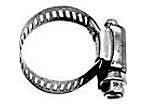
I have never bothered to install any with a torque wrench; but, for the curious:
The standard torque setting for these slotted band-clamps depends on the width of the band. Frankly, there are no places on BMW motorcycles for these types of clamps, but I know some of you will use them anyway at the carburetors, and maybe some places in the fuel solenoids area of later bikes, etc.
5/16" width band: 14 to 16 INCHpounds.
1/2" width band: 25 to 35 INCHpounds.
9/16" width band: 30 to 40 INCHpounds.
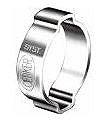
There are special clamps that BMW used for high pressure fuel injection hose connections, such as for K bikes. You really should use these Oetiker types. These Oetiker clamps have also been used on Airheads at times, such as piping on later models in the starter motor area for fuel and fumes connections. They are generally used for extra security and where they are not removed and replaced often. When the liquid flowing inside the hose is under pressure, you can have a LEAK at the hose-to-metal-pipe junction if you use regular aftermarket band-clamps, because they tend to distort the hose as you tighten the clamp. Oetiker clamps offer also much less chance of a failure of the clamp itself.
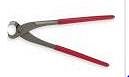
Oetiker clamp: Oetiker pliers:
What is posted in this article is believed correct, but no guarantees!
Revisions:
Initial edit & release: 07/05/2004
12/16/2004: Clarify torqueing cylinder head nuts in section 11.
02/26/2005: Layout, URL, copyright, hyperlink.
07/16/2006: Add note on calibrating the wrench.
08/20/2006: Editing for clarity.
01/09/2009: Updated.
04/25/2009: Clarify crankshaft bolt torques, to eliminate any chance of misunderstandings.
07/15/2009: Clarify rear drive to driveshaft nut tightness; minor other typos or unimportant clarifications.
10/24/2009: Clean up the article.
10/15/2012: Add QR code, add language button, update Google Ad-Sense code.
04/23/2013: Change cover from 5.0 foot-pounds.
09/25/2013: Clean up cam tip nut torque wording.
03/10/2014: Clarify, condense.
10/02/2014: Prep. for smaller devices. Clean up some.
10/25/2014: Add note #1 near top of page, and later in section 26.
08/15/2015: Clarify & expand small amounts ....and more on 08/16/2015, with some corrections.
10/11/2015: Add additional comment & cautions to oil cooler hose banjo bolts. Font size increased. Narrow & clean up article. Update Meta-codes. Clarify a few things.
02/29/2016: Add line to section 31/32...adding information on the side-bolt oil drain.
04/14/2016 : Begin to update article. Metacodes; format; horizontal lines; fonts & colors; layout.
08/21/2016: Minor correction to subframe mounting bolts in section 46.
11/21/2016: Remove Spark Plugs section and move & update ....to sparkplugs.htm article.
12/23/2016: Check metas & scripts. Revise to clean up presentation & expand some areas. Simplify HTML coding. Add band clamps photos.
02/10/2017: Improve clarity in the red box descriptions, and in a couple places in the text, particularly about rod bolts....and degree tightening.
04/28/2017: Clarify transmission shift lever torque for the central bolt.
05/15/2018: Overhaul of entire article. Reduce excessive HTML (fonts, colors). Fix tables outlines, etc. Improve layout. Minor explanation improvements including torque value changes.
05/18/2018: Add reference to /2 era torque values source.
07/22/2018: Add emphasis to section 33, because someone miss-understood: the drain and fill for the driveshaft is located ON the rear drive nose).
10/03/2020: Fix hyperlink to flywheel removal warning article.
© Copyright 2022, R. Fleischer
Return to Technical Articles LIST Page
Last check/edit: Tuesday, September 06, 2022