
|
|
Lamps
Theory & specifications, substitutions. Updating /5
headlight. Fuses,
LED instrument lamps, large and/or
LED headlights,
sockets, heavier gauge wiring, relays,
headlight modulators, flashers .....and more.
+Difficult-to-find information.
Due to considerable interest in Light Emitting Diode lamps of all kinds, I am placing them first. Here is information about LED lamps, for indicators, dash instruments, turn signals, headlights, brake lights, run lights, etc:
Many of you have, or are contemplating, the installation of LED lamps for the instrument pods and/or turn signals, running/brake lamps, etc. While I have some information on these modifications for you, I thought that it would be a good idea for you to FULLY read the following article by the KatDash folks. Take a look at all the other pages in their website when done reading this:
https://katdash.com/f-a-q/
After reading that article, and reading through the rest of KatDash pages, then continue on, below...
LED's (Light Emitting Diodes):
LED lamps are available for substitution in your headlight; and for auxiliary lamp housings, ETC. I believe that LED headlamp conversions haven't generally been very good for installation inside or in place of stock incandescent headlights/housings, nor for H4 headlights/housings. There are definite focus and light pattern problems, some worse than others, and a few problems are severe. Some have longevity problems due to the inability of the design, and the headlight bucket, to get rid of the heat, ....heat kills semiconductors. There are folks that don't care about the light patterns, and use LED conversions anyway. Depending on the conversion, you may have problems with fitment, focus, irregular patterns, or even insufficient lumens. There ARE now some LED headlight lamp conversions that DO fit, perhaps with possibly rather minor work on the metal shield (removing it) in the stock headlight (if you have that), or with minor scraping with a sharp knife, etc., on the opening hole. One that is received fairly good reviews is here: https://stores.advmonster.com/native-H4/ . Keep in mind that the stock reflector and outer glass are likely to NOT work all that well with any LED lamp, as far as beam pattern is concerned.
Bright 12 volt-rated LED lamps that fit the indicator sockets on most BMW motorcycle instrument pods are available reasonably priced. Some give insufficient light output, particularly the beam is too narrow ...there is not enough light to the sides.
LED lamps generally do not work in flasher circuits in which the flasher unit operation is load dependent or requires a minimum of lamp current flow. BMW has used several types of flashers and different flasher circuits on our Airheads, and the circuit in the Classic-K-bikes has a lamp monitoring circuit that is quite complicated. There ARE flasher relays available that are designed to work with LED lamps for your Airhead. https://katdash.com/ will answer most questions.
For 1978 into 1980 models, BMW installed a beeper/buzzer to indicate that the turn signals were in use. The added relay can cause problems if you are using LED lamps, and some find the buzzer very annoying. The simplest fix is to unplug the relay.
Some 12 volt LED lamps, or lower voltage ones with added resistors, work OK on most /6 and later bikes. Many types of LED's and multiple LED lamp assemblies are available commercially. Be cautious about their use, especially for the rear tail light which is a big safety item. There are some LED lamp arrays that project to sides and forward, and I have seen some that were decent for the turn signals, and even in use for converting to combination turn/running lamps. SOME don't work well when the turn function is on, because the turn function is not all that much brighter-looking than the illumination in the run mode, although the specs say they are. Specs are helpful, but REAL world LOOKING is important here. It is IMPORTANT that a running/turn lamp light output be VERY distinct in the TURN mode. This is ALSO SO for a lamp combination of RUN and BRAKE.
Modifying to LED instrument lamps is not necessarily always an improvement. It is easy to remove a pod and replace lamps, and they last for years anyway. You hardly save much in total wattage doing a dash LED conversion; and if you have to add parallel resistors for turn signal lamps to make the LED's work properly (you can use an electronic flasher relay, no parallel resistors needed), you have not saved much in wattage. It is true that a LED lamp usually lasts almost forever if properly powered. It may, however, be hard to see, especially in the daytime. Some have almost a dot type light.
Think ...and perhaps test ...before you modify! For extra lighting, consider a license plate frame that has LED lamps all around it, in particular the type that operates as RUN mode AND has a braking mode; use such an item in addition to your regular rear run and rear brake lamp(s).HID (High Intensity Discharge) lamps:
There are problems in using HID headlamps, particularly with slow turn-on times, when going from low to high beam and when, in particular, the high beam is HID. There are one-bulb HID lamps, but they still have lengthy turn-on-to-full-power. It may not bother you. There are also reflector and focusing problems that are, or can be, severe. The stock reflector and lens are not OK for most HID conversions of just the LAMP, but there ARE a few conversions for HID that are adjustable, and work SOMEWHAT better. For a SEPARATE, ADD-ON HID lamp, in its own separate housing, I have no objections, but also no recommendations!
Vacuum vs. gas-filled bulbs:
Even as far back as carbonized cotton filaments in Edison's day, incandescent bulbs were made with a vacuum inside, otherwise, the oxygen in the air would oxidize the filament at high temperatures. Later, it was discovered that filling the bulb with an inert gas such as argon or an argon-nitrogen mixture slowed evaporation of the filament. Tungsten became the major portion of filaments much later, and atoms evaporating from the tungsten filament can be bounced back to the filament by gas atoms. The filament can be operated at a higher temperature with a fill gas than with a vacuum. This results in considerably more efficient radiation of visible light.
Many lamp bulbs are still made with a vacuum because a fill gas would conduct heat away from the filament. Conducted heat energy cannot be radiated by the filament & is lost, or wasted. This reduces the bulb's efficiency of producing radiation. If this is not offset by the advantage of operating the filament at a higher temperature, then the bulb is more efficient with a vacuum.
NERDY: One property of thermal conduction from the filament to the gas is the strange fact that the amount of heat conducted is roughly proportional to the filament's length, but does not vary much with the filament's diameter. The reason this occurs is beyond the scope of this article. For those reasons, and some explanation and math that is beyond any need to mention here, bulbs with thin filaments and lower current are more efficient with a vacuum, and higher current bulbs with thicker filaments are more efficient with a fill gas. Sometimes, premium fill gases such as krypton or xenon are used. These gases have larger atoms that are better at bouncing evaporated tungsten atoms back to the filament. These gases also conduct heat less than argon. Of these two gases, xenon is better, but more expensive. Either of these gases will significantly improve the life of the bulb, or result in some improvement in efficiency, or both. Often, the cost of these gases makes it uneconomical to use them.
At this point you probably better understand why the small diameter quartz glass H4 gas filled lamps get so very hot, and why getting natural or otherwise oils, etc., from your fingers on their glass during R/R can limit the life of the bulbs. In other words, clean your lamp bulbs (common isopropyl rubbing alcohol used at home is OK) after touching the glass.
Headlight lamps, including the /5 headlamps; relays and switches, etc.
1. In the USA we drive on the RIGHT side of the road. In some areas of the world they drive on the LEFT side of the road. Light output from a headlight is shaped by three things; the reflector, the lamp internals, and the glass lens. These three things are usually different, between, say, USA and UK headlight assembly parts. Unless you have the correct parts, your road illumination will be POOR ...or you will blind oncoming drivers ....or both ....in various ways. The outer glass is NOT THE SAME for right and left side roads!! There can also be lamp differences for right and left side roads riding/driving.2. The /5 did not come with a halogen H4 lamp. Many have been converted either using the BMW kit; or, parts from other BMW motorcycles. BMW no longer offers the /5 conversion kit for this, so most use the lamp assembly parts from a R65. The stock original /5 lamp was 40/45 watts, and very different in light pattern from the H4 halogen that came later. If you have a stock /5 glass, and change the reflector so you can install a common 9003 style H4 lamp (the /5 lamp base and the H4 9003 are different), the light diffusion is NOT all that effective for you as a rider, nor is the diffusion acceptable for your oncoming traffic. There are some special H4 lamps that will work with the stock reflector and glass and have the correct base, and they are listed in this section. The common lamp number 7951 is what is originally in the /5, it has a P45t-41 base. That is also sometimes written P45T-41.
Little known to many is that by using a 64198 lamp, which is a 55/60 Halogen made by Osram, the particular construction and filament will work with the stock /5 reflector and lens. For a chart of all sorts of equivalent numbers, such as 48884, and generic description, sketches, ETC., one could, in the past, see:
http://www.donsbulbs.com/cgi-bin/r/b.pl/philips.html. However, as of 08/04/2018, and again checked on 07/25/2020, and again on 09/21/2023, the website is no longer available. I have, so far, not found a source for copies of his entire website. Best I can offer at the moment is: https://web.archive.org/web/20170728192521/http://www.donsbulbs.com/cgi-bin/r/t.pl This is VERY worthwhile looking at.
Note, again, part number 64198. There are other lamps of the H4 type with P45T bases. I have extensive literature on the various lamps.
The /5 and other 'foreign' vehicles of the era that used the P45T base, are numerous. The P45T original lamp is not all that easy to find; and you may not want to use it anyway. The P45T base has NO TAB and the base is 45 mm in diameter. The H4 halogen lamp used on your later model BMW Airhead uses the P43T base, which is 43 mm in diameter. THAT base DOES have a locating tab. The locating tab is needed due to how the H4 lamp is constructed, in particular how the light beam is 'cut off', for high beam versus low beam.
There IS a plastic adapter available, a ring with many notches, etc., that can be inserted into the /5 headlight, that allows common H4 lamps like the 9003, to fit. Those plastic rings are probably going to be difficult to find, and possibly expensive (perhaps $20-$35). If you can find them, they are OK to use ...BUT! ...truly proper light beam characteristics are NOT then had with the /5 reflector and outer glass, no matter what bulb or adaptor ring is installed. However, this is a less expensive method of obtaining a stronger light output. To find such an adaptor, search the Internet for something like this: P43T to P45T adaptor.
Note that the light pattern, using the original /5 housing parts, especially the front glass, will not be the same as later models, but you may find the light beam to be adequate, and certainly with an H4 lamp element it will be much brighter. I suggest NOT using lamps more powerful than 55/60 watts. It is true that the /5 had a high temperature rated socket (often used for high lamp wattage conversions on later models), but the wiring may not work well with 80 or 100 watt lamps ...so, if you intend to so equip your /5, be sure to re-wire the headlight with larger gauge wires, and you may well want to use heavy duty relays to avoid overloading switch contacts.
3. EXCEPT for the stock /5 Airheads, and as mentioned, all our Airhead motorcycles can use common 9003-H4 headlight lamps, often just identified as 9003HB2. There are some differences in lamps, particularly in specialty versions. For the most part, colored glass versions are WORSE, over-all, than the stock types, in BOTH light output, and visibility. That means both from an oncoming driver's viewpoint, and partially from YOUR view. The 9003 H4 has a base type P43t-38; it is 60/55 watts for the stock headlight (aka HB2). Be aware that while 9003 is a generic number, the Euro lamp versions are generally of better quality, light pattern and output.
4. Here is some nerdy headlamp information:
International specifications are not the same for the H4 headlamps as for USA specifications. You will find the information in this paragraph to be generally hard to come by. International H4 lamps are rated at 1650 lumens on the high beam and 1000 lumens on the low beam, both at +- 15%. Note that the specification has a maximum power drain, and it is 75 watts on high beam and 68 watts on low beam, and these specifications are for 13.2 volts. That 13.2 volts is more important than a quick glance tells you. For the USA, the equivalent lamp is called a 9003/HB2 or H4, and the lumens are 1580/910 +-10%. The draw is specified as maximum 72/65 watts but at 12.8 volts. You will find the drain about the same or somewhat higher at the European 13.2 volts. If you are 'lucky' your bike's system has a voltage of 13.8 to 14.4 AT THE LAMP (turned ON, and riding, at maybe 3000 or higher RPM). This raises the drain in watts, but increases light output, but can (and may not) decrease life. A regular incandescent lamp, such as nearly every lamp in your motorcycle, except the H4 or other Halogen lamp, has a life that goes down on a steep curve, as voltage rises over the rated voltage. BUT, in the other direction, a quite modest DEcrease in light is had with a QUITE MODEST DEcrease in VOLTAGE, ....YET!...that results in a HUGE increase in LIFE. Halogen lamps often last about the same OR LONGER, even if the applied voltage is a small amount higher than commonly in actual use. ....more:
Halogen lamps should be run at 13.8 to 14.5 volts as measured at the base/socket; this voltage may drop lower, if at a stop sign and idle rpm. They are very differently constructed and the halogen gas in them creates very different specifications for life expectancy. In fact, running a halogen lamp at too low a voltage will DEcrease their life! Halogen lamps continuously re-plate the lamp element as molecules of the filament boil-off. The voltage at the headlamp itself will be lower than the voltage as read at the battery so be careful about measurements. Voltage drop depends on your bike's wiring size, condition of contacts and switches, etc. ...and if you have added headlight relays ...and, of course, at what voltage the alternator voltage regulator is set for, which affects the voltage during cruise, not generally at idle (where most alternators have little output).
All things considered, the European headlamp bulbs perform better.
If you have a headlight modulator, that MAY actually increase lamp life, which is very different from any effect a modulator might have on a NON-halogen lamp.
The below voltage versus light output is for a USA specification 9006 lamp (I could not find the data in good format for the 9003 series), but the idea is common to all lamps. The 9006 is essentially the same lamp innards as the low beam of the 9003 H4 type used on Airheads, etc. Note that the rated USA LIFE is done at a higher voltage than at rated output.
10.5V : 510 lumens
11.0V : 597 lumens
11.5V : 695 lumens
12.0V : 803 lumens
12.5V : 923 lumens
12.8V : 1000 lumens ←Rated output (USA)
13.0V : 1054 lumens
13.5V : 1198 lumens
14.0V : 1356 lumens ←Rated life (USA)
14.5V : 1528 lumens
NOTE that some manufacturer's rate their lamp life at the rated voltage. Thus, 12.8 for output and life. It is extremely difficult to get the information details. European lamps may be specified differently; most rate the light output at 13.2 volts.
I recommend a VR setting, as measured AT THE BATTERY, room temperature for the VR and battery, of 14.2 volts. More detailed information is in other articles by me on this website.
When operating voltage drops to 95 percent, headlamp bulbs produce only 83 percent of their rated light output. At 90 percent, you get 67% of normal light output. At 85%, about 11.2 volts, you get HALF of normal light output!! It is for these reasons that many install relays and heavier wiring, to bring up the voltage to the headlight lamp a bit (besides protection against excessive switch wear).
There is an enormous amount of false advertising and hype from those selling aftermarket headlight lamps. I will get into this deeper later.
"PLUS" type lamps have a slightly different focus point, REDUCED life, but the focus is further down the road, even when the low beam is properly adjusted.
The BMW-furnished or standard 55/60 watt (Federal requirement) halogen H4 headlight lamps are similar to common type 9003 and really same as BP1260-H4 and generally equivalent to 9003/HB2. These are often changed by owners to much higher wattage types. Be very cautious about this. The handlebar light switch is NOT rated for those increased wattage lamps, and therefore it is a MUST to use a heavy duty relay (the autoparts store Bosch 20 or 30 ampere relays are not expensive and are fine for this), using the original light switch output connected to the relay coil. You can do this conversion with ONE relay, if that relay is "SPDT", which means Single Pole Double Throw. Some use two relays. The Eastern Beaver Company sells small sized relays in kits, that just PLUG IN! ...but I am not a fan of them for higher than stock power lamps, feeling that the contacts in these relays are not heavy-duty enough ...although, to be fair, their kits DO seem to hold up ...usually ....to 80 watts and "maybe" a 100 watt lamp. No hard and fast rules here on how to wire and use the relay(s) and switch gear, installations vary, depending on what you want to do/have. I will have more to say later in this article.
5. Eastern Beaver also has ceramic sockets available, that handle high temperatures. Here is a hyperlink, you will have to scan to find the ceramic sockets: http://easternbeaver.com/. They are not the only company selling such high temperature sockets. A discussion of sockets, and other recommendations, is later-on in this article you are reading.The original stock /5 socket was rated for fairly high temperature, mostly not so for later stock sockets.
6. Your Airhead probably has a high beam flashing switch on the left end of the handlebar. That switch is part of the Hi/Lo selector switch assembly. There are peculiarities. The Hi/Lo switch section, in the stock bike wiring, for 1974 and earlier, DIRECTLY controlled the headlight. In the 1975, when the light switch was made a separate control on the handlebars, BMW added a headlight relay, where before there was none. That headlight relay reduced the current in the handlebar switch unit. In 1978, the relay circuit was re-wired, and from then acted as a partial load reduction relay, shutting off the headlight when the starter motor is in use. The push-to-flash/pass section is a partially separate circuit. It is wired so as to totally bypass the headlight relay. Thus, just how you wire up your added relay (s) for use with high power headlamps is important.
7. Phillips makes what they call an Xtreme Power lamp, stock wattage, that puts out 1150/1895 lumens. It is a decent lamp.
The best 'nearly stock' H4 lamp I have found, to be used with stock or with one or two relays, is the Osram lamp 64205, it is rated at 70/65 watts. It has a very nice output, at 1350/2000 lumens. Very well made lamp, and perfect on the beam and color; even though the catalogs call it an 'off-road' model (mainly because it has slightly higher wattage than standard, and thus is slightly over-wattage compared to the federal specifications). I think it will generally be OK to use this without adding a relay(s), but relays will improve light output and lengthen switch life. The H7 version is 64217 for those of you with auxiliary lamps that use H7, or, have other motorcycles.
Brighter yet is the higher powered 64206 at 80/85 watts & 1750/2400 lumens. (The standard legal lamp is 64193 at 60/55 watts). The rated life for these lamps is 100/200 hours when at 13.2 volts, under normal automotive type use. Expect somewhat less on a vibrating bike. If your lamp runs at 14.2 volts, that is better, for brighter and longer life! A headlight modulator (on the high beam) probably extends the life. Due to a peculiarity of how H4 Halogen lamps work (redeposition of material back on filament, etc) the temperature of the filament must be adequate.
Here is a place that seems to stock many of the lamps I mention in this article; I have no experience with the company:
http://store.candlepower.com/
8. This is how an H4, 9003, etc., lamp is internally connected. In this view, you are facing the base of the lamp from the rear. This sketch applies to just about all 3 terminal lamps. The colors, White, Yellow, Brown, refer to standard BMW and German use for connections to the lamp socket.
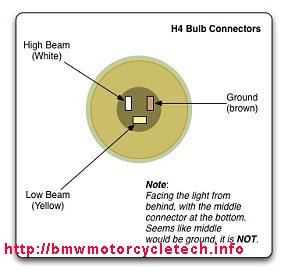
9. HINT: Early Airhead headlight chrome rings were not screw/clamp fastened. Many have been lost along the road. It is best to fashion a method to secure them at the very bottom if you are using the early rings.
10. Article 24B discusses the headlight relay, its internal diode, the handlebars switch, and how they all work together. It is not simple, and the article's information is sometimes needed to fully understand using larger wattage lamps, relays, etc.
https://bmwmotorcycletech.info/headlightrelay.htm
The blue-coated lamps and other high priced trick lamps may seem brighter even with the standard wattage lamps, but if you are riding for more than a few moments, or are in an oncoming car, you may think differently ...claims of 100 watt equivalent light output for 55 or 60 watts of power are dead flat wrong and completely misleading. If the lamp really did that, it would burn-out very quickly. PIAA and others advertising is, in a lot of instances, bogus.
The human eye is much more sensitive to certain colors. The eye's sensitivity to yellowish-green is quite interesting, but we do not have headlights of that color ...because, while the light would be very visible and very noticeable to the drivers of other vehicles, the light would not illuminate the ground/highway/etc., for the driver of the car (or motorcycle) with those yellow-green lamps. Please read that sentence several times! There is a big difference between what YOU see and what an oncoming car driver sees (that is, what YOUR motorcycle headlight looks like to that oncoming driver). I know this sounds crazy, but it really isn't.
It is altogether way too easy to confuse the buying public with claims that are either unproven, or, downright incorrect ...or, that mix up the following things (besides light spread, cutoff of the beam, and other things):
1. Illumination of the road, etc., for the DRIVER and/or RIDER.
2. Illumination of the oncoming vehicle FOR RECOGNITION.
Those items are NOT ONE AND THE SAME THING; nor are quite a few other things, barely mentioned. Blue-lamp (etc.) makers, like PIAA, are definitely taking advantage of the confusion, in order to sell you a lamp at a high price. You may even THINK that their stock 55/60 blue lamps are better by being, somehow, actually brighter ....yet, they are actually less so! There are many ways, besides color filtering, to obtain what your brain erroneously thinks are brighter lights, overall. One is focus, the other is spread.
Our brains are 'annoyed' MORE by some 'colors' ....which, at the same time, may ...and often do NOT ...provide better clarity, visibility, and recognition. "The" prominent example is the bluish light from blue-coated H4, H3, and many other types of lamps. The light output is not nearly the same from those bulbs as the spectrum of light from modern bluish-looking HID or LED lighting in car headlights; which these aftermarket blue lamps were designed to SEEM to copy. The blue coating of aftermarket lamps like the PIAA let more blue of certain frequencies through ...but greatly remove the amount of wider spectrum light that might give YOU, the rider/driver of that vehicle, more information about things YOUR light lands on. But, your brain, just looking briefly at the lighted area, especially if the beam is focused differently, particularly narrowing the beam in some particular portion ...may 'trick' you into thinking that the blue lamps are better than the clear ones. That is the sneaky thing about these blue-coated lamps. The other thing that is particularly nasty is that bluish light of the filtered PIAA, etc., type (and not usually the REAL HID UNfiltered bluish light) is that when the light from a blue-tinted bulb lands on some things, it tends to be shown as much blacker, or, invisible, than if a non-filtered lamp output shone on the item. That is NASTY. Try looking at deer, white things, blue things, red things, brownish things ....when using a PIAA or other blue-coated lamp in your headlight. You may not like what you see (or, don't see!....). Trying to identify/notice a deer in your or other's bluish headlights, with brown trees, green grass that both show as much darker, same for the deer....well, you are less safe! Note that a blue-coated lamp is NOT AT ALL the same as a lamp with a natural higher frequency (higher Kelvin degrees) light output, such as a HID type, and many LED types now too. This is why the car makers that use specifically designed lamps and reflectors give so much better TRUE illumination, than aftermarket 'blue coated lamps'. No matter what I say here, plenty of motorcyclists and many car owners, will still install blue lamps, such is life.
Some lamp manufacturer's will also change the guides and director metal bits inside the lamps and provide what you THINK is brighter light, but it is a different dispersal .....and the beam cutoffs barely are legal. Some are not legal ....some have too much power and are illegal ...and some have almost no, or actually no, beam cutoffs, and are very illegal, and blind oncoming drivers. There were some lamps being sold that changed the FOCUS point, by changing the distance between reflector and lamp light emitting element ....not sure if those are still on the market. Those lamps can show a bright light, make you think your headlight is brighter, yet you will more easily out-drive the illumination.
The blue coated PIAA lamps (and their many imitators) are not good, IMO; and most users have no idea, and think them better (let us hope that comes NOT from having purchased something, in itself, that is, $ must mean better). That the blue-coated lamps by such as PIAA are poor has been proven by many tests. This is likely contrary to what some of you think. I don't blame you for thinking that way ...even if you are not influenced by the advertising. MISCL information about headlight lamps:
All conventional headlight bulbs glass run quite hot. The halogen lamps glass run VERY hot, and use a type of quartz glass. You should NOT touch the glass with your fingers, which can leave invisible skin oils on the lamp, which WILL shorten the lamp life. If you have handled the lamp glass, clean it with alcohol and clean soft rag. This is a good policy for any lamp. The stock headlight lamp sockets are capable of handling the stock lamps (and, the /5 socket will handle higher powered lamps). If you increase the wattage of the headlight lamp (use relays!) ...then I advise, for /6 and later, to use a socket that handles more heat. The /5 socket was 63-12-8-650-145. A substitute could be the NAPA LS6235, around $6. That number is listed in Napa literature now as under the ECHLIN electrical's section ...and the Napa number in the catalog is ECH LS6235. It appears to be bakelite and have ~14 gauge wire, 3 each black, maybe 6-1/2" long. Hi/Lo/Ground is marked on the socket. It seems well constructed. Another socket is the Autozone 84790, called a high temperature socket ...I was told it was ceramic, which would be the best way to go ....but someone reported to me that it is actually 482°F rated nylon; 3 colored wires, and a rubber boot included ...that would be OK, but I have not tested the socket. Here is another source, scan for the ceramic socket: http://easternbeaver.com/ If your vehicle's lamp assembly has a protective plastic outer lens, be cautious about increasing lamp wattage too much ...the heat could affect the plastic outer lens. This has happened, particularly, with the RT eyebrow lamp cover. Headlight reflectors interiors ...and inside the glass, will both get fogged up by dirt, etc., over a long period of time, and should be cleaned with common household rubbing alcohol (70% isopropyl) mixed with a drop of detergent and possibly some added water, perhaps by half or so. Use appropriate lint-free cloth. Follow by cleaning with clear water is not needed. Allow to dry very thoroughly before installing the lamp, etc. I do not ever try to separate the glass parts, I do my cleaning through the lamp hole. I strongly recommend you not use Windex, or similar, containing ammonia! Incandescent lamps have a very hot piece of glowing metal inside, and that metal radiates heat. The wattage rating of a lamp is the power input to the lamp, and that power is directly proportional to heat. Some lamps are rated only in voltage and current. Multiply voltage times amperes to get watts. It is quite possible that too powerful a lamp will cause heat damage to your lamp socket or surrounding area. Some larger lamps have so much extra heat they are not only going to melt or deform the plastics in the area, but may well detract from life of such as the tach and speedometer/odometer if such lamps are used in the instrument pod. Almost always a modest wattage increase will not be a problem. The later headlamp sockets are not good with large lamps ...early ceramic ones or other ceramic or high temperature rated sockets are OK. I have not tested all the possible combinations of higher wattage lamps for any heat or other problems in the instruments in any model; nor, eyebrow area of the RS/RT ...which I THINK can be used with most 5 watt lamps ...but perhaps marginal or a problem with a 10 watt lamp. Interesting things about lamps, theory, characteristics, life, some NERDY stuff, miscl stuff ....etc. If your motorcycle has just one stock rear running lamp, and it fails, then you have NO light to the rear at all, unless you have running lamps that have been added. Conversion of the turn indicators to have an additional running lamp function is not difficult, and an article is in this website:
https://bmwmotorcycletech.info/addingrunninglamps.htm There are pros and cons to that conversion. The strongest argument AGAINST the conversion is that the turn signal portion function MIGHT NOT be AS visible, with the illuminated running lamp. You can select a running lamp wattage or light output that is relatively low, to mostly offset this argument. I prefer separate lamps in most instances. When a common incandescent lamp fails it is almost always because the filament broke from being thinned or stretched or sagged, all from usage, over a period of time. You can generally identify a lamp that is close to dying as the filament is visibly sagging. This is particularly noticeable in the turn signals, taillight and braking lamps. Thus, regularly, you should visually inspect the lamps. Sudden failure is usually brought about by a characteristic of the tungsten filament in incandescent lamps. The lamp filament wire has a far lower electrical resistance when cold, than when hot. Thus, at the instant the power is applied to the cold lamp filament, the 'inrush' current is very large, and the thinned or otherwise weakened area of the filament fails. As the wire breaks, if the spacing between the broken ends is small enough, and the time that small spacing exists is long enough, the lamp might arc. The lamp might draw a large current at that time ...and in rare instances, blow a fuse. This effect is far more prominent in higher voltage lamps, such as in your house, where the filament breaking is accompanied often by a bright flash of light due to the arcing (but seldom blows a fuse or circuit breaker). Generally, the higher the voltage at the lamp, the more likely for a bright, perhaps bluish flash of light when the filament breaks. When a turn signal lamp is in use, the flashing on and off detracts considerably from the lamp's official life expectancy. Strangely, perhaps (if you do not understand halogen lamps), this is usually not so with Halogen lamps ...especially if flashed at a relatively fast rate. Using a headlight modulator might even increase lamp life. I believe headlight modulators are a very strong safety device, although some dislike them, feeling that they annoy oncoming drivers; and, some have strong feelings about being in front of someone with flashing lights. Use of proper types of HEADLIGHT modulators are legal in all States FOR MOTORCYCLES, and it is codified into Federal Law. There is an article on headlight modulators on this website: Book values for lamp life are most often based on AC, not DC, and for NO vibration. At least this is so for American numbers. It is not at all clear if all vehicle lamps are even rated for DC. Lamp manufacturers do not supply the complete information ...even when asked. The rule of thumb accepted by most, on life of lamps rated for A.C., is that the average life will be half the book value at best if an AC-rated lamp is used on DC. Think about it ...there are only a few vehicles in the world that use AC on the headlight (very old Vespa scooters did, for one example). Thus, rated lamp life really means little-to-nothing, since you cannot competently compare one lamp to another without full information. A few say the half-value average life idea is wrong, but never seem to have specific data to prove their statement or ideas. There is a contrary opinion that covers several details, and it seems believable, certainly some is; but it does not explain the actual testing results for halogen and vacuum lamps differences, and a couple other things. But, some of you like my occasional nerdy explanations ...so.... I thought I would let you read my version of this type of opinion, all-in-one-short-paragraph: Nerdy & contrarian: GENERALLY, a non-headlight-Halogen lamp will last MUCH longer, in a circuit that has SLIGHTLY LESS than that lamp's rated voltage, at very little reduction in light output. LIFE INcreases however, supposedly exponentially, specifically at the 12th power (some books say 8th and neither group shows the specific testing criteria, although it is available in their engineering data) of the INcrease in the voltage RATING of the lamp, above actual circuit voltage. The DEcrease in life if a lamp has excessive voltage applied to it is vastly faster, percentage-wise. Thus, over-voltage application to lamps means a SHORT life. SOME lamps are specifically over-voltaged in actual use, but in an almost clever way. You will have to think, when reading this. It is often done for the brakes and turn signal lamps. The reason this can be done successfully is that the manufacturer of the vehicle uses a slightly thinner copper wire (copper is $), the wire length is usually fairly long, and these two things add a bit of resistance and thus cause a moderate voltage drop. That voltage drop is effective in particular at idle rpm where the alternator output may be neglible; and has a small effect at cruising rpm. Another effect is that at the INSTANT of turn-on, the lower cold resistance of the lamp is not heavily stressed, and yet the lamp can burn quite brightly within milliseconds. For an example, let's say the lamp is rated at 12.8 volts, instead of higher voltage. The system in the motorcycle runs at 13.8 (or higher, say 14.4 being the typical limit). At turn-on, during cruising conditions, the system voltage is as noted and the lamp, filament still cold, draws some additional current due to the low resistance, but it is moderated some by the resistance of the thinner wire, and the lamp is not excessively over-voltaged. After the lamp is lit, and still at cruise speed, the voltage will over-power it slightly. The over-all result is shorter lamp life, but not excessively less life. Another factor is that the factory knows that MOST of the usage of the BRAKE or TURN signal lamps is done DURING A STOP, when the engine is at idle, and the system voltage drops off, due to no alternator output (typical for motorcycles, not cars). Yes, brakes and turn signals are certainly used on the way to a stop, but the stops are most often longer than the time of braking with higher engine RPM and thus alternator output. Those that tend to think about what I wrote here will possibly now mention the use of aftermarket alternators that produce charging current at idle or a bit above, thus, that should shorten brake and turn signal lamp life. Yes, that IS true, but the effect is quite moderate. The voltage measured AT the rear brake lamp, or headlamp, or any lamp, is ALWAYS going to be a bit BELOW the measured BATTERY voltage, and probably a bit below the fairing voltmeter (if you have one of those) ....by a typical 0.4 volt OR SLIGHTLY MORE. THUS, a battery might be, during cruising, at 14.0 volts, the fairing voltmeter read 13.7, and the brake light or headlight when illuminated be actually at 13.3 volts. While life of normal NON-halogen lamps increases fast, that is, exponentially, as voltage is lowered more and more, not so the halogen ...which, if filament temperature drops enough, will start to lose life ...on a complicated curve, which then, as voltage continues downward, increases life, again, but the light output is very yellow and poor at that point and below. The area of DEcrease is generally at and below 11.5 socket measured volts. DC (direct current;...battery power) operation of lamps really does REDUCE lamp life as was noted well above, it is just the amount of such reduction that is not well agreed-upon. Small lamps are generally rated by the manufacturer using AC (alternating current) power. It is UNclear if headlamps and other vehicle lamps are rated on AC or DC, and if this is arbitrary, or not, and by manufacturer. Yes, this is peculiar, because most all vehicle lamps, not just headlamps, are designed for vehicles that certainly do not have AC systems driving the lamps. There are some rare exceptions ...and peculiarities. My old Vespa scooter had DC output for the battery, coil ignition, and taillight, and an AC output strictly for the headlight. I have had antique radios come into my shop for work ...that have AC on their dial lamps, and the lamps are original, and the radio has been in use for 70+ years. Most old vacuum tube radios used AC on their indicating lamps. The measured LIGHT output of a lamp is increased only very slightly, by, example here, a 10% increase in voltage. However, going the other way, for headlight use with halogen lamps, where the effect of lowered voltage is a faster decrease in light output, it is sometimes worthwhile to use larger gauge wire, relays, more direct wiring, etc., to raise the voltage half a volt or more ...or to protect expensive handlebar switches (particularly with larger wattage lamps). Note that modern design modulators DEcrease headlight voltage very little, so there is very little decreased actual light ...and modulator usage extends lamp life by simply the SLIGHTLY lower voltage and the timing period; but not always, as it depends on the lamp construction. Here is a hint: If you are purchasing INCANDESCENT lamp bulbs for your home, office, etc, instead of 120 volt rated types, see if, for same price, the store has 130 volt types. They can, if well-manufactured, last MUCH longer, and at hardly noticeable light reduction. You may be advised by advertising, know-it-alls, etc., NOT to do this, as the light output is lower, well, it is, but only SLIGHTLY, and you will NOT notice, but the lamp can last a VERY much longer time. This is a particularly nice thing for those hard to get-to lamps in stairways, etc. If your voltage regulator is set for 14.9 volts at 70°F (this is when measured directly at the battery terminals, and is also the absolute upper limit voltage for most types of batteries at that temperature), you can expect less life on your lamps. They will be "somewhat" brighter though. Probably 14.2 is a nice value for most batteries as a compromise, when one also thinks of battery life (most batteries have a longer life if the charging is set for 14 to 14.4, as opposed to lower voltage). 14.9 is the limit for lead-acid AGM batteries, and offers the best over-all performance and life, but the voltage is a bit high for flooded batteries, water use increases, and there some other effects that are not necessarily good. The 13.8 that is often found will extend lamp life SOME, and rather considerably reduce how often you add water to the battery (assuming a flooded type battery). The best compromise, that covers most all types of batteries, and includes consideration of cruising, stop and go in cities, temperature variations (below freezing to way hot air temperatures), etc., is such that I recommend 14.2 to 14.4 volts for the readings AT the battery TERMINALS ...as initially measured at 70°F with a cool voltage regulator and cool battery, in other words, at engine startup. These values will give the best over-all life and performance for battery life, lamp performance and life, etc. Final nerdy point: A lamp with 50% to 100% greater instrument-measured (or specified) light output will NOT look all that much brighter to your eye, due to how we humans perceive things. Smaller lamps; equivalents &/or substitutions: SUBSTITUTIONS ARE JUST THAT, AND MAY OR MAY NOT BE TOTALLY EQUIVALENT. Various lamps in our motorcycles can be substituted USUALLY WITHOUT PROBLEMS. Nowadays, one can purchase original European lamp numbers at most USA autoparts stores; and, in general, the Euro lamps are somewhat better. However, there can be times you WANT a substitute or have to use one, for a variety of reasons. It may be an emergency burn-out; it may be you want a brighter lamp, etc. When I list a substitute, it means you will have a usable & useful lamp. I may describe the differences, and what that means. Many folks have no idea that common 'radio' and other lamps are the equivalent, or close-to the equivalent, of many vehicle-use lamps! Lamps that are sold in the USA with Euro part number often perform BETTER than the American part number that is often substituted. In particular, the BRASS base American lamps do not do well, and intermittent lamp connection to the mating socket are more common with those than the silver-looking bases. This is noticeably so on the Classic K bikes. The problems are coatings, tarnishing, and slight incompatibility with the sockets. If you have a choice, select the lamp with the silvery color base. The rear running lamp, BMW 07-11-9-978-227, rated at 12 volts (which is NOT correct, by BMW, just call it NOMINAL) and 5 watts, can be substituted by a very commonly available 97 lamp, which is rated at 13.5 volts at .69 ampere, which means that at THAT voltage, it would draw 9.3 watts, and, of course, it will draw less at 12 volts, but that is not the real running voltage anyway. Regarding the substitution of below 158, 161, 168, 193, and 194, ...at the instruments: These lamps are called style T 3-1/4 and are used at the tachometer, speedometer, turn signal indicator, GEN. Note what I say about using the 2825, and, 168, below, and especially the 193, which has a long life. 158 lamp: 2.80 watts, .20 ampere, rated 500 hours, A.C. (some rated at 13v and .24 ampere), about the same light output as 193 & 194. 161 lamp: 2.66 watts, .19 ampere, rated 4000 hours, A.C. Depending on where used, possibly Emergency use only. 168 lamp: 4.90 watts, .35 ampere, rated 1500 hours, A.C. This is a good sub for the GEN lamp (/6 and later), as its characteristics ever so slightly enhance the starting of charging. The 4 watt GEN lamp for the /5 is covered in the Airheads Information section, further down this article. 193 lamp: 4.62 watts, .33 ampere, rated 5000 hours, A.C. (rated at 14 volts too). Long life lamp, for GEN lamp. 194 lamp: 3.78 watts, .27 ampere, rated 1500 hours, A.C.; a bit less light than 168. The Airhead alternator lamp after the /5 models are 3 watt lamps, part number 07-11-9-978-372. The voltage rating is 12, which is unusual, but I suggest you FORGET the voltage rating, as a full explanation is tedious; the wattage rating is 3. For all Airheads except the /5, the 2825 lamp will offer more brightness and a very slight bit more alternator output at the lower initial output rpm area. You can also use the common 168, etc., as they ARE functional in this alternator position ("GEN" lamp). See below. There is an article on this website on adding a resistor in case the GEN lamp fails. Lamp failure usually prevents alternator output, or, requires very high rpm to initiate output.
https://bmwmotorcycletech.info/genlampresistor.htm 2821 lamp: It is 12 volts rated. 0.25 ampere, 3 watts, light output fair, only a slight bit more than the 194, and not super long life, but longer than the bright 2825. The 2821 is also called the W3W, and is ~10mm dia bulb. The 2821 and similar sized equivalents, is often installed in place of BMW 62-14-1-244-727; 62-14-2-346-479; and 07-11-9-905-358 (W3W). 2825 lamp: This is a 5 watt Euro spec lamp, but commonly found in the U.S. The 2825 lamp draws 0.4 ampere, and is brighter than 168 and 194, and a very nice, if slightly pricey, replacement for them. NOT super long life. This lamp develops too much heat, IN MY ESTIMATION, for anything except the GEN lamp usage. The /5 alternator lamp is different (4 Watts) and covered in a later section of this article. For all Airheads except the /5, the 2825 lamp will offer more brightness and a very slight bit more alternator output at the lower initial output rpm area. You can also use the common 168, etc. ANY of these bulbs will work adequately, the 168 & 2825 being a slightly better choice for the GEN lamp, wherein you want charging at the lowest rpm point where charging begins. Just a SMALL amount of help though. If you are traveling, and the GEN lamp burns out, rare as that is, simply purchase whichever one of the lamps you can find. In general an E- prefix means European standards. Instrument lamps: #07-11-9-978-279, 12 volt, 2 watt. This is usually the more difficult lamp to substitute. This lamp has what is called a PHILLIPS base (BA7s midget Bayonet Base; T2 tube; 1/4" diameter). The BA7s base is 8.7 mm from top of locating tang to bottom contact, the barrel diameter is 7.0 mm, tube is 1/4" diameter, and the width across the located tangs is 8.6 mm. The ORIGINAL type of lamp was called a J12V/2W lamp in BMW literature. Equivalents or substitutes for that lamp: 1. GE 2696; Osram 3898; Philips 12829. These 3 are all 12 volt, 0.167 ampere, 2 watt, and rated at 200 hours. 2. It is not clear to me, and I have never tried this lamp, that the Eiko SE1274 would fit. It is 12 volt, 0.125 ampere, 1.5 watt, but the base is BA7.5 (I think) ...and uses T-1-3/4 shaped glass. 3. There is also a Narva 101006 lamp, rated at 12 volts, .17 ampere, 2.04 watts. 4. The BA7s base lamps were used on some old car radios. It is possible a car radio repair shop has some 12 volt lamps with the BA7s base. BMW has used a metal socket for the BA7s lamp that pushes-into a metal sleeve. The socket with either male spade or screw connection is available, and not easy to find the number for. For male spade: 01-111957397 Lamps; Turn, Brake, Run ....uses, numbers, additional information: 12 volt, "21" watt BMW #07-11-9-978-370, or 63-21-7-160-789; substitute is common #1156. The 1156 lamp is rated 12 volts, 2.1 ampere (25 watts), some books have it as 12.8 volts, 27 watts, 1200 hours (A.C.) (you will NOT get that number of hours) ...which is a BIT brighter ...you probably won't notice. Some other books may say 25 watts, 13.5 volts, 1.86 amperes. The 1156 lamp is also available sometimes in copper and plated bases and sometimes in aluminum. Get a silvery one if you can. The 1156 has two side guide pins directly opposite each other and has a single contact base, and ONE filament. The Euro number for a close enough lamp is 7506. The 7506 is RATED at 13.5 volts, for a "12 volt system". That lamp is typically called a "12 volt 21 watt lamp", and the Euro rating is 150 hours. It is more accurate specification for life (I'd actually expect 80 hours or so), than the 1200 hours specified for similar lamps like the 1156, and even some 7506. These lamps are for one-function use, such as just a turn signal, or just a brake lamp. P21W Eiko number is 7506, style BA15s, used for Turn or Brake. There is a 6 volt version, which is common number 1129. The very common 1157 lamp has the side locating pins OFFSET in distance from the base; one pin is lower and one higher than the other. This was done so the lamp can only be installed in one position, not 180° around the other way ...and allows the lamp to be used in a dual filament, dual contact, dual-function arrangement, in which one side of the lamp is much higher powered than the other. The high power section is the brake lamp, the low power section is the running lamp section. This lamp has also been used for other multifunctional positions in some vehicles. For practical purposes, the 1157 lamp is the same or similar to the 2157 and 7528. For those who have converted their turn signals to add a run function, the usual lamp used are these double contact lamps. The Euro number 7528 is better. For the conversion to turn/run, the lamp is wired for the TURN function to be the high power filament of the lamp, and the run function is the lower powered filament. These lamps vary a bit in the filament rating and light output, but the truth of the matter is that it makes little difference, and how the specifications were done makes this a bit complicated to understand; but this article has, earlier, explained it adequately. Both the Euro and American lamps are the same size, have the same basic structure, but the way they are rated electrically and for light output is a bit different, which is why things could be confusing. Just go ahead and use whatever one you want. I am well-aware that others think differently. The Euro lamps have fewer problems with poor electrical connection of the base in the socket. You can clean socket and lamp contacts with a common pencil eraser. If you are in a humid and/or salty environment, give a faint poof of Caig contact treatment to the lamp/socket before installing the lamp. The brass bases give more problems, particularly with the K bikes which have sensitive bulb monitoring electronics. The two lamp sections are, generally, rated like this, or close enough (don't expect to obtain the hours rating): Rather often you will find the base of lamps stamped with 12 volts. That, confusingly, is not the lamp voltage rating, but the SYSTEM rating. What makes it even more confusing is that some lamp manufacturer's use 12 volts in determining lamp life (perhaps A.C., perhaps D.C., they don't offer details). Classic K-bikes: The rear brake lamp is rated 21 watts, 12 volts 1.75 amperes. The present number is 7506. There is another rating, unlikely to be on bulb nor package, and that rating is 25 watts, 13.5 volts, 1.86 amperes. The BMW number is 63 21 7 160 789. I have more on the 7506, 4 or 5 paragraphs above. Especially on K bikes, but also seen on Airheads, is incompatibility of the socket plating with the type of metal used on lamp bases. The EURO lamps have the proper metal, and it is silvery in color. Use of brass-looking lamp bases can bring intermittent operation. Airheads information: The original dash/pod function lamps, T-1-3/4 style, #07-11-9-978-375, were 1.2 watts, very similar to the 73 long life lamp, or the slightly brighter 74 lamp. One could even use a 37 lamp, which is similar to the 73. Another lamp is the E2723, rated at 2.3 watts. Sometimes these small indicator lamps are hard to find, and an electronics supply company may have them in stock. You MAY find the E2723 at autoparts stores, also sometimes the other lamps. All these lamps can be used as the high beam indicator, brake light failure, OIL, and neutral indicators. LED substitutes are now available, white output, for these lamps. The power drain is typically only 0.32 watt, but they are VERY bright ...but not all that much of the brightness is fully usable. The 4 watt lamp 07-11-9-978-256 (the updated BMW number is 07-50-9-063-576) is used in two places, the GEN lamp on the /5 bikes, and in the Parking Lamp position. When used in SOME models in the headlamp REFLECTOR SHELL (on faired RS/RT models no lamp was fitted, but CAN BE), they can be substituted, and also with vastly brighter lamps if wanted. BUT ...some might want slightly weaker lamps, such as the 1893. The 1893 lamp can be substituted for the 07-11-9-978-256. There are a lot of these types of "standard miniature bayonet" lamps, such as 1889, 1895 (round bulb), 1891, 57 (round bulb). Some folks do install these for 'daytime running'. Some folks have a headlight on/off switch, and use the parking lamp to save watts, a 5 watt halogen used here is very considerably brighter than the above lamps, and a 10 or 20 watt halogen is VERY bright. Some Airheads are equipped with a headlight switch (depending on year & model, and Euro or not) that makes it possible to ride without the headlight on ....probably illegal for some, but this is done anyway. It is possible to make a small wiring change at the ignition switch and have this 'side of reflector light' ...and the ignition ....be ON in the PARK position, and the headlight main bulb on in the normal position. Don't use 10 or larger watt lamps for the RT and RS eyebrow lamp. It may be possible to use the 5 watt halogen in the eyebrow position. The eyebrow lamp housing and plastic lens do not like excessive heat. Some have removed that lamp, and wired the eyebrow to the place for a socket on the headlight reflector, and used a Phillips Halogen lamp, 10 watt being 12024; 20 watt being 12452. See below for the 5 watt probably OK lamp at the eyebrow. Some have simply tapped into the eyebrow lamp (leaving it functional) and used the 10 watt 12024 Phillips lamp in the reflector of the headlight reflector, in the hole that exists there on most models (esp. RS and RT). Some have used the 5 watt at the eyebrow and a 10watt in the reflector of the headlight. That may work nicely for you. Below is additional information on the socket and the higher powered lamps for the headlight parking lamp position, which is the small hole on the side of the headlight reflector (remember, not in the eyebrow light of the RS/RT ...except maybe for the 5 watt halogen lamp). Parking lamp bulb socket, in case yours is missing: BMW #62-14-8-680-130. If you want the wiring harness it is #61-12-1-358-176. Osram Miniwatt #64111, also known as Sylvania 39431, and Philips 12023, halogen, 5 watt. This lamp may be OK for use in the eyebrow too, as I've discussed above. Osram Miniwatt #64113, Philips 12024, halogen, 10 watt. This lamp is brighter than you think, because it will be used in the hole of the headlight reflector. Osram Miniwatt 64115; Sylvania #64115; Philips 12452; Napa-Wagner 47835; Hella 78165; halogen, 20 watt. The 64111, 64113, and 64115 all are the same size of physical lamp, they use a Euro base style called a BA9s, and have a 9.3 mm diameter bulb and MOL (length) of 33.0 mm. All of these lamps are nominal 12.0 volt rated. These halogen lamps are not overly common, and prices vary CONSIDERABLY ....even 2:1. You can find them by using Google.com by simply entering something like this for a search term: 64111 lamp. There are many possible other lamp substitutions possible for various places on the motorcycle. I have information available on many lamp numbers. The actual drain and power/light output of a lamp depends on the actual measured voltage at the lamp base itself. A few additional lamps: More on wiring, lamp life, etc. : Increasing the wire gauge size to the headlight, and/or using one or two medium-heavy-duty relays will improve light output. Adding one or two relays eliminates high currents through the hi/low stock switch & can brighten your headlight by reducing voltage losses in much of the wiring ....& greatly reduce $$ switch wear. The stock headlight (except early /5 which had 40/45 watts) is 55/60 watts and the bars switch in particular will not hold up to larger lamps (80 watts probably for awhile, but not 100+) that one might put in the headlight shell ...or for added external lamps; and, hence inexpensive 20 to 40 ampere rated relay(s) from a local auto-parts store, is a good idea. Use of a headlight modulator with an increased lamp wattage (higher than stock) also means you should use a relay. Versatile relays that can work fine for many functions for your motorcycle, such as switching lamps, running horns, starting, etc., are the Bosch (now Tyco) 330-073, rated at 30/40 amperes and 12 volts, SPDT, 5 pin, with tab for screw (tab area can be removed); or the Blazer DF005 or DF005W which also has a tab/screw mounting. Various other contact arrangements are available, such as DPDT. There are OTHER considerations. There are some things not usually discussed about changing the wiring, adding relays, etc., ....besides the need to do it neatly and foolproof. One must avoid poor connections, bare wiring, places rubbing could compromise the insulation, and, of course, have a fuse! In almost every instance of adding one or two relays; you will want a direct to battery connection via a fuse. Did you know that BMW, like most vehicle manufacturers, does not generally fuse the headlamp circuits? You can, but understand why BMW did not....you don't want a blown fuse to suddenly cause no lights at night. Yet, you want protection. THINK! BMW could have used larger gauge wires for the lighting, but elected not to. In the following, some (but not all!) is repetitive from information earlier in this article, but is explained differently
The light output of a lamp is decreased if the voltage at the lamp base is lower than optimum or lamp rating. Typically, in an Airhead, with reasonably decent wiring, switch contacts, etc., the headlight will see, in some instances, as much as 0.8 volt less than at the battery terminals. This is less voltage than the voltage shown on the fairing voltmeter, if you have one of those and it is accurate ...usually they are accurate for the point at which they are connected, which is not the battery. Those voltmeters usually show 0.3 volt lower than a direct battery terminal measurement. A decrease in headlight output for a decreased lamp base voltage over 1/2 volt is noticeable, and is one of the two main reasons for adding relays and a direct, fused, connection to the battery. The relays are usually wired that the headlamp can not be turned on without the key, exactly like the stock function. Lamps used in vehicles are not all rated at 12 volts. Some are rated at 12.8, or 13.2 or 13.5 or 13.8 or 14.0, & sometimes some other voltage. Some foreign, German too, lamps are rated at 12 volts "nominal", but the method by which they are rated and tested amounts to about the same thing as U.S. lamps in effect, or, close enough ...so I will treat them the same, although they are differently rated. Yes, I know that the Europeans and the U.S., has used slightly different voltages on some, at times ...but the principal here holds up. The 14.0 volt rating is typically used for lamps that are on all the time the engine is running. The headlight is a special case though, and is not thusly rated. The 12.8 rating is generally for higher drain lamps that are used only for short periods, such as turn signals and brake lights. These lamps usually have a much higher rated wattage than other small lamps (such as clearance and running lamps and dash lights), and hence will put more of a load on the electrical system, and typically the engine is idling, or soon will be, or producing little electricity from the alternator, and the manufacturer's know that the voltage at the lamps will be substantially below the 14 volt rating, and hence that is the rated voltage. I know that some lamps are somewhat overpowered on purpose, so they are brighter. A case could be made by nerdy engineers about the faster lighting-up; or, the transient period from higher system voltage to the decreased voltage after a few moments at idle, rather than cruise rpm ...but I won't get into that here, and I've already mentioned it for the nerdy, earlier in this article. The headlamp is a special case, and has complicated ratings, not easily found in specification books. When you raise the system voltage, whether by an alternator conversion that increases the voltage at idle and above; or, by higher voltage regulator settings, larger gauge wires, relays, etc. ....you can expect shorter lamp life in many instances. That is the tradeoff. Often the shortening of lamp life is unnoticeable. The drain in watts will be a small amount higher. That is fairly negligible. You may find that all the special wiring and relays, for the stock lamp, do make a difference, but not a great difference. You can find out how much difference light output might be, before adding relays, etc. ...by turning on the headlight, and then adding, temporarily, and momentarily, a heavy duty (large gauge, perhaps #16) wire from the battery + terminal ....directly to the energized headlight terminal. Be very sure you have identified the correct terminal! Do this at idle rpm, and also do it with the system at an rpm (and battery fully charged) that has the maximum system voltage. You will see the difference. For a truer idea, also add a grounding wire of 16 gauge to the lamp common terminal. Be careful! Don't mix up wiring and terminals. If you intend to increase the headlamp wattage size, the increased illumination can be substantially larger. You will probably like the changes. If your motorcycle has larger voltage drops than normal, you probably need to attend to the various connections, plugs, sockets, even relays and ignition switch, etc. One of the known places for problems is the red wires connections at the starter relay, and also a slightly loose starter motor solenoid terminal nut that the large gauge battery wire (and, another smaller wire) connects to. Other places often having problems are the connections at the diode board ....most of them! ...but especially the larger red wire connection at the right side of the diode board, as you face it from the front ...it must be TIGHT fitting onto the spade. Same for the three stator push-on wires ...and if anal, check the diode board end of those. Those who are running heated clothing; or, perhaps some extra lighting, and are running at or near the limits of alternator output, and do not wish to spend the $$$ for a larger alternator conversion, can consider a headlight modulator, which will save quite a few watts (in effect) ...besides adding to your safety. Those with a lot of additional headlight power and/or heated clothing PROBABLY SHOULD have larger aftermarket alternators. The ones from Emerald Island (Red Centre or Omega, depending on the Country they are sold in) are very nice.
https://bmwmotorcycletech.info/hdlite.htm
As tungsten atoms evaporate from the filament, a very small percentage of them are ionized by the small amounts of short-wave ultraviolet light being radiated by the filament, the electric field around the filament, or by free electrons that escape from the filament by thermionic emission. These tungsten ions are positively charged, and tend to leave the positive end of the filament and are attracted to the negative end of the filament. The result is that light bulbs operated on DC have this specific mechanism that would cause uneven filament evaporation. This mechanism is generally not significant, although it has been reported that light bulbs sometimes have a slight, measurable decrease in lifetime from DC operation as opposed to AC operation. In a few cases, AC operation may shorten the life of the bulb, but this is rare. In rare cases, AC may cause the filament to vibrate enough to significantly shorten its life. In a few other rare cases involving very thin filaments, the filament temperature varies significantly throughout each AC cycle, and the peak filament temperature is significantly higher than the average filament temperature. Ordinarily, one should expect a light bulb's life expectancy to be roughly equal for DC and AC.
(see earlier for headlamp numbers & information)
1. 12.8 volts, 2.1 ampere, 27 watts, 32 CP, 1200 hours.
2. 14.0 volts, .59 ampere, 8.26 watts, 3 CP, 5000 hours.
Some manufacturer's rate the 7528 lamp high power (brake or turn) section at 13.5 volts and 1.85 amperes, and the low power (RUN) section as 0.44 amperes.
P21/5W lamps are available at your autoparts store, part number 7528 Eiko; or other mfr.
The rear running lamp might be old #1077; the present number is 5008, and the lamp is 12 volts 10 watts 0.83 ampere. BMW number was 07 11 9 905 337.
Silvery color of lamp bases is recommended, over brass-looking.
2827 WY5W W2.1 x 9.5d (not for Airheads, AMBER marker)
3893 T4W BA9s Parklight & GS gauge
3898 --- BA7s Clock/Voltmeter ...& /5 (aka A-1272)
5007 R5W BA15s Tail Light
7507 PY21W BAU15s (not for Airheads, AMBER Turn)
77528 P21/5W BAY15d Brake+Tail
HEADLIGHT MODULATORS, in depth, and recommendations:
Decades ago, headlight modulators were quite scarce and nothing much was standardized. The frequency, duration, etc., of the headlight period ON versus OFF is now specified in Federal Law, and the Law allows modulators ONLY for MOTORCYCLES (the definition of just what is a "motorcycle" is not overly-clearly spelled-out). Also specified is the use on either High or Low beam, but only in accordance with how the beam is, my words here, focused and used. You can NOT legally put the modulator into the ground side of the two-filament lamp. All is simplified here, but good enough. Because of the Federal law, and Federal money into the States' road systems, AND THE GREATLY INCREASED SAFETY FOR MOTORCYCLISTS, headlight modulators for motorcycles are approved in every State. Some States have their own laws, but I don't know of any that negate the federal requirements, I suppose that is possible on non-federally funded roads, but have never heard of a problem. So, for practical matters, they are legal everyplace in the USA. If you want to make your own modulator, some schematics are on the www.ibmwr.org website. One version will modulate either beam, as it is inserted into the stock headlamp ground circuit ....which is NOT LEGAL.
I have an article on this website including information on the federal law allowing modulators, and the technical details:
https://bmwmotorcycletech.info/hdlite.htm It will take about 10 minutes. The article covers just about every type of lighting, side, front, rear, etc., including reflectors, etc. ....for ALL vehicles in the USA!
I LIKE Headlight Modulators. I always always have my blinking high beam ON during the daytime. Some folks hate them, feel they annoy or attract attention. The purpose is not to annoy, but IS to attract attention, and they seem to do that fairly well, although in really bright sunlight your headlight is perhaps not so easy to see and recognize from an oncoming car driver's standpoint, but certainly better than without the modulator. I think modulators are a quite strong safety item. The Federal Government, and many States all agree. One of my nicknames, from a Club I occasionally ride with, is BLINKY ...due to my bikes always having modulators. I think headlight modulators are of MAJOR help in helping to keep oncoming car drivers from turning left in front of you.
I had a custom high power modulator on my sidecar tug (1983 R100RT, Ural chair). It was massive, would power an aircraft landing light (don't ask!). Prior to that bike, there was a home-made modulator that I designed and built and installed on one of my R75/5 bikes. I had a Kisan unit on both of my solo bikes (1983 and 1984 R100RT), and I also put a Kisan modulator into my girlfriend Lilli's R80ST as a little gift. I have a Kisan modulator on my present K1100LT-EML sidecar rig, and also one on my 1995 R100RT. The Kisan units are available from quite a few motorcycle dealers, and while they are not cheap, retail is around $100.00, they are really nice units, and plug'n play. I've installed dozens of them. They are programmable, and fairly reliable. Mount the photocell unit cleverly. Ask me, if you have questions on them. More on them:
These clever plug-'n-play headlight modulators come from a company called KISAN (KisanTech). They are simple to install, since they are a wafer affair that simply plugs into the rear of the headlamp bulb, then you plug in the regular cable. There is NO wiring to connect to power or ground, etc. Because there are several types of headlight bulbs used on motorcycles, one has to get the proper Kisan model. They handle up to a 100 watt lamp. In operation, you still have the various stock functions of your bar switches. The Kisan unit has another cable, that is thin and long, it plugs into the wafer unit on some models, and the other end of the cable is the photocell, a Federal requirement. The Kisan modulator automatically works on only the high beam because of how the plug is made; and, will not operate at night due to the photocell. The photocell circuit has multiple sensitivities and you program the unit, if you have to (usually not), by simply turning the ignition key rapidly on and off per the small booklet that comes with every unit. Directions for the Kisan light sensitivity adjustment has varied slightly over the years, so be sure to read the instructions that came with yours. I like the design, obviously, since I have installed dozens. I also can recommend another type, from EasternBeaver.com. I am not sure if Eastern Beaver is still selling modulators. That company also sells a relay kit that is nearly plug and play ...easy installation, and fused too. I do not recommend their standard relay kit if you are using quite high power aftermarket headlights. Light output is improved with a headlight modulator only by using a heavy duty relay. You don't HAVE TO do that, however, as the light output increase is modest. HOWEVER, if you are using a high wattage lamp (over 70 watts), then it is a must to install a relay, to protect the bars switch. You can do this with one or two Bosch relays yourself, or just buy EasternBeaver's modulator with relays. If just wanting relays on the stock unmodulated lamp ...or other modulated headlight, ...they also have a nice relay package. YES, you CAN combine the Kisan modulator with relays for increased light output.
Due to a peculiarity of halogen bulbs, your headlight, on the modulated high beam, may last longer.
Nerdy:
A modulator typically has one of two types of circuits. In one, the modulator is turned on, then fully off, at an approximate 4 Hertz rate. In another method (the Federal law specifies this), the modulator does not fully turn off during the flashing mode. Many a modulator does not conform, and has no real need to, since the visual effect is about the same! ...this is due to the inertia of the heating/cooling of the filament of an incandescent lamp. On a practical basis it makes NO difference about turn-on and turn-off, as the rate of flashing is fast enough, and equal enough in time between on and less on or off periods, that the bulb filament never 100% cools off. The law was wishy-washy on how it was worded originally ...did headlight power mean electric or light output? The flashing mode is officially, by Federal Law, at 4 Hz to become more recognized by the brain's alpha rhythms. Since the period of time the modulator driven lamp is less than constantly at 100% power, the use of watts from your charging system is reduced. Peak watts may be at the lamp rating, but the over-all electrical drain should be calculated as average watts. I have not made a quantitative study of this, but you should gain 20 to 30 watts effectively.
There is a very small voltage drop in the modulator unit, but it has only a very tiny effect on light output and power drain, because the special type of "transistor" used in modern modulators has a very low voltage drop. The voltage drop in associated relay and switch and fittings/wiring should also be insignificant.
I happen to like things that easily and reasonably inexpensively add considerably to safety, and I believe modulators do add to safety, very considerably. The lamps may last longer; and, you get some additional watts from the alternator on high beam (modulated) daytime use.
I prefer, ESPECIALLY with higher power lamps, to use one or two separate relays, of the 20 or 30 ampere or even 40 ampere types available from autoparts stores. I prefer to wire the relay(s) so that the Hi/Lo switch on the motorcycle controls ONLY the relay(s) COIL(s), and the main power input to the relay(s) comes from a separately added, and fused, wire to the battery. This gives the best life to your switches, and the brightest light output.
Additional Resources, comments, etc.:
http://donklipstein.com/ That website has a tremendous amount of lamp information, SOME REALLY GOOD stuff, and lots of things besides lamps. If you are the really curious type, you may want to read all the sections of that website. Here is one particularly interesting page on LAMPS: http://donklipstein.com/bulb1.html. NOTE that I do NOT agree with some of what is on that website. For instance, he goes into depth on light output, voltage lowering for increased life, etc. His conclusions leave out an IMPORTANT fact ...that you may not care, IN YOUR HOME, if a 100 watt incandescent lamp puts out less watts. THUS, if you are in that category, which he does NOT MENTION, you certainly WILL save money by using a 130 volt rated lamp, running it on 110-120 volts in your home. He makes some conclusions about minimizing costs that are not necessarily true. THESE and some other conclusions, I do not agree with ...but the articles are a very good read!
For those installing extra lamps on their motorcycle, or have specific reasons to replace an existing flasher unit, ...there is a heavy duty flasher unit available at auto-parts stores, under the SignalStat brand, model 263. Mechanical and electrical. Flash rate is 60 to 120 per minute, has 3 each 1/4" male spades, is 1.33" round, 1.35" high, works on 11-15 volts, and from well below freezing to damned hot. It will handle 20 ampere loads!! It is a very good idea to know what you are doing when installing a substitute flasher!
Versatile relays that can work fine for most functions in your motorcycle, such as switching lamps, running horns, starting, etc., is the Bosch (now Tyco) 330-073, rated at 30/40 amperes, 12 volts, SPDT, 5 pins, with tab for screw (tab area can be removed); or the Blazer DF005 or DF005W which also has a tab/screw mounting. On your Airhead, some models/years, use special relays at certain places ...they contain one or two diodes internally. Those can be added, externally, if you do not wish to purchase BMW's $$$ relays. In many instances, you do not need to add the diodes.
Revisions:
To 02/03/2003: clarifications: headlamp shell, use of 9003 in /5; minor additions to descriptions; headlamp & eyebrow lamps usage; add socket & harness numbers.
04/17/2003: Add .htm title; clarifications here and there.
07/13/2003: /5 large alternator information clarified; add 2825, 2821, and some notes on these types; resources URL's.
09/15/2003: Lots of clarifications and includes LED indicators information, more links.
11/22/2003: Clarify 20 watt lamp and part numbers.
01/03/2004: Revise in several places for clarity, add section on wire gauges, relays, in-depth lamp life considerations. Add -24 ID to top of article.
04/03/2004 : Greatly expand section on side headlight shell information; also add #64198 for /5; edit entire article a bit.
08/25/2004: Minor updates, comments on 2825.
10/29/2004: Add part 3.
07/05/2005: Lamp information updated for 64115.
03/23/2006: Slight updating.
03/25/2006: More lamp substitutions for BMW -279.
03/26/2006: Extensive editing.
02/07/2007: Minor editing, mostly for clarity.
01/08/2008: Fix URL's; add Eastern Beaver information; and revise the modulator section.
06/26/2008: Add Osram 64205 information.
11/03/2008: Add more information on PIAA and other headlamp bulbs.
06/21/2009: Recheck article. Minor clarity improvements.
07/13/2009: Add hyperlink to article with the federal modulators law.
08/28/2009: Add paragraph in two places on lamp sockets and their numbers.
09/15/2009: More information on 64205 & 64206 lamps. Later in the day, add more information on high temperature sockets for H4 lamps, & more on 09/16/2009.
10/21/2009: Add sketch of H4 lamp base and revise article for more clarity.
12/05/2009: Add Signal Stat information.
02/18/2010: Clear up wrong or misleading information on the 4 watt lamps; add the -576 later part number.
04/20/2010: Remove mbz hyperlink.
11/17/2010: Clean up article of typos, extended line lengths in certain places, clarity, etc.
05/09/2011: Add information on Eastern Beaver's ceramic sockets.
07/04/2011: Add K bike rear run and brake lamp information.
05/13/2012: Add information on headlight specific lumens @ specific voltages, update other areas (minor).
06/08/2012: Expand the section on 1156, 1157, 7506, 7528 lamps, to explain the confusion as best I can.
09/18/2012: Fix typo on 7528 lamps (in one place was listed as 7527); expand alternator voltage & current on 7528, as not all manufacturer's rate it at the same voltage. Add QR code & update Google code.
01/07/2013: Add more information on voltage, life, Euro versus USA, and explanations.
05/16/2013: Review and update article.
11/16/2013: Change URL for the H4 lamp sketch, to eliminate a space that confused some computers.
01/14/2014: Add link for HID lamps, from Daniel Stern.
02/26/2014: Add Handy Quick List.
09/14/2014: Review. Fix possible problems with understanding voltages at lamp base versus life.
08/13/2015: Add small amount of information on /5 halogen substitutes and a link to chart/sketches/etc.
10/13/2015: Revise & update, almost every area of the article. Reduce SOME redundancies, condense some areas, update certain technical lamp specifications, ETC!
03/06/2016: Metacodes, layout.
08/21/2016: Update article. Metacodes, scripts, H.L., layout, improved explanations, clarity.
11/22/2016: Consolidate scattered lamp numbers. Improve clarity of equivalent generic part numbers, & add some BMW part numbers. Clean up article & HTML. Inspect metas & scripts, layouts, colors usage.
02/13/2018: Updating article. Reduce excessive html, colors, fonts. Add 10pxl margins. Clean up layout & explanations.
08/04/2018: Don's bulbs link is NG, added note.
08/29/2018: Slightly revise LED headlamps section, to include new information.
07/22/2019: Clean up article. Move LED major information to beginning, add KatDash links, etc.
08/17/2023: Minor spelling. Add notes about lamp base colors (silvery or brass).
© Copyright 2023, R. Fleischer
Last check/edit: Thursday, September 21, 2023