
|
|
The ads above are Google-sponsored.
Clicking on them at every visit helps support this website!
Clicking on something inside an advertisement helps even more!
History of this website, and donating: CLICK!
This is a lengthy article. It includes highly detailed
information on what is often referred-to as "The $2000 O-ring".
It covers all the oldest and newest part numbers and descriptions.
©
Copyright 2021, R. Fleischerhttps://bmwmotorcycletech.info/Oil.htm NOTE the capitalized O, in ...Oil.htm
51A
Failure to follow advice in this article on measuring & assembly of parts in the oil filter canister area can cause SERIOUS damage.
I suggest you read all articles from #49 through #51D....and I suggest you read them today!
PREFACE:
Your /5 & later BMW Airhead motorcycle has a well-deserved reputation for reliability & exceptionally long life, if the engine is kept properly lubricated. Regular oil & filter changes based on both oil quality, time, & mileage, are required. Regular oil changes are more important on the Airheads than on modern cars. That said, changing oil too often does not do anything but empty your wallet. Yeah, REALLY!
The following will give you a good background on lubrication and how oil really works, and you won't find this sort of comprehensive and easy to understand information in one place ANYPLACE ELSE (AFAIK):
https://bmwmotorcycletech.info/oilessay.htm
Please then read: https://bmwmotorcycletech.info/oilcansimple.htm
After reading the above two articles, please review sketches & notes on the Airhead oiling and breather system:
https://bmwmotorcycletech.info/oilsketch.htm
Over the many years (1970-1995) of Airhead production there were a fairly large number of different filter numbers, filter styles, methods of fitting them & associated parts such as O-rings, gaskets, shims, and oil cooler attachments. This article will attempt to cover all versions, models, & situations. This is an in-depth & lengthy article that is intended to be THE place you will find ALL the information. I expect you to read it all the way through at least once; then in the future use what parts of it that are pertinent. Another website I can refer you to is Anton Largiader's:
http://largiader.com/tech/filters/canister
http://largiader.com/tech/filters/
I suggest you first read through the rest of my article, below, and when done, read the above two by Anton, completely, links just above. Sometime during all this reading, you should go through the two links provided at the very beginning of this article. By reading them all, you will likely understand nearly everything.
OAK (Orlando Okleshen), an Airhead Guru of a quite well-deserved reputation, wrote numerous articles over many years covering the oiling system, and, especially the oil filter canister area. Much was published in the magazine of the BMW Motorcycle Owners of America called BMWNEWS, now BMWMOA-ON. Those older issues may be difficult to find. OAK treated the broad subject in depth, in AIRMAIL, the publication of the Airheads Beemer Club in the June 1997 issue, with follow-ups in the July 1997 & August 1997 issues. Most postings made after the June 1997 article will refer to the $2000 O-ring. Oak wrote an article in AIRMAIL for the August 2004 & September 2004 issues, with a somewhat different approach to explaining the problems, and making measurements. If you have them or can obtain them, these are good articles to look at. The January 2008 issue of AIRMAIL has a good summary of Oak's approach & that issue is recommended by me, as it is the latest AIRMAIL that has the basic information. Nothing has really changed, since. Folks are still messing-up, and destroying engines, ETC.
Some folks understand the measuring method, & what to do with the measurements, better from other articles, some understand it better in MY article you are reading. My method works & is simple & easy to understand; it is also VERY SAFE to use my method.
Information published in the popular manuals from Haynes and Clymers MAY BE WRONG! Certainly some of it is confusing, not the least of which are errors in sketches in one version of the Haynes manual on the parts fitment in the oil canister area.
BMW themselves have published information that is misleading. BMW sketches often show parts that are NOT necessarily going to be used by you, or NOT installed in the order shown. BMW's sketches tend to include any & all parts that might be used in any version of a variation of the items for which the sketch was made. This can be for all BMW sketches, not just at the oil filter canister. The oil filter canister area is the Airhead major problem area for you; it may be the most serious to your wallet. Another area for problems is the front fork variations. You must know what parts are to be used wherever you intend to work-on.
Note very carefully what I say: BMW's own information about what parts to use may be wrong! These things can be particularly bad & confusing in Haynes & Clymers books. That is because their writers/editors did not, it seems, understand what they were writing about. It is sometimes what is NOT published that causes problems!
OK...a bit off-topic:
It takes fairly EXTREME temperatures to cook the engine oil fast enough to considerably damage the oil or the engine. The BMW factory cooler extends oil life, and only slightly engine life, especially with a quality oil to begin with. Thus, one might rightly conclude, that for the same conditions, a cooler-equipped Airhead being ridden a lot in hot weather, can extend oil changes, compared to no cooler. With hotter oil, oil consumption is greater. There is no reason for an oil cooler on an Airhead that is ridden almost exclusively in moderate weather .....unless ....the bike is ridden considerably, and often, at quite high speeds, perhaps those miles are also in hot weather. The higher the speed and load, the more heat is developed in the engine/oil. This is not linear. Stop and go in city riding is NOT extreme, unless quite prolonged. Few are likely going to be riding in conditions that require less than 2000 miles between changes, perhaps, however, those who put on exceptionally few miles per year. The typical temperature of the engine oil is around 180°F in cool temperatures, cruising at quite moderate speed. As speed increases, expect the oil temperature to increase, to perhaps as much as 225°F, and in warmer temperatures almost for sure will reach 225°...even more if cruising at 5500 rpm. If you have a BMW oil cooler, it is unlikely that the oil temperature will go higher than 235°F even under fairly severe conditions of increased speed, and higher loads. That temperature is acceptable.
Once in awhile I am asked what the temperature the oil is supposed to be at. More often come questions about the use of deeper oil pans & aftermarket cooling-tube inserts between pan and engine; etc. Questions also arise about the effectiveness of the oil cooler (the GS type and the thermostat type are about the same in cooling effect, except the GS type can OVERCOOL in colder weather without a COVER, due to there NOT being a thermostat).
There are no factory numbers for engine oil temperatures for various conditions, AFAIK. What the factory supplies is a chart (updated over the years) of oil type and grade specification) for the expected riding atmospheric temperatures. Your Airhead is designed to operate OK and have good life, over a wide range of atmospheric temperatures, road speeds, idle resting time, and oil temperatures. BMW has published very little in the way of what oil temperatures are supposed to be. One figure that HAS been published by BMW is what an accurate dipstick type of temperature gauge should read from normal riding. The stated normal figure is 80°C (~176°F). They do not specify the actual riding conditions nor atmospheric temperature. The faster you ride, or, possibly better said the more throttle and thus more horsepower you use, the higher the oil temperature is going to be as the engine is producing more heat, and the increased air velocity (from speed increase) across the engine is not going to cool the oil as fast as it heats up from that increasingly higher power output. NOTE that the engine heat increases FAST as the engine power output is increased.
Nerdy: The heat is produced at roughly 3 times the rate of cooling, per speed amount.
The engine needs at least 180°F at some moderately large areas in the oiling system that the oil passes over or through, in order to adequately 'burn off' moisture that accumulates in the oil. Your Airhead has some VERY hot places, far beyond what a dipstick thermometer might measure. These places are around the exhaust valve guide, the cylinder head and cylinder in general, and some other associated places. It takes TIME and MILES for the moisture to be burned-off. Because of that, quite short trips are going to eventually use up the additives in the oil that protect against corrosion, etc. BTW...if you store your bike for periods of time, such as over the Winter, do NOT start the engine unless going for an actual 20+ mile ride.
BMW has published nominal values for when the thermostat (on those models so equipped) should start to open, & when it is fully open. 'Open' means cooler is in operation. I have published that information in this article. In general, the cooler can be counted-upon to reduce maximum oil temperatures ~15°. That does not seem to be much, but it is significant. Petroleum-based oils are generally going to be OK up to 230°F+-, and as temperature rises above that, the oil will increasingly deteriorate on a steepening curve. Above 275°F the oil is VERY quickly going bad. Semi-synthetic oils like Golden Spectro 4 20W50, which is one of the oils I recommend for our Airheads, do better than lesser oils, due to Spectro using a premium oil base & quality additives. Some synthetics, including the full-syn Golden Spectro, will do even better ...but are NOT required; and, I generally advise that you should not use full-synthetic oils in your engine, transmission, or rear drive. There can be problems with full synthetic oils for various reasons, not just the common thoughts of seal leakage.
Keep in mind that some of the oil gets exceptionally HOT near the exhaust valve area, etc. ...but only for moderate periods of time ... as the oil is constantly circulating (not in large volumes at the valve area), thus, some deterioration of the oil happens from this exposure to high heat. Deterioration is not really all that much as far as lubricating qualities are concerned, considering the entire bulk volume of oil; rather, the deterioration is likely more of concern in its important additives, which tend to be volatile. This is the prime reason why you should change oil regularly at the proper intervals.
One of the reasons to not use a full synthetic oil, particularly in the gearbox, is that some areas might not get lubricated enough (yes, really), friction could increase, and wear accelerate. I don't have enough data to specify.
THE BASICS:
If just changing the engine oil, and NOT the filter, it is best to take a 10 mile ride to warm the oil, more is OK. On the center stand, remove the engine pan drain plug, drain the oil, replace the oil drain plug using a new crush washer (yes, even if it is the solid aluminum type), top up the oil to the proper mark (NOT screwing in the dipstick when taking a reading is standard for BMW Airheads). Inspect things, eh?I know you might disregard advice and reuse the pan drain plug crush washer, but it really is best to use a new one, as a used one might leak, or, you might be tempted to over-tighten the drain plug. The truth is that the ENGINE drain plug is rather tolerant of torque values. Not so much tolerance for the transmission drain plug ...and very much intolerant for the driveshaft drain/fill and rear drive inspection port plugs. DO NOT over-tighten things!
BMW originally used crushable, fold-over type crush washers, also called crush rings, etc., made of copper and of aluminum. Later, BMW used solid aluminum ones. All are OK, BUT, the copper type are the best, and really should be used at the thermostat area banjo bolts. For the banjo bolts (two crush washers for each banjo bolt), the copper ones are 07-11-9-963-151; aluminum solid types 07-11-9-963-130. The copper types are available cheaply in the aftermarket, such as from Euromotoelectrics. You can also refer to my hardware article for information on various washers. https://bmwmotorcycletech.info/hardware.htm
BMW publishes torque figures for most things, and the engine drain plug is no exception. From my torque values article,
https://bmwmotorcycletech.info/torquevalues.htm:
"Engine oil pan drain plug: 20-22 foot-pounds (book values have been variously from 20-25). I use the low side of specification for this pan drain bolt."
Early Airheads have shallower oil pans. You may want to keep the oil level lower than the maximum marking on the dipstick ...otherwise the first ~half-quart might disappear too quickly. This is actually so for all the Airheads, just more important on the earliest with the shallower oil pans. The early "burn-off" (mostly, but not all, condensed mist loss through the engine breather valve) effect is worse with 'cheap' oils. Using up the first ~1/2 quart relatively quickly is particularly so on the early models with round disc breathers ...more specifically it is especially the early versions of the engine case used with the round disc breathers that do NOT have the breather drain-back hole in the bottom of the breather valve chamber. See the sketches on this linked page:
https://bmwmotorcycletech.info/oilsketch.htm
A few HINTS:
AVOID bending the left throttle cable when checking the oil level at the dipstick. The dipstick reading is ALWAYS taken by removing the dipstick, wiping it, then inserting it, but NOT screwing it in before looking at the oil level reading. The motorcycle must be upright for the reading to be accurate (don't use the side-stand).
If you are also changing the oil filter I suggest you first drain the engine oil as above; then, put the bike on the SIDE-stand, which tilts the right side up for easier work in the oil canister area.
Be sure there are no old O-rings, etc., left inside the canister and located on the central pipe, when you remove the filter.
If you are changing the filter, always hang it to drain well, and then use some large dikes or pliers, and pry off the metal ends. Remove the outer wrapper, and unroll the filter. Look for metal or other particles, in every pleat on both sides. By looking carefully for any particles, all pleats and sides (we hope you have no substantial metal, plastic, or rubber particles of any note), you can probably determine a fair amount about engine wear.
Getting into the DETAILS of an "oil change":
The earliest Airheads, without an oil cooler kit having been installed, have a flat plate covering the large hole in the right side of the engine that, inside, in a metal canister, contains the oil filter. All those earliest Airheads without coolers must have a paper gasket at that cover. All covers, all models, all years, are held to the engine by three screws. The earliest models are basically fool-proof, and do not have any of the potential wrong assembly problems of the later models. Later models have a changed outer cover. There are three versions of that later cover. In addition, there are two versions of the canister and two versions of the central pipe. There are more items, they have to be installed in the correct order and the canister depth measured, etc. I will get into all of these things in this article and suggest you read this whole article before you start your work, unless you are familiar with the various items I'll discuss, later.
1. Turn the fuel tank petcocks off. If the oil is quite hot from a ride, wait half an hour or so. Oil is best drained if warm to hot, and not if cold.
2. On the center-stand, drain the oil from the oil pan. If the motorcycle is pointed slightly uphill, the draining is only slightly better.
3. If you have a magnetic drain plug, inspect it for particulate matter. If you do not have a magnetic drain plug, I suggest you use one. You can use 11-41-2-343-498, which is used on the F650, and there are many others that fit. The threads on that number are a bit shorter, so be a bit extra cautious to not over-tighten this plug. Use a brand new gasket/crush ring. Many dealerships & Independent's carry proper magnetic drain plugs, of that and other numbers. There are also aftermarket makers of such plugs (Hornig, etc.), which are particularly nice.
Some oily fine powder, not feelable sharp particles, is OK, on the magnet part of a magnetic drain plug. Any feelable sharp particles probably means you need to do some investigating.
4. If you are only changing oil, and not the filter, you do not need to drain the cooler if you have one. If you are NOT changing the filter, go ahead and install the fresh oil now, but I suggest you read all of this section first.
5. Specifically draining the cooler is not really needed during a filter change job. Draining of a cooler will happen during the filter change procedure. Since you are changing the filter, unscrew the two 17 mm banjo bolts. I vastly prefer to use a SOCKET WRENCH or FULL BOX WRENCH on those 'bolts' ...then let the hoses hang down and let the cooler drain. You will need four brand-new banjo bolt washers when re-assembling. The Banjo Bolt is a "funny looking hollow bolt" with a 17 mm hex head. DO NOT reuse the 4 washers. Several types of washers are usable. The stock later versions that BMW used are solid aluminum ones, 07-11-9-963-130. The better (less chance of cracking damage or leaking) are the copper ones 07-11-9-963-132 (16 mm OD). There is a 17 mm OD one, 07-11-9-963-151. More information in the crush washers section of my hardware article: https://bmwmotorcycletech.info/hardware.htm
6. Change the filter & associated parts, reinstall the banjo bolts using 4 new washers. Note that even the solid aluminum washers can get a faint metal deformation, and reuse of old ones is a bad idea. If you are not 100% informed about the problems with the -098 large round O-ring, shim, etc., that may be necessary for your model and bike specific measurements of canister depth, ETC. ...then read the information later in this article again. This is NOT an idle recommendation, it is DURING THIS STEP OF INSTALLING THE NEW FILTER AND ASSOCIATED PARTS WHERE YOU CAN GET INTO SERIOUS TROUBLE! At this point I assume you have read and measured and have assembled the correct filter, shim(s) if needed, O-rings, etc.....and in the correct order of assembly.
7. Tighten the 17 mm banjo bolts with fresh washers to 13 foot-pounds, USING A SOCKET AND YOUR TORQUE WRENCH. Be sure to re-tighten them overnight, or at least after a few hours. It is a good idea to position the outer hose away from touching any fairing, as fairing vibration CAN loosen the banjo bolt. Tightening the 17 mm banjo bolts to over 14.5 foot-pounds is likely to result in shearing them off, or, cracking them, and that might not show up for awhile. You can lose all the engine oil. DO NOT worry about mixing up the two hoses/banjos, they might fit the cover plate in either position ...just select the best hose routings ....be sure the hoses do NOT rub on the fairing, if you have a fairing.
8. With the fuel tank petcocks off, carefully remove the carburetor bowls one at a time, inspecting for dirt & water. Check that your carburetor central pipe & the corner jet are clear. If your Bing CV carburetor bowl gasket is in poor condition, replace it, as a poor gasket can affect the enrichener operation. Reinstall the bowls, making sure the gasket stays in proper position! You may want to reinstall the float bowls empty ...read section 10 just below here .....and read the information on cranking the engine without starting it.
9. Fill the crankcase with about 1-1/2 liters of fresh oil of the proper recommended type. Don't use 20W50 if the weather is going to be quite cold, unless you are careful not to use much rpm at start-up; as the very high pressure in the canister area might crush the filter, until the oil warms up some.
10. If changing the filter:
The earliest Airheads with NO oil cooler, but with a FLAT OUTER PLATE, are the easiest and simplest and most foolproof (well, mistake-proof). Remove the outer plate. Unscrew the metal cap-cover inside (one bolt), remove the old filter, inspect (look deep inside!) for any old O-rings, etc., that might have been left on the central pipe, look at the ball check valve to be sure is intact, then install the new filter, the cap-cover, the paper gasket, and the cover and three screws. Do not over-tighten the screws. Tighten them back and forth, so the cover mates to the engine evenly. All other models require more things to be done, and I will get into those things later here.
Once the old oil filter is removed, the new filter installed, and the cover installed, you now have an oil chamber area that is empty of oil. All the oil from your engine's oil pump must pass through that oil chamber (called the filter canister) first, before the engine parts that need lubricating get any oiling. You want to fill that chamber with oil, and pressurize the system. It is not necessary to go overboard on doing this. It perhaps is not absolutely necessary to go through the oil filter chamber filling method I outline below ...and that BMW wanted you to do. I do think it best to fill the chamber, and cooler if you have one, properly, than not to.
The standard method of filling the oil filter chamber (you DID put oil in the crankcase, didn't you?) is to use the starter motor to crank the engine, without letting the engine start. Doing it this way is easy on the engine bearings, AND protects the empty oil filter (esp. if a new filter) from collapsing from a cold start and too many RPM. Some folks will short out the spark plugs; or, remove them and tie the spark plugs (with caps attached) to the cylinders, perhaps with a sash rod spring to keep the spark plugs in contact with the cylinder metal to protect the ignition from serious damage from not grounding the spark plugs. Neither is really necessary, and you can avoid wear at the spark plug holes by not removing the spark plugs. Turn off the gasoline at the petcocks, empty the carburetor bowls if not done previously, replace the bowls, and then crank the engine. No need to remove the spark plugs. Do not remove the spark plug caps; if you do, YOU MUST ground the internal cap connection! Crank the engine until the OIL lamp goes OFF, this can take as long as 10 seconds, longer in below freezing temperatures. Do NOT confuse the OIL lamp indicator and the GEN lamp indicator. The battery and starter motor are more than capable of the necessary ~10 seconds of cranking time. You can then ride to recharge the battery, or connect a trickle charger or Smart Charger. It's a good idea to check for leaks at the oil filter area, etc.
If you have a BMW cooler setup and the cooler had drained because you unfastened the banjo bolts to gain access to the oil filter, and your motorcycle has the BMW thermostat type of oil canister area cover, ....you can refill the cooler. Failure to do so can possibly damage the cooler, per BMW's old literature, when the thermostat opens with a large high pressure surge into the cooler. While a decent argument can be made that this is probably not necessary, as the thermostat should open slowly, .... But...because of some uncertainties, including the very high pressures the oil pump can produce with a quite cold engine, I suggest you use the BMW special filler bolt and refill the oil cooler; what you are doing, in other words, is removing any air in the lines and cooler; consider this an air bleeding! There is sometimes a fair amount of confusion over use of the special filler bolt, and what that actually does. The confusion can extend to arguments over the GS models, see the next paragraph. NOTE ALSO that doing it correctly will avoid damaging the oil filter itself. See the boxed-table, below.
The GS models use an semi-internal system bypass hole (located in the outer cover plate), not a thermostat, so there is no special oil cooler filling procedure for them, but the cooler will be filled enough during the starter-motor only cranking method as in the previous paragraph. To make this all clear, at this point you have refilled the canister by cranking the engine; and if a GS with no thermostat, the cooler is filled; but, the thermostat models have not yet had the cooler filled. The next step is to fill the cooler on those thermostat models.
For the thermostat models, install the special long hex-bolt, 23 mm thread length. Do NOT use the bolt if it is the very rare wrongly made one that is not 23 but 25 or 30 mm. The special and proper 23 mm bolt has a smooth rounded tip, a necessity. ***Description and photos of the proper and the wrong thermostat/cooler refill bolts are in the Hardware article on this site: https://bmwmotorcycletech.info/hardware.htm. More detailed information on this refilling bolt, with photos, is located at item #30 in the following article: https://bmwmotorcycletech.info/tools.htm.
Install this special bolt together with the old washer, finger tight (or, very lightly with 10 mm wrench), in place of the much shorter 10 mm bolt, at the bottom of the thermostat. Again crank the engine until the OIL lamp goes OUT, this will take a few seconds. Again, don't confuse the lamps. Re-install the proper short 10 mm bolt and washer; very little torque is needed on that bolt.
The following boxed table information was placed here for emphasis for you, on the importance of doing things correctly, and WHY. Some of the information is being re-said differently or is otherwise repetitive from what is in this article.
| In my opinion, for a normal engine oil (only) change (not changing the filter), I'd not drain the cooler. I'd not remove the outer cover at all. I would not loosen the banjo bolts if you have a cooler model. I would check the banjo bolt tightness with a torque wrench, and check that neither hose was touching the inside of the fairing, if you have a fairing. If a hose was touching your fairing, I would loosen the associated banjo bolt only just enough to allow you to reposition the hose, with mild force on the banjo metal. If you have to remove or greatly loosen the banjo, then replace its two washers (two gasket washers per banjo). You must re-torque the banjo bolts to specifications. DO NOT reuse the 4 solid aluminum style washers. See my hardware or other articles on the proper washers (gasket rings)as the solid aluminum ones are not the best to use.
The cooler will drain some when you undo the banjo bolts for a filter change. Further draining is not necessary. The amount of old oil left in the cooler radiator is rather small. If the cooler drains some, you should properly refill it, which helps protect it against oil pump output surges. That's a simple way of explaining this. BUT, refilling the oil canister is ALSO important. There is more than one type of outer oil filter cover. The very earliest Airhead outer cover was a flat plate. Inside was a cap cover and a central bolt. The outer plate on that version REQUIRES a single paper gasket. When an oil cooler is installed, the original type used a two-port outer plate of more complexity, and there was a cylindrical part on the casting containing a thermostat. The thermostat opens when the casting and oil get hot enough to warrant oil cooling. Another type of cover came with the later GS models. It does not contain a thermostat and looks like a flat plate with two ports. Inside that plate is a bypass hole, which, in the early versions of the flat plate, should be drilled out a bit, exactly per a BMW Service Information (SI) bulletin. There are a couple of other outer covers, without oil cooler ports. Basic internals are mostly similar. ALL cooler models, and ALL later models cooler or not, have more complicated internals, that is, inside the cover area, and MUST be dealt with appropriately, or major engine damage is possible. There is NO internal cap cover and internal bolt. For the thermostat version, refilling of the cooler was originally to be done by installing a SPECIAL 23 mm bolt, nose radius'd (no sharp edges), designed to lift the internal thermostat, so oil and air in the lines, etc., from the engine could pass into the cooler, whether or not the oil and thermostat housing were hot enough, etc. You would crank the engine (not start it) until the oil light went out ...usually a few seconds. However, there were differing instructions over the years, and, perhaps strangely, there usually was no mention of not starting the engine. Information was sketchy, and in some literature, and even the owners booklet, there was conflicting information. There were also some too-long cooler bolts shipped ...if they are installed, they can ruin the thermostat. The too-long ones can be modified rather easily to be the proper length ...and the nose properly radius'd. These special bolts could be called drain and/or refill bolts, because, if used for that during an oil change (without filter change), the cooler will supposedly drain some oil back into the engine, without the outer filter cover being removed. Do it if you want to. I never do. I use the 23 mm special bolt only to refill the cooler after a filter change. BTW...the use of the long bolt to 'facilitate cooler draining' is NOT what the bolt's purpose was. In only some literature, was published the idea that the main reason to fill the cooler (assuming it had drained some) was so that in very cold weather the thermostat would not 'suddenly' open, allowing a sudden surge of extra high pressure cold oil into the cooler, and thereby break the cooler seams. There is only a bit of truth to that story, which may or may not say use the bolt for draining. The literature I am talking about does not say anything about the types of outer covers in use. An outer cover (after the /5 era internal cap cover type) either has a thermostat that shuts off oil to and from the cooler, or the cover does not. For the non-thermostat GS models, you are supposed to not over-rev at start-up (1500 to maybe 1800 RPM could, perhaps, be considered the starting-up limit). I USE THOSE VALUES FOR ALL AIRHEADS, NO MATTER THE MODEL AND IF IT HAS AN OIL COOLER OR NOT AND NO MATTER WHICH DESIGN OF OIL FILTER, HINGED OR NOT. NO serious throttle blipping, PARTICULARLY ON A QUITE COLD ENGINE, AND EXTRA PARTICULARLY IF A NEW OIL FILTER WAS INSTALLED. With thermostat outer cover, I suggest using the 23 mm bolt at every filter change, to refill the oil canister and refill the cooler. I refill the oil canister after a filter change, by engine cranking, which also eliminates the air pockets. If you have a BMW cooler, any model of Airhead motorcycle, no matter the oil filter cover, and this includes the /5 era with the internal cap cover: Both filling the oil canister area, and filling the cooler (23 mm bolt on thermostat type cover), are done by cranking the engine without starting the engine....until the oil lamp extinguishes. I either ground the spark plug caps; or, more usually (since I don't like removing spark plugs unless it is necessary), I don't turn the fuel on, and I empty the carburetor float bowls. I recharge the battery after cranking, unless I am going to be starting the engine and riding.
|
11. You already installed ~ 1-1/2 LITERS OF OIL, so, turn on the fuel petcocks, start the engine, let it run a minute ...looking for leaks, ...1200 to 1500 rpm is fine. The oil lamp must not be lit after the engine starts, not even at idle! Do not blip the throttle hardly much during the startup ...just enough to start the bike. Blipping the throttle above perhaps 2000 rpm might cause oil filter element damage in quite cold engine startup. If you drop the rpm to idle and the OIL lamp lights up, you have a problem! If so, don't wait, shut the engine off!
12. Shut off the engine, wait a minute or so, recheck oil level; you will have to add some. Top up the oil as required. You may want to keep the oil level somewhat below the full mark on the dipstick. BMW issued a factory bulletin in 1975 or so. The bulletin dealt with increased oil consumption on some models, specifically the R75/6; R90/6, and R90S. The bulletin said to use a decreased amount of oil when changing/filling. The new amount was to be 1.9 QUARTS. Obviously the amount YOU use depends on which oil pan you have, as many have been changed over the years. It also depends on your riding style. I always start on my long tours with the oil nearly at the maximum marking. Do not over-tighten the dipstick, it tends to tighten itself with heat/cool cycles. The early metal dipstick has a metal crush washer & that washer must be there, but lasts forever. The later style black top dipstick has a rubber O-ring in a groove which must be there, it lasts a long time. Dipsticks vary in length and markings between various years and models of Airhead motorcycles; and some are likely modified for use with other than the original oil pans. Information is on this website on various dipsticks. Avoid bending the left carburetor throttle cable when checking oil level! Oil level is measured by inserting, but NOT screwing-in, the dipstick.
13. Do not forget to re-torque the cooler hoses banjo bolts after the engine has cooled, preferably the next day. Even if you did not start the engine, be sure to check those banjo bolts for proper torque, the next day. Do not forget the caution about not letting the outer hose touch the fairing. If the hose is in contact with the fairing, the banjo bolt can loosen. Recharge the battery if you need to. The torque on the banjos, use a 17 mm socket, not an open end wrench, is 13 foot-pounds. Use a torque wrench, do not guess at the torque. Be sure the hose banjo fittings, etc., do not move when tightening (hold it).
14. Oils of somewhat questionable properties tend to 'burn up' rather quickly, particularly the first 1/3 liter; even more so on the shallower oil pans which cause somewhat more blowby effects through the breather valve and thus oil burning via the carburetors. It is somewhat a matter of the oil additive package, but can also be due to lower grades of crude oil base stock. Airheads with the smaller volume crankcases, a pan size change was made in 1977, tend to make the situation worse. Engine condition, in particular the rings, valve guides and style/condition of the breather valve, have quite an effect on oil usage. The early style round disc breather valve is prone to making gobbling noises, and may get chipped or otherwise damaged with age ...and there is a drain back hole in the cavity (except earliest models) that is a bit hard to find and it needs to be kept clear. You can install the later reed valve in place of the round disc. The round disc, if damaged, is NLA from BMW, although there are aftermarket sources. It can also be duplicated out of printed circuit board material (a type of glass fiber and resin material). With the round disc unit, there is an adjustment; there are two grooves in the post structure. There are two grooves in that shaft, the top groove is used for the R50/5, R60/5, R60/6 and R75/6, and the bottom groove (the stiffer pressure position of the clip) is for the R75/5, R90/6 and R90S.
Replacement discs are NLA from BMW, but you can get them from ME! https://bmwmotorcycletech.info/oilsketch.htm, which is article 50B has sketches, photos, and extensive details on the breathers, etc.
NOTE!
There is a difference between the amount of oil 'used', between the later reed type breather valve, and the older round disc type breather valve. While the reed valve may last forever, and the disc valve need replacing at rare intervals, the disc valve, IMO, can lower the oil usage, particularly the first pint or so.
15. It is usually OK to change the filter and any canister area O-rings normally used, at every other oil change. Never ever reuse the -098 white high pressure O-ring! It is OK to extend the oil drain and filter change period, if you are on a long tour. Those doing stop and go city commuting, and especially those who do mostly short rides of under ~20 miles (more especially in high humidity areas), should change the oil more often. Engines that are well-worn, and smoke some out the exhaust, are also in that category. Generally speaking, under average use with non-premium oils, my recommended change is every few months and 3000 miles, whichever comes first. Premium oils can go up to twice that, yes, premium oils are often fine at 6000 miles ...it really depends on how the engine is being used, the base stock, quality of the additive package in the oil, and the amount of blowby. It also depends on engine condition, with engines that are burning oil needing oil changes more often, due to the faster blowby pollution of the lubricating oil.
Once you remove the outer cover on any model Airhead, the paper gasket, if used & if required, must be replaced. Later models & models with oil coolers have O-rings on the inside of the outer cover. The large round one, usually white in color, part number ends in -098, must be replaced by a new one, if the cover is removed. There is a smaller O-ring on the inside of the cover; it is square in cross-section, it is to be replaced, but it is not critical, & if you do not have one (they come in the filter box), the old one can be re-used. If you have one or more thin flat large round steel shims that are against the canister metal itself (they are not installed against the outer cover), they need not be replaced unless damaged. It is CRITICAL that the proper number of these steel shims be used in accordance with canister depth measurements. A paper gasket might be used (mostly usually not) on later models. You must measure the canister depth, & doing so occasionally at filter changes is a good idea, even after the first time, as canisters have been known to move inwards, necessitating a change in the number of shims. The earliest canisters (/5 era and bit later), with no oil cooler, had an internal cap cover with one large bolt, those ALWAYS need a paper gasket at the outer cover. I will discuss all the pertinent details in more depth, later in this article.
16. READING AN OIL FILTER ELEMENT:
Much about the health of your engine is easily obtainable. When you change your oil filter, follow this procedure, every time. After removing the oil filter, hang it to drip-dry, overnight. Use a sharp knife and slit the outer paper wrap (do not cut the filter folds). Pry the ends off. Remove the pleated paper and stretch it out, and look at both sides of the pleated paper, preferably in sunlight. If you see some few small extremely fine metallic particles, it is probably normal wear. I keep any internal filter perforated metal tubes in a small box, to mystify folks why.
If you see any pieces that you can identify with a magnifying glass, this is what they mean:
If dull, flat, gray on one side, it is Babbitt metal, from rod bearings and main bearings. The other side will be coppery in color.
Non-magnetic aluminum chunks that look like rough teeny snowballs are from the corner of the main bearing carrier, being hit by a floppy timing chain. You eventually will have to dig into the timing chest and check such as chain, guides, sprockets. This wear is far more likely to happen on a pre-1979.
If there are rubber bits, or hard plastic, this is almost for sure from the cam chain tensioner. These bits tend to be pointy. Early models had rubber; replacement 'shoes' are plastic.
If the bits look like brass or bronze, all over, they are from valve guides.
If there are pieces of WHITE soft rubber, it is from the oil canister's large high pressure O-ring.
***Many have installed, a good idea too!, a magnetic drain plug for the oil pan. Normal indication at oil change time is a small amount of soft fuzz, nothing sharp edged.
17. Very approximately from about 1988 (this is not an absolute date as it was phased into production, and some late models might still NOT have this), the canister got a LIP at its outer edge. This lip was supposed to eliminate the need for the thin (0.011") metal shim ....the purpose of which was to keep the non-lipped canister edge from cutting the critical large white O-ring. These so-called LIPPED canisters may, or may not, exist in your later Airhead. You should still measure the distance between canister and the outer engine face ...see information much later in this article ...as you MIGHT VERY WELL STILL ABSOLUTELY NEED TO USE ONE OR MORE metal shims, etc. The lips seem to be of two types, rolled and swaged, one is a bit bigger (wider). This measuring caution is VERY IMPORTANT!!!
18. CAUTIONS, and, HISTORICAL INFORMATION!! There is a lot of wrong information floating around the Internet. Besides those "bad sources", there is wrong information published by BMW themselves, re-published and further 'interpreted' by such as Haynes and Clymers, etc. The real truth and real information is on this website you are reading. Much oiling system information, particularly dealing with the oil filter canister area, can be misinterpreted, or is just plain wrong. Much of this 'information' came from wrongly interpreting BMW Service Information Bulletins ....and, those bulletins were not complete, nor fully accurate either! This can create a very serious situation, and it is extremely important that you understand all the ramifications, & be able to separate correct information from that which is not correct. Here is a link to an English language document from Germany, but was not issued by BMWNA, they had their own version ....which is somewhat similar. I have the German document here for you in PDF format. See my added comment near the top, on it. Use this document, of several pages, only for historical reasons and somewhat for informational purposes....because there are errors in this sketch and text. It has not only sketches of the oil filter chamber and outer area, but information on some old filters.
https://bmwmotorcycletech.info/111982 206R Oil filter mods.pdf
19. The three outer oil filter chamber cover screws:
Deeper head screws, deeper than the somewhat shallow original allen head screws, are available from your dealer. The deeper types tend to round-out with use far less. Do use locking washers, such as waverly or star types. It is a good idea to use a faint smear of anti-seize compound on the threads and washer. DO NOT over-tighten. These do NOT have to be tightened very much. JUST moderately SNUG. Tighten in stages, evenly.
20. Do not use single weight oils, unless you have a problem breaking in the rings on a newly ringed engine; or, are in an area of the world where multi-grade oils are not readily available. DO NOT try to break in an engine on full-synthetic oils. Engines will usually, not 100% always, break in OK on semi-synthetic oils.
Some folks will use a common cheap car oil the first 50 miles of break-in, then change to a quality oil, ....again, not a full synthetic. I think that is dangerous to engine life, due to lack of ZDDP, etc.
I have, at times, safely used Rotella or Delo diesel oils, the NON-full-synthetic ones. They have ZDDP in them, and are much easier on the engine ...at cams and followers as an example. I haven't looked into the ZDDP content of those oils in some time ...if you want to use those oils, I suggest you find out. I suggest Golden Spectro 4, semi-synthetic, in 20W50 or 10W40.
NOTE....this is a 2019 update! DO NOT use Rotella T1 oil, the zinc has been overly reduced, as I expected it eventually would be. Still safe at that time: Chevron Delo 400.
21. The OIL light must NEVER come on ANY time the engine is at idle or above ...UNLESS you have a faulty oil sender switch. However, on some Airheads, especially early ones, a very vigorous stop can cause the light to flicker momentarily ...and this is usually OK. If the oil light otherwise comes on at idle or above ...stop the engine right now ...no waiting!!! The problem is likely the switch ...or a sliced/cut 11-42-1-337-098 large white O-ring at the filter canister. It really takes very little time for true low oil pressure to damage your engine. In a few rare instances, especially with thinner oils in very hot weather and/or with extreme stop and go traffic conditions, the engine, and oil, may heat up enough to cause the oil pressure to drop enough to activate the OIL lamp at idle RPM. This can be more likely with vigorous braking and worn engine bearings. Do not use anything but the stock type of oil switch sender; there are others that fit, and have wrong characteristics. The stock oil pressure switch activates at an oil pressure of approximately 3 to 8 psi. Generally speaking, even with very hot and thin oil, the oil pressure will not fall under 15 psi, unless the engine is quite worn, or there is a large O-ring or insufficient shims problem.
The present part number, the white 11-42-1-337-098 O-ring, was, a very long time ago, 11-42-1-264-160. That -160 number is obsolete. The large round white O-ring is 44 mm x 4 mm. More on O-rings a bit later.
Idling the engine for long periods of time at low rpm, ESPECIALLY with a fully heated up oil/engine, is NOT a good idea. This WILL greatly reduce the output from the oil pressure relief plunger valve located in the timing chest, and thereby increase wear on the timing chain and crankshaft sprocket and the camshaft sprocket. This situation will be worse with a worn engine. This is just one good reason of several to not set the idle rpm too low. I think Airheads should NOT be idled under 800 rpm, and probably best at 900-1100. This also helps with synchronizing the CV carburetors, they are less touchy at 1000. I use 1025 rpm on my own bikes, but sometimes 900 on bikes prior to 1980. You can use 1025 for all Airheads. Excessive idle time can also increase wear on the camshaft and followers.
22. The oil pressure lamp is there for several purposes:
a. You are soon to be pitched over the bars from a seized engine, and you have already damaged your engine.
b. Advance notice that your bank account is going to be drastically affected very shortly.
c. You want to know that the filter chamber and/or cooler is properly refilled after changing the filter; & you should finish that job by checking the dipstick for the correct final amount of oil in the sump.
d. You are VERY low on oil, and you may have already damaged your engine.
e. Cause you to worry more, and perhaps change that faulty oil pressure switch.
f. Stop doing 'stoppies'.
g. You didn't measure your filter canister depth; and/or, you did not assemble certain things properly, such as O-rings, shim(s) (if needed), paper gasket (if needed), ETC., & the white high pressure O-ring is either cut/leaking; or, the white O-ring is not sealing the canister to the engine wall, ...& high pressure oil in the canister is going directly to the crankcase, ...partially bypassing the important parts of the engine, giving LOW oil pressure in the engine, & likely is injuring that engine EXPENSIVELY. See a, b.
23. BMW could have used an oil pressure sender switch that closed its circuit at perhaps 20 or 30 psi. However, BMW may have thought that the lamp (it would illuminate in hot riding and braking, or even at normal idle; perhaps with thin oils, and so on), might be confusing & annoying. Aftermarket switches are available with a higher set point. Unconfirmed information given to me is that a switch sender used in water-cooled Volkswagens at their filter, part number 056-919-081E is rated at 1.8 BAR, which is approximately 27 psi. I do not know if the threads are straight or tapered, so as to fit the airhead engine threads (early airheads used a different thread!). Note that part number as above but ending in C is rated at 0.3 BAR, and I have no information at this time on part number as above but ending in B. Information straightening this out will be appreciated. While I have mentioned these VW parts, I do NOT suggest you use them; rather, I suggest you use the stock BMW motorcycle oil sender switch. The BMW switch is only about ten bucks ...use it! You probably won't need to replace it unless it fails, or starts to leak.
24. The thermostat seldom fails; unless abused by use of the wrong length and/or tip of the special cooler refill bolt. They have been known, rarely, to stick. This does not have any bad effects on engine oil flow. The thermostat is not simply an on-off valve. The thermostat is a temperature-sensitive valve that determines what percentage of oil is routed to the cooler. The thermostat is specified to begin to open at 80°C (176°F) and be fully open at 110°C (230°F). GS models without the thermostat use a sized hole (SI about increasing the size is shown later) to control the flow to the cooler. This GS style cover seems adequate, although using a lot of engine start-up rpm with the engine oil at very low temperature, might be hard on the cooler soldered/brazed seams. The GS cooler is also supposed to be COVERED in really cold weather, to avoid OVERcooling the oil.
Use of the special cooler refill bolt is not mentioned in the later non-GS owner's booklets. Its use is not a must, at least on the thermostat equipped oil cooler setups. Remember, the purpose was to bleed air out of the cooler system to avoid cooler surge damage from a 'slug of air, etc'. Some folks, who have experience with plumbing systems in homes, might call that effect Hammering.
The last Airheads production models did not mention (in the Rider's Handbook) the filling of the oil cooler. Information on the shim(s) and paper gasket (if either are used) was VERY skimpy, and thus can be dangerous to your engine's health.
Please read 25 through 34 slowly & carefully!
25. The earliest airheads, such as the /5 and /6 series, up to a change in 1976, had a flat outer cover held to the engine casting by 3 small bolts. When the cover is removed, you will see a round metal cap cover, held onto the end of the oil filter canister by a single large bolt. That bolt screws into threads in the central pipe, which is not the same length pipe as on the later models, thermostat type or not. No inner cap-cover sealing method (no gasket or rubber O-ring of any type) was used to seal that early inner cap-cover to the metal canister. No gasket or washer was used under the single bolt head. On early airheads, with this metal cap cover, the outer 3 bolt cover must have a paper gasket. No sealant is used on that paper gasket. None of the potential problems with the later models with cover O-rings, shims, coolers, etc, are seen with this early simple system. Replace the paper gasket each time the outer cover is removed. Use the proper size of filter. Be very careful not to nick the cover metal or case surface, or the gasket won't seal properly and you can have leaks. Evenly tighten, only moderately, the three small bolts. That's all there is to this early style filter area.
The original /5 filters were sealed to the metal cap cover and to the far inner end of the canister, via small round black O-rings, that lightly push fit over the central oil tube. These O-rings were normally replaced at each filter change, and removing the innermost one was done with a bent end of a straightened coat hangar. Later, these small O-rings were eliminated, in favor of bonded-to-the-filter rubber seals. At one time filters were available that had the bonded rubber only for the far INNER end, and one small O-ring was still used at the OUTER end of the filter. Do NOT confuse these words with the much larger two separate O-rings now used, one is round, & the somewhat smaller one is square-sectioned and both fit on the outer cover ...and neither grip the central tube, which is not necessary due to the late style of filter. On the later bikes an outer medium-sized O-ring, square sectioned, fitting into a groove on the outer plate, is used to 'modestly' seal the low pressure area of the right end of the filter metal to the outer cover plate.
The pipe must be very tight into the engine block itself, and that pipe is longer on the cooler-equipped models. MANY an early model has been converted to use a cooler. Information is later in this article.
The O-rings on the later Airheads are 34 x 3 mm and 44 x 4 mm. I highly suggest you do not substitute for the BMW parts.
26. Just to make this very clear, all later models, cooler or not, eliminated the inner one-bolt metal cap-cover.
If you have an early model that has been converted to use the factory style oil cooler, comments regarding metal inner caps and no $2000 O-ring problems are only for reference purposes, as you have essentially, or nearly, the latest production version; that is, the central tube was changed, and there is no inner metal cap cover or bolt, and you may have a cover (thermostat or not) with two sizes of O-rings, and you use different filter model(s) ...and you ARE vulnerable to the $2000 O-ring problem. You may or may not have the lipped canister.
When an oil cooler is installed on a motorcycle that did not originally come with a cooler, the central pipe is changed, it becomes longer, and sticks proud of the engine case surface by ~3 mm. If the bike originally came with the inner cap cover, then the associated canister itself must be removed and the later type installed at its proper 3.0 mm distance from the outer wall of the engine. These two dimensions, both 3 mm, are not for the same thing!
Some models, such as the GS ....would have the frame in the way of the outer plate, if that plate was the thermostat type. BMW uses a NON-thermostat plate (we call it a GS Plate) for these installations. I will have more to say about it later in this article.
27A. After the inner metal cap cover was eliminated, all Airheads still use an outer 3 bolt cover, although several types of covers were used. These various covers had the same two different sizes and types of O-rings, both are needed. The cover has inner grooves to position and retain those O-rings. The smaller one was that previously mentioned 34 x 3 mm round O-ring ...that is, it was round in early production, 11-42-1-337-097, but it is no longer available, and a square sectioned one is supposed to be a separate part, to be found in the oil filter box as purchased.
27B. Please keep in mind that I am now discussing the NON-inner cap cover models/versions. The factory might have shipped the motorcycle with a paper gasket at the outer cover ...that is, the paper gasket, when and if used, fits between the cover and the engine block, and BMW drawings usually show that gasket. That paper gasket should not 'always' be used. The factory might have installed a metal shim at the canister. That shim is almost always to be used. It fits against the canister, and not against the cover side of the large white O-ring. That metal shim is 11-42-1-336-895, it is about 0.010" to 0.012" thick, and its purpose was to prevent the sharp thin edge of the canister from cutting the large -098 O-ring (44 x 4). The shim was installed in all models by 1979. It is a MUST for all the non-rolled edge canisters, which is most canisters, certainly all the early ones, perhaps up to at least 1988; and could be much later. There are quite a few instances where more than one of these shims is installed, because a second reason for the shim is to ensure proper compression, thus sealing, by the white -098 round O-ring. Much more on those items later herein.
OAK's $2000 O-ring articles in Airmail, MOA-ON, and other places, were originally prompted by an inquiry from someone who did major damage from using a too thick silicon rubber cover gasket (an aftermarket item), when no gasket at all would have been just fine, and preferable. What is often not understood is that the metal shim is there to protect the large, usually white, high pressure area O-ring from being damaged by the sharp edge of the canister, and also to increase pressure on this large O-ring. This large O-ring is the critical one, the so-called $2000 O-ring, and its part number is now 11-42-1-337-098. Never reuse one of those, and always inspect the new one, never nicking it in the slightest while you install it. BMW filter kits are usually sold with that large white O-ring loose in the box. If your filter does not come with that white O-ring, get one. Be sure to have the proper O-rings, etc., when you are ready to replace an oil filter. You might even need a fresh metal shim, if yours gets deformed. There are instances where more than one such shim is required. I recommend that you stock a few spare white -098 O-rings and a few shims. INSPECT the filter kit, etc., at the dealership, when you purchase them ...be sure the needed parts are there.
****IMPORTANT!**** The open end of the canister is NOT part of the outer engine wall, there is a small gap space between the right outer end of the canister and the inside wall of the engine. The purpose of the large white O-ring is to seal THAT space and ALSO seal the canister to the outer cover. Please re-read those two sentences. If you still do not understand, keep reading, or, look at the PDF sketches mentioned much earlier. If still confused, look at Anton's articles, noted at the beginning of this article. If this large O-ring does not seal perfectly in one critical area ...that small distance between canister end and inside the engine block (engine block inside wall), then the VERY high oil pressure inside the canister, which comes DIRECTLY FROM THE OIL PUMP, can flow back into the oil pan/sump instead of circulating in the engine. You very likely will NOT see tell-tale outside leaks! That is particularly so if your particular bike requires the paper gasket, which will mask otherwise noticeable leaks!
A leak to the engine oil pan at the large white round O-ring will reduce oil flow to the engine, and it can be quite drastically reduced. Due to the very high pressure, a slight nick or cut in the large O-ring (usually will get larger) and allow a lot of oil flow downwards to the oil pan, instead of into the proper areas of the engine. This would be on top of oil flow if the pressure on the O-ring was not enough. If a 'cover' paper gasket on the 3 bolt cover is used, its stock thickness of paper gasket might be just thick enough to give problems, especially without a metal shim, ...there may well be insufficient pressure on the large O-ring. Obviously the large white O-ring must be in perfect condition. It is foolish not to replace it any time the outer cover is removed. Mind my words here: that large O-ring tends to flatten (over time and use in the engine), and must not be reused. The large O-ring needs a certain amount of compression to be fully effective ...but not too much. I'll get into all that, as this article proceeds.
28. METAL SHIM:
In late 1978 the factory began adding the metal shim. It is available separately; the part number is: 11-42-1-336-895. It is 0.010"-.012" in thickness. They vary slightly, officially they are 0.3 mm ...and of diameter to match the outer face of the oil canister. No, it won't slide down into the oil pan!
Many, if not most or all of these shims were made in such a way that one side had a sharp edge. If you have those, the sharp side goes inwards and contacts the canister. If you have to use TWO shims, have the sharp edges face each other. Don't have a sharp edge face the large O-ring that is in the cover.
The shim is installed immediately, that is, it is the very next item after installing the filter, which is the first item installed. In the instance of using multiple shims, you can, but do not have to, use them at the canister AND at the cover. That is, they CAN be on both sides of the large white O-ring. BUT, one must be against the canister. Any sharp edge of a touching-the-O-ring shim should face AWAY from the white large O-ring. If you have the non-lipped canister, you must have at least one shim in contact with the canister itself.
The filter KITS do not include two shims, only one. I suggest that you save any left-over filter and filter kit parts!
29. As you have now learned, BMW manufactured late model canisters with an outer lip, that supposedly do not need the metal shim. ALL literature, price lists, Fiche, etc. ...is quite confusing to the uninformed on this, and some fiche often makes it appear that it was introduced in 1988 model RS bikes ...and then may not show it for other models. Some literature implies that all 1988 and later models have lipped canisters. I highly suggest you 'not trust' that you have a lipped canister! I have seen very late models with non-lipped canisters.
One must be very careful about not using shim(s). In fact, in some not-so rare instances, with the canister depth being too far out of tolerance (read on, later herein), I have had to install one or two shims, and rarely three shims, and very seldom any paper gasket. The important thing is that the -098 O-ring is squeezed well, yet not so much that one cannot get the outer cover fully seated onto the engine or that the O-ring be damaged. A complete analysis of the proper dimensions follows later in this article. Even if you have a late lipped canister, you may need one or more shims; many are like that! Note that measuring, to determine if you need the paper gasket or even more than one shim, is necessary for a thorough job. Failure to do the measurement (which should be repeated now and then) can lead to engine failure, and this can happen even after many miles and years of no problems.
BMW said, in Service Information Bulletin 11-021-82 (2050), that sometime during the 1982 production year (the lipped canister was said elsewhere's to have been introduced in EUROPE in 1982, but in stages) the canister end was changed to a flat/lip ...I have never seen a early 1980's rolled edge (flat/lipped) canister. It is the MEASURED dimensions that are critical, and the metal shim is used in every instance of every early 1980's canisters that I have ever seen. A real 'lipped' canister should be easy to see visually.
I want to emphasize here, that even if you DO have a lipped canister, you may need one or more shims, and in the rare instance, a paper gasket. Do NOT guess. DO NOT 'assume'. "ASSUME", the word, can be split up into a special meaning for you if you disregard my advice: ASS U ME
The 11-11-1-338-203 lipped canister was the last version of the oil filter canister. I never bothered to measure any, but Anton Largiader did, and reported thusly:
137.60 mm deep
51.85 mm lip outside diameter (noting that the case is 52.0 mm)
45.50 mm lip inside diameter (cover lip is 45.0 mm)
49.85 mm tube outside diameter
Earlier canisters may vary in length, at least somewhat, compared to the -203. Anton reported a 1977 was 138.2 mm, with the block machined to 142 mm. That means that there is plenty of room for the canister to move inwards, and they CAN and DO, if rarely, over time & miles. This is just one of the reasons why I recommend you check your canister depth more than just once.
The BMW factory specification for the canister to outer wall depth, on ALL models with the later type canister (not the single bolt type) is minimum 0.122"; MAXimum 0.1496". Many are found outside this range, and this article you are reading discusses how to deal with that, quite specifically.
Anton's page on the canisters has a chart that you can use, and Anton has a different style of describing the canister area information from how I do it:
http://www.largiader.com/tech/filters/canister.html
also: http://largiader.com/tech/filters
Both Oak, & especially Anton Largiader, show detailed calculation methods, & Anton's is quite nerdy, & may confuse you, although he does have a chart on what to do, with certain measurement values.
In MY treatment herein, you need not calculate anything. I suggest you first read through the rest of my article, below; when done, read the two, completely, just above. My method will keep you from coming too close to problems.
30. Airheads with coolers have either a thermostat type cover; or, in the case of GS models, a restricted orifices non-thermostat outer cover. On the GS models with oil cooler and the non-thermostat cover, there is a factory bulletin on the covers. The bulletin says to inspect the small hole in the cover inside area, and if 2.0 mm, to drill it to 5/32" (that is 4 mm for the math challenged). That is the bypass port hole, the function of which is to allow some oil to properly flow, no matter the temperature. The GS radiator must be covered (in quite cold weather) to avoid over-cooling the oil. The advantage of the GS plate is that it is a bit simpler & takes up less room in the canister outer area ...but, notice, especially, that the frame on the GS models is high & the thermostat unit would not fit those frames. Take a close look at a GS sometime.
The oil cooler system is a bypass system. Only part of the oil flowing into and through the engine goes through the cooler. On the thermostat-controlled system, the cooler gets oil flow when the bike is at speed; that is, when some goodly load is on the engine. Yes, the thermostat probably does not operate in typical busy traffic riding, as BMW engines cool rather well. A cooler is a very good idea for a sidecar bike, or a bike ridden in hot weather, especially at high speeds, where the engine develops a lot of heat. You can tell if the cooler thermostat is working by riding at high speed (which means lots of throttle, and hence lots of engine horsepower being developed) for a few minutes after engine warmup ....the cooler will get hot. The thermostat unit should not be disabled permanently, that is, there is no reason to keep the 23 mm bolt installed, and I recommend against that, it can cause overcooling of the oil. The only purpose of the special 23 mm bolt is to refill the cooler radiator, well, let's say it another way, technically, it eliminates possibly any troublesome air pockets, if the cooler has drained. It WILL drain some when you remove the cover plate ...as you will unfasten the banjo bolts (stock the gasket washers in modest quantity ....you need 4 each time, and while I always change them, changing the solid aluminum ones probably should be considered a must). For whatever reason, BMW sells filter kits withOUT those aluminum banjo bolt washers ....maybe they will include them in the future. A bit more of the technical reason for re-filling the radiator during an oil filter change, which requires that 23 mm bolt on thermostat models to enable refilling, is that if the engine is started, especially when quite cold ...how cold is not specified ...nor is the oil grade, etc., ....then the huge oil pump pulse output together with the hammering effect allowed by the air in the hoses and cooler, upon starting, might rupture the oil cooler. For anything but really extremely cold conditions, refilling the radiator is probably not necessary (it is not even mentioned in last of the owners booklets) ....but many of us do it anyway as it might well protect the expensive cooler. I do the cooler refilling.
A few of the special bolts were made too long ....be sure yours is 23 mm from tip to under the head, and be sure the tip is not sharp edged, but fairly well-rounded and smooth. To see a photo and description of the correct and the wrong bolts, see: https://bmwmotorcycletech.info/hardware.htm or, https://bmwmotorcycletech.info/tools.htm. Scan with your mouse to nearly the end of the article.
31. The center pipe in the oil canister area has been known to loosen. Be sure it is very tight. If it is loose, perhaps by 1/8th turn or more, remove it, clean male & female threads with a good solvent, and use RED Loctite sparingly, before replacing, tightly. Use an appropriate sized tool, you might consider making a mandrel...do not bugger-up the outer end. If worried about the RED Loctite, use BLUE. A very thick, well fitting, very broad, parallel tip screwdriver can be used. Grind such a screwdriver or make a tool for yourself. If it does not fit all the area provided for it on the pipe, it is not made correctly. If you do not use a properly fitting tool, you will cause burrs in the pipe end metal, that must be removed, or the pipe will not fit easily into the cover plate, and could cause other problems.
The pipe should be sticking out outward (proud-of) of the engine pad surface, by 3.0 +- .4 mm. It really is not overly critical, the pipe must fit inside the cover some, when the cover is bolted up. There are two basic types of center pipes. The short stubby pipe used with the single-piece filter (and old cap cover models), and the longer pipe used with the cooler and later models. NOTE that if you are installing a center pipe, and at the 3.0 mm distance proud of the engine it is loose, then you must use the extra strong version of Loctite, usually it is Red, and hold the pipe centered by installing the outer cover overnight, or longer ...then you can remove the cover.Do NOT confuse that 3 mm pipe distance, PROUD of the engine casting ...with the CANISTER depth of 3 mm.
If trying to remove a center pipe, where you intend to use the pipe again, considerable force may be necessary, and I strongly recommend a custom-made mandrel. I also recommend a mandrel when installing a new pipe. If using even a very thick very wide screwdriver blade, if it slips, you will bugger up or otherwise damage the center pipe outer end, and then possibly have some fun in figuring out how to remove the pipe. This is especially so if Loctite was used at the inner threads where the pipe screws into the engine,... because ...Locite needs HEAT to release, particularly the strong versions, and you likely have no good way of heating that area hot enough, and may well damage the ball and spring which is off to one side.
A typically tried way to remove a center pipe without welding washers or nuts to it, is to insert a proper size of Screw Extractor; there are several types of those available at almost any auto supply store. Here is a photo of what happens to a central pipe when not using a mandrel, and using a badly fitting screwdriver. The second photo is of one type of screw extractor. Be careful, this type of extractor is brittle! ....keep it squarely centered, etc. I would use a socket with it, or a large threads tap holder. Obviously, this type of extractor ruins the probably already damaged pipe.
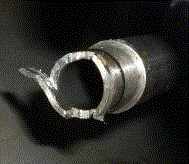
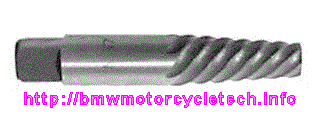
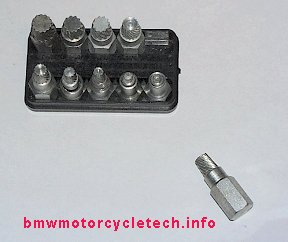
The above extractor tool is also sold as an EZ-Out, Easy-out, etc. There ARE other versions of this type of tool, including some very stubby and extra strong types; such as those in the below photo:
32. The Large High Pressure O-ring 11-42-1-337-098 is a nominal 44 mm outside diameter and 4.0 mm thickness. The metal shim is nominally ~0.3 mm thick (~0.0118"), with some small variances in thickness being seen, down to ~0.010 and up to 0.012". The paper gasket is 0.5 mm thick and is 11-42-1-338-600. There was an earlier number. These dimensions are not critically important, unless you are using the method described by OAK in the August 2004 issue of Airmail. Because of that method, I recommend using MY method.
In my treatment, herein, you need not calculate anything. Both Oak, and especially Anton Largiader, show detailed calculation methods, and Anton's is quite nerdy, and may confuse you, although he does have a chart on what to do, with certain measurement values.
33. DO NOT rest your foot on the oil cooler radiator if you have a GS or G/S, or a R100R or R80R with cooler. You can damage the cooler and it can leak.
34. VERY IMPORTANT SECTION!
THIS is where all the previous information gets into some additional specific details, measurements, etc. Nitty Gritty stuff...a MUST!
With regards to the later models (not the inner metal single bolt cap-cover), BMW was NOT consistent in the installation of the canister. MANY times it is set too far in; sometimes it is set too far out. Some folks think it can move, over time, with engine heating ...I've also seen that happen. I've also seen installs where the pressure was way too high from such as canister depth, shims, whatever, and that excessive pressure MIGHT cause the canister to move, probably after many heat/cool engine cycles;...so, measuring your canister depth more than once over the years is a good idea, as the information will let you determine the use of shims and/or paper gasket. I measure mine every time I change the filter because it is so easy to do at that time. WRITE DOWN the depth and other details. I have that information printed onto my Service Records to-do at xxx service interval, sheet for that particular bike.
As has been said many times already in this article, the depth of the end of the canister to the outer engine surface is critical, as the O-ring must seal both the canister to the outer cover and seal the canister to the engine inner area casting wall. The proper sealing prevents oil from escaping the cover to the outside (where it is visible) ...but far more serious is that improper sealing means that oil escapes the canister area and goes directly down to the oil pan. Due to the high oil pressure, this can be a very serious amount of oil that does not enter the motor's lubrication passageways, lowers the oil pressure, etc. The actual ideal specification for the distance from the end of the oil filter canister to the OUTER face of the engine casting is 3.0 mm (0.118"). You can use a T style depth gauge, or the end of a vernier caliper. Use these tools squarely and accurately, and at more than one place on the circumference.
In a few fairly rare situations, supposedly on some R45/R65 models, but has been reported on some other models, the canister depth was set insufficiently deep; that is, it was under 3.0 mm. One must then either reset the canister deeper, or, use at least one outer paper gasket to avoid excessively crushing & damaging the shim (which needs to be there, against the canister) & O-ring. In every instance of this I have heard about, the outer cover would not draw up 100% to the engine casting without a paper gasket; but, do NOT depend on that.
Use of a paper cover gasket, where one is not needed, can not only reduce pressure on the large O-ring, but can mask tell-tale large O-ring leaks. It is a BAD idea to use a paper gasket at all if not needed! ...and by measuring canister depth, you will know what to do! As a general rule, paper gaskets are not needed, not used, not wanted, on any model, EXCEPT that this does not apply to models without coolers that HAVE the internal cap-cover with the single large bolt ...those MUST have a paper gasket.
If the distance is exactly 3.0 mm (0.118"), you can use the paper gasket, or not. At 3.0 mm and no paper gasket in use, there will be a slight over-pressuring of the large O-ring, but probably this is OK, and not having the paper gasket gives extra safety, in that leaks at the COVER, from such as a cut O-ring, will very likely be noticed.
If the distance is over 3.0 mm (0.118") you must NOT use the paper gasket! You MIGHT have to double or triple up on shims! The large O-ring MUST be under proper pressure!
If this distance is over 3.2 mm (0.126"), use of a metal shim(s) is mandatory, even if you have the very last production version of the canister with a lip on the end. If your depth is much over 3.6 mm, you may have to consider using two or more shims. Some canisters that measure over 4 mm HAVE been reported. In this instance, refer to the August 2004 or January 2008 articles for calculations; or, just calculate it from known distances here.
Even the latest lipped canisters must have the distance measured, & shims, etc., used if needed.
If your depth is 4.0 mm, you will want 2 or 3 shims, at 4.3 mm, you may want 3 or 4 shims, if 4.5 mm you want 4 or 5. ALL these figures are for NO outer paper gasket being used.
In a few RARE instances the canister, a press-fit into the engine, has reportedly moved deeper into the engine over time, and the measurement has changed. That is what happened to TWO I have seen; and I am not the only one reporting this. I again RECOMMEND that you check your canister depth more than once over your time of ownership, keeping notes on the measurement depth, and what shims/gaskets is in use. I have mentioned repeating the measurement at least twice in this article now.
YES, it IS possible to, on purpose, move the canister in or out, but I recommend you do not try this, and I am NOT publishing the procedure here ...on purpose, because it is easy to cause damage.
Whenever the large O-ring is removed from the engine after the motorcycle has been driven a number of times, the motor has been heat cycled, it may show evidence of being deformed, that is, flattened. That IS NORMAL. NOT normal is excessive flattening, cuts, etc. ALWAYS replace a used large O-ring.
Seriously deformed shims should also be replaced.
The order of installation of parts for NON-internal-cap-cover-models is ALWAYS:
Filter>>> shim (1 or more, and if two, the sharp edges, if any, face each other or one on each side of large O-ring and sharp edges face away from the O-ring>>> cover >>>RARELY a paper gasket on cover.
The 11-42-1-250-284 paper gaskets, now 11-42-1-338-600, vary some. Brand-new they measure ~0.02" (0.51 mm)-0.022" (0.559 mm); possibly some slightly outside this range. An approximate size when compressed is 0.018" (0.457 mm).
Canister and canister pipe numbers. Filters... quality... numbers... descriptions, etc.:
The canister area parts numbers can be confusing; and if you need any of these parts, be very careful. I will try to clean up the confusion here, because the on-line fiche is usually wrong on what it says, or implies. The quite old literature (yep, I have it all back to the /5 era) shows that the canister for the non-cooler model was 11-11-1-250-189, using a central pipe 11-11-1-250-158. Neither of those numbers is still available. The somewhat later fiche says, if you search for the -189 number, to use 11-11-1-263-343. That also is no longer available. Interestingly, for the oil cooler model the canister was also shown as 11-11-1-263-343, which obviously must be a non-lipped type, since there was no lip on any early canister. In the early 1980's, there was listed the 11-1-1-337-292 canister. It is very unlikely to be lipped, and the old printed price book (last one, 1995 published) sent you back to the -343 number. Both of those canister numbers are obsolete and not in present fiche. In the late 1980's, some microfiche for only the R100RS model ...shows another, and erroneous, number for that canister. No microfiche before or after shows that part number, which I am leave out of here (enough confusion!), except it was shown as the central tube, which means the pipe. The parts price book shows it vastly cheaper too, which you would expect for the tube (pipe) only. OK, now that we've done all this mess, see the next paragraph:
The only early items still available are the outer covers, cap cover, and the short 38 mm pipe, which is 11-11-1-263-342. The early canister used on the /5 and early /6 is not shown in the present fiche. The later pipe is still available, and it is part number 11-42-1-335-387, and is 162 mm long. The canister that is available is the very last (and it is lipped) version, 11-11-1-338-203. SOME fiche may show that number on the engine sketch and parts listing, yet call the canister "steering column tube". The -203 IS the latest, lipped, canister. Now that you know this, it may make no difference, as you won't likely be changing your canister. Well, you could, but, why would you really want to deal with what that change entails? Well, maybe you will be converting a stock no-cooler bike to a cooler model? It would be best to ask for the latest information for such a conversion, on the Airheads List.
FILTERS:
BMW, over many years, has used quite a few filter numbers, and, thusly, has eliminated or deleted quite a few from the parts fiche. My guess is that BMW may eventually sell only three filters, one for the old short pipe non-cooler models; and two different length hinged filters for the cooler (longer filter) and non-cooler filter (shorter). They might even reduce to two types, all being hinged, by using a design change, but that is strictly a speculation on my part. In my opinion, the hinged filters are best. I believe them to be stronger and less likely to have a somewhat rare problem, a crushed filter from oil pressure and probably cold startup. I suspect that filters from BMW will eventually be available only as kits, with extra parts, so the kits will be even more universal. As it is, the kits have extra parts you may not need, and, missing at least the gasket rings for the banjo bolts.
Quite a few manufacturer's used to make filters that would physically fit, and were thusly sold for our Airheads. Long ago I obtained filters from Purolator, Fram, a BMW dealer, and one other manufacturer. All were boxed with information stating that they were for a BMW R-xxx bike. I did not like what I saw on a few, and I went so far as to send OAK some of my new ones for his eyeballing. Both of us felt that pending laboratory tests which we never did, we would stay with the dealer supplied official part.
When I had my BMW repair shop we sometimes ordered the Purolator filters in bulk, and same for the Mahle filters, both direct from the manufacturers. BMW themselves sold filters from these manufacturer's, usually they were stamped with BMW emblems and/or BMW numbers on them when you purchased from a BMW dealership. Purolator filters, and Mahle filters, are well-designed and well-made.
Purolator: Had 41 paper pleats, paper is of fine grade, proven quality, and the void space between the pleats was maximized. The pleats went deeper, the I.D. size well-selected. From end to end on the I.D., the holes in the grating surrounding the center tube existed. The pleats were somewhat spread out, unevenly. The flow rate is proven acceptable. This filter and the well-made Mahle are recommended.
Fram: Had 35 paper pleats. Paper is coarse, lessened void space, not as deep so square area is less, I.D. is larger than the OK Purolator. From end to end on the I.D., the holes in the grating surrounding the center tube go only about 2/3 of the way & the remaining area is closed off solidly. This reduces the flow rate. The pleats are spread out more evenly than the Purolator, a minor plus factor. Paper quality is questionable, fuzzy, & it MIGHT be decayed by the oil. Flow rate unknown. Oak & I both recommended against using this filter, and I personally highly recommend against aftermarket 'copies'.
Filters may be available in bulk from sources other than a BMW dealership or independent shop. Filters and filter kits are available from BMW dealerships with O-rings, shim and gasket, etc. Note that I consider replacement of the large white O-ring a MUST if the cover is removed on those motorcycles having that O-ring. Be 100.00% sure that any -098 large white O-ring you install is absolutely perfect, without the slightest nick or cut, etc. Once an associated metal shim deforms much, it must also be replaced.
If a filter should collapse due to faulty manufacturing ...perhaps a lousy central metal tube in the filter itself? ...or maybe excessive end pressure in installing? ...the canister bypass valve should ...one hopes ...allow oil flow for lubricating the engine. Most filter failures seem to come from over-revving the engine with quite cold oil, and higher viscosity oils are even worse in these circumstances. THROTTLE BLIPPING IS A BAD THING TO DO ON COLD OIL. There have been reports of filter failures ruining engines. That does not mean to keep the rpm overly low. Nothing wrong with starting the engine and keeping rpm under 1500 or even 1800 during the start, but, if you can, keep it under 1500 rpm, perhaps better to try to idle the engine immediately after starting at ~1000 to 1300. DO NOT blip the throttle to 2000+ during starting & during initial warmup on a very cold engine! It is a good policy to not blip the throttle upon starting the engine, even if not very cold!!
I suggest using ONLY BMW filters, Purolator or Mahle.
FRAM OIL filters ...including their car filters ...seems to be of questionable quality. I have seen this same questionable quality in other Fram filters, even the small plastic gasoline filters, ...and, yes, their car type air filters. I will not purchase nor use Fram filters!
I think the hinged filters are stronger as I have noted, making them less likely to be damaged from oil pressure surges ...certainly they are easier to use, and, in many instances only a hinged filter will be installable. HINT!! If you have a problem installing the hinged two-piece filters (they often just need the 'correct' angle), simply separate the two at the plastic strap!...snip it!
As I noted, there have been quite a few BMW part numbers for their filters over the years. Some of the earliest filter part numbers are still seen, if very rarely, on someone's shelf ...I've also heard of very early ones being found in super low mileage engines. My list of filters, below, is, I think, complete.
After someone visits a supposedly knowledgeable dealership it is not rare to find out that they have purchased the wrong filter for their motorcycle. BE SURE you get the correct filter for YOUR motorcycle! The correct one will install, & it will fit properly. It is, of course, up to you to take care of this shimming, paper gasket, etc., complicated stuff.
Filters used with coolers are the longer filters.
I haven't the faintest idea why BMW kept changing the BMW number for filters.
I will start with the non-cooler filters:
11-42-1-253-817:
Replaced by 11-42-1-253-919;
Replaced by 11-42-1-337-198;
Also part of this group is 11-42-1-337-572 (single piece, bonded rubber at the ends, Mahle OX35).
These filters were for NON-cooler airheads. The filters are rigid and not hinged, and are ~119 mm. Used on /5 & later models. The BMW Parts CD said replacement was by the -572 filter; but it is really the -570 which is the short HINGED filter (same as Mahle OX35 in usage though). You will also probably not like to hear that the -198 will be seen, WRONGLY in some literature, to cross to the -575 filter, which is also the 11-42-9-062-495 filter. NEITHER is correct here. The original type of filter was the Purolator PL-16 and also the Mahle OX-35 was used. From BMW, the straight non-hinged filter is now obsolete. The -198 may come with 2 square O-rings, but usually is seen with rubber sleeves at both ends, as is the OX35D. It is supposedly, in some fiche, as for 1969 to 1991 models, but the literature can be quite wrong! Some literature may show the -198 being replaced by 11-42-9-062-464. Some literature really mixes up the -817 number, etc.
I'll finish up the non-cooler models with the following:
11-42-1-337-570 (also used in kit 11-00-9-056-145): This filter is for non-cooler airheads, it is the SHORTER BUT HINGED TYPE, may come with 2 square O-rings, and is OK to use to replace the 11-42-1-337-198. It may be marked OX37 or OX37D, and might measure about 127-1/2 mm long ...perhaps 119 mm compressed. It is really the hinged version of the -572, supposedly OK for same usage as -385, plus the R65. It is OK for most 1976 to 1992 models, not that THAT information is useful, as there are instances NOT to use it ...you have a cooler?. The filter now has bonded rubber ends (BOTH ends), and the -145 kit has the -098 high pressure white O-ring, paper gasket, drain plug washer, and the flat metal shim.
Filters for the cooler-equipped Airheads:
11-42-1-335-385: This filter is 'listed' for 1979 and later RS/RT models with a cooler. It is rigid, and long. It is obsolete. Confusingly, some listings may not tell you that it is really for /7 and later, but NOT the R65, and NOT the R80GS, R80ST, R80RT, R100GS, and R100PD. ALL OF THE YEAR AND MODELS STUFF IS JUST CONFUSING THINGS, AND MEANS NOTHING. My Parts CD says it is replaced by the -575 filter.
11-42-1-337-575 (also used in kit 11-00-9-056-146): This filter, which may be marked OX36 (Mahle), or PL-17 (Purolator), is for use with the cooler equipped airheads, it is the LONGER type & HINGED (two piece joined) filter as opposed to the -570. It is about 134 mm compressed in length, about 139 mm when not so compressed, and comes with 1 square O-ring loose in the box. It has a rubber 'tube' or 'sleeve' bonded at ONE end. THAT BONDED RUBBER END IS INSTALLED INWARDS. It supposedly has the same usage as the -385; it will replace the -385. Some literature may say to use it for the cooler equipped models from 1976 onwards. It really is for coolers, PERIOD. Another number is 11-42-9-062-495, and you might even find BOTH these numbers on a filter box (-575 and -495). This -575 filter, whether you purchase it in a filter change KIT (11-00-9-056-146), or by itself, is the one for the cooler-equipped Airheads. The KIT contains the filter in a separate box, the square O-ring (that is, or should be, in any 11-42-1-337-575 filter box), a paper gasket (for use WHEN needed), a drain plug washer-gasket. Note carefully: The filter INNERmost end has a bonded rubber tube/sleeve. The OUTER end of the filter has NO rubber tube nor sleeve, nor is there a bonded O-ring of any type. The necessary square rubber O-ring is supposed to be supplied in the oil filter box. That O-ring is 34 x 3 mm. This is NOT the larger 44 mm x 4 ROUND WHITE HIGH PRESSURE SEALING rubber O-ring that is or should be loose in the KIT box. That white O-ring is 11-42-1-337-098. Many years ago that large O-ring was another number, 11-42-1-264-160.
11-00-9-056-146: This is the filter KIT, noted in the prior paragraph. See above 11-42-1-337-575. It contains the longer hinged -575 filter (for the cooler equipped models; this filter is hinged) and ONE -098 O-ring (see above paragraph), one paper gasket, one drain plug washer, two small metal seal rings, and does NOT, UNfortunately, have the 4 banjo bolt washers, and you will need them. This kit also contains one of the large metal shims, 11-42-336-895. This is probably the filter kit to actually purchase for the cooler equipped bikes, and you should separately purchase some of the banjo sealing washers. I suggest purchasing separately a few -098 O-rings and for SURE a dozen at least of the banjo bolt washers. Don't use the paper gasket, nor other items, unless needed, but the kit does have that white -098 O-ring that you MUST replace each time. Save the shim if not needed. In fact, save any parts not needed (like the two small sealing washers).
11-00-9-056-145: This is a KIT, similar to above, but has the shorter and hinged, -570 filter (bonded rubber at both ends). See 11-42-1-337-570, in the non-cooler section well above, for further description. There is NO square sectioned rubber O-ring.
Do NOT depend on dealership parts people, who may be 'guessing'!
You may have a choice of a hinged filter or straight filter. The hinged filter can make life easier, not the least of the reasons is that they are much easier to install on many of the Airheads. I think they are also stronger. Snip the hinged filter at the strap, if you think you need to, during installation.
Some folks have been known to drill an almost unnoticeable small hole, perhaps 1/4" or slight amount smaller, in a RT fairing, to allow easier access to one of the outer cover Allen bolts. The hinged filter WILL allow you to place the filter into the canister without removing things ...like the engine (as erroneously mentioned in certain publications), or, the exhaust pipe or crash bar if you have one. Did you know that some right-side exhaust header pipes may have a somewhat hidden, inside towards the engine, flattened area? I have seen folks assemble the exhaust system and put the dimple-containing header pipe on the left-side! The angle and position of the filter hinge is usually critical as to slipping the filter into the canister, without crushing or otherwise deforming the filter. You may need to experiment, then write down the exact angle, hinge position, etc. Understand the description of the various methods of use of filter, shims, gasket, O-rings. I recommend the BMW kits. I suggest you do not try to save money by purchasing other than filters from BMW, or Purolator, or Mahle.
The metal shim is 11-42-1-336-895. 51.9 x 45, 3X0, .3 mm.
The copper washer that is on the bottom of the thermostat is 07-11-9-963-034. It is in the cooler KIT -146, but you don't need to replace it. It is specified as DT RGA 6.5 x 9.5, and maybe A6 5 x 9, Cu. Use it if you want to. I use it or an old one on the 23 mm special cooler-filling bolt. I think, not sure, that the only purpose of that washer would be to eliminate oil leaks from the thermostat IF the thermostat was damaged, perhaps by someone using a wrongly made bolt.
The -300 aluminum gasket-washer is 07-11-9-963-010. Have also seen -301, and they are interchangeable. This washer is 18 x 22 mm. SEE my hardware article for information on the copper, and preferred, gasket rings for this, and other places.
https://bmwmotorcycletech.info/hardware.htm
The on-line fiche's have part numbers and ""information"" that has been known to be faulty. Use CAUTIOUSLY.
Clearing up some details:
1. The square O-ring used on the outer cover plate was originally not square, it was round, and was 11-42-1-337-097; that part is no longer available. The square type does not ...or, rather, did not, have a part number. It may well STILL not have a part number. It is normally located in such as the -575 filter's own box. The -575 filter does not have bonded rubber at the right (outer) end. That was continued when BMW introduced the filter KITS. The square O-ring was then inside the filter box, which was inside the KIT box. However, that square O-ring is NOT in the -570 box, since that is the NON-cooler filter, and that square O-ring is not needed, as the -570 filter has bonded rubber at both ends. There may be an occasion to modify these statements.
2. The cooler type of outside cover plate has two threaded holes for the hoses/banjo nuts. The cover was made in four styles, one had a thermostat. One had NO thermostat and NO GS style for the cooler. There were two early styles, one had a sort of pointy inside. The GS bikes had a NO-thermostat cover. The COOLER types of covers require the square O-ring, which CAME in the -575 filter's box, at one end of that small box. That filter had rubber bonded at ONE end ONLY. That end went into the canister first. When assembling the area, first went in the rubber end of the filter (the other end, remember, has NO rubber bonded). The purpose of the square O-ring (on the cooler-equipped models); or the bonded outer end on the non-cooler models, is simply to provide a LIGHT sealing to the COVER. The oil pressure differential is low at the junction. The large WHITE -098 O-ring, on the other hand ....has HIGH pressure, ....& is a critical part. It is very important that the proper setup be used as far as shim (1 or more if/as needed), paper gasket (if needed), and -098 O-ring.
3. The NON-cooler covers have NO threaded ports for the two banjo bolts. Thermostat covers and also GS style covers may be seen now and then that had the two ports plugged, and the bike's cooler removed, or bypassed.
4. There is a oil pressure bypass valve located at the innermost end of all oil filter canisters. The purpose of this spring-loaded ball-check valve device is to allow oil, unfiltered, to pass into the engine from the pump and canister, if the filter somehow is blocking oil flow. This ball-check valve has very rarely come loose, and you may find parts in the canister area. Somewhat more often, but still rarely, the spring has broken, and bits of it gets into the oiling system ...bad news, as considerable damage is possible. If you have to replace the valve or otherwise repair it, clean the male and female threads with a good evaporating spray solvent, and then apply BLUE (medium strength) Loctite or equivalent, in a SMALL AMOUNT to the case threads. DO NOT get any on the ball and where it seats. There is no specification on how deep to install the slotted holding part, I suggest FLUSH. Do NOT screw it in way too far, you will change pressure characteristics. After installation, I immediately squirt a good spray, under good finger pressure from my bench spray can of oil, into the ball area, and move the ball a wee bit with stick or other item. That ensures the ball and spring will not stick.
5. A modestly RARE event, is an engine with the front main bearing having rotated, which cuts off oil to the rocker arms, & lowers oil pressure. You will usually find a steel pin, of about 4 mm diameter, about 11 mm long, in the oil pan. It may, or may not, be on the magnetic drain plug (if you have one). While the main bearing is a press-fit, if the pin (which is supposed to be pressed-in and staked), comes out (big oil pressure is there, helping to push out the pin), then the bearing may rotate. The pin is 11-11-1-253-184. This is a SERIOUS event, and requires the entire front of the engine to be disassembled.
6. Anton has good illustrated information of the oil filter canister setups (some) on his website:
http://www.largiader.com/tech/filters/
Anton also has an excellent illustrated article, about canister depths and shimming, etc. You may find it useful to better picture in your mind what is going on.
http://www.largiader.com/tech/filters/canister.html
7. As you have seen in this article, BMW sells filters and filter kits in which there may well be extra parts that you will not be using on your motorcycle; so I suggest you save unneeded parts for future needs.
EXTERNAL oil filter conversions:
A conversion kit was sold commercially by Suburban Machinery. There was a major article in Airmail in November 1997 by OAK on that specific conversion, his misgivings, & the company's reply. There are probably some Airheads around still running those external filter kits. They had hoses from the oil filter cover plate area to a remote mounted spin-on filter. A conversion has also been done by individuals in somewhat similar ways, not from Suburban Machinery. I recommend you do not install a Suburban Machinery setup; I consider it potentially dangerous to your engine health, and the complexity alone can detract from reliability. Generally-speaking, only those with extremely high labor to get to the stock BMW filter, perhaps folks pulling close-to-tug right-side-mounted sidecars, might want to consider an external filter.
The only other commercial type I know of is this one, which is still sold by Motoren-Israel (a German company):
http://www.motoren-israel.com/product_info.php?info=p16_Oil-pan-intermediate-ring-25-mm-with-external-oil-filter.html. Or, try:
https://www.motoren-israel.com/Shop/Oil-pan-Distance-rings/Oil-pan-intermediate-ring-25-mm-with-external-oil-filter::16.html
special considerations, including on this page:
https://www.motoren-israel.com/Einbauanleitung/FAQ117002-eng.pdf
This product seems to be engineered nicely. It is expensive. There are some more things you will need, and there may be shipping costs. For this Motoren-Israel product, it is a probably matter of money for very little cooling and mostly for convenience in changing filters. There is complexity added. The links, above, and their links on the pages, should give you most of the information you need to evaluate before purchase (except anecdotal reports, which you can probably find on the Internet). Do you REALLY NEED this conversion? REALLY??
I had a 1983 R100RT sidecar rig (with the sidecar on the right side, as is normal in the USA). I left the oil filter & cooler setup absolutely stock. I measured the canister depth. I added the metal shim and deleted the paper gasket, as was proper for my canister's actual depth measurement. I did NOT change to the GS type plate ...I kept the stock thermostat type of outer plate, which has better cooling control performance than the GS style of no-thermostat. With the proper tools such as a ball-headed T Allen Wrench, and a 1/4" hole in the fairing which is almost unnoticeable, I had no problem laying on my back & changing oil filters without using any sort of lift, platform, etc. I usually jacked up the right side a small amount (at the sidecar outer right side frame rail) some for ease and convenience. I had no leaks, no oiling failures, & a lot of miles, some on forest service rough roads. Nothing was hanging or sticking out or down, where obstacles might cause problems. While it was more effort to change the oil filter since a sidecar was attached, & the bike could not be put on an angle by use of a left-side sidestand, or compensated for by much in excess lifting, overall, it was really not all that much extra effort. Even setting the valves on the sidecar side was not much additional work. Unless you are physically handicapped, or have a very specific access or other reasons, perhaps having a sidecar very close to the right side of the motorcycle, I just cannot recommend conversion to external oil filtration.
The Motoren-Israel modification, done according to their instructions, should work OK. It will be a fair amount of effort and cost to gain an extra liter of oil & the 'convenience' of the screw-on filter, but you will gain in somewhat lengthier oil changes, have slightly better oil cooling, etc. You will spend money, have more things in the way of 'things' in the roadway/trail/whatever. Be sure to look at the website carefully, & read any hints, warnings, advice, etc. THINK IT OVER.
I have seen some external filters done by various methods, and most, if not all, should have the filters thoroughly soaked in oil before installation, otherwise the engine may be starved for oil during filter filling during engine start.
Revisions:
11-12-2001: Clarity, adding some explanations in greater depth.
12-16-2001: Remove e-mail address; correct Purolator spelling.
to 02-12-2003: Minor cleanup, typos, hints, nothing substantial.
03-23-2002: #4 edited; add thermostat specifications to #10; add specification on pipe distance to lower series #7; size of the 098 O-ring in lower series #3; add official tolerance to lower series #8; add note on SI to lower series #5; add longer filters for coolers note to Filter-Mania.
04-18-2003: Add .htm title; clarify a number of details.
04-29-2003: Re-number items to eliminate confusion of lower & upper section numbers, expand on the GS type non-thermostated cover; last numbered item is #32.
05/26/2003: Minor updating includes red notes, consolidation of filter types. Add hyperlinks.
06/12/2003: Add NOTE in BLUE about the filter lengths.
07/26/2003: Add note on F650 magnetic drain plug to #3.
09/05/2003: Clarity & emphasis various places, clarify filter numbers, etc. Many changes.
09/21/2003: Minor clarifications.
10/08/2003: Add -145 filter kit information.
03/21/2004: Clarifications...especially in #27, but in many other places as well.
05/16/2004: Expand information on -145 filter kit, add a cross-reference to the -570 filter.
08/02/2004: Update entire article; mostly simple clarifications, and also adding references to Oak's August 2004 AIRMAIL article.
08/29/2004: Clarifications, minor, on kit contents. Add the comments from the Airlist.
02/15/2005: Clarify the canister depths, and more information on filters.
05/17/2005: Add to #16.
07/20/2005: Clarify details on the GS type cover, versus thermostatic cover, extensively.
12/06/2005: Clarifications, mostly on the paper gasket
03/16/2006: Edit number #11, #13, #14, #15, #17. Minor editing elsewhere's for clarity.
06/07/2007: Add emphasis where needed, clarify wording. NO substantive changes.
06/18/2007: Re-arranging & adding an Amendment, & numbering for 2 Amendments.
01/01/2008: Revise #24.
02/09/2008: Canister dimensions.
06/25/2008: Revise #25 for clarity; minor editing, mostly not much further than item 27.
08/17/2008: Edit to clear up possibly confusing OX numbers on filters.
08/27/2008: Slight editing for clarity and add hyperlink to Anton's filter/canister article.
09/24/2009: Update for links to hardware article which has photo now and description of the correct and incorrect thermostat special bolt.
06/16/2010: Add #33, and number the part just following as #34.
02/24/2011: Was 52A.
05/20/2012: Add information on External Oil Filter adaptations.
08/29/2012: Slight update to #20.
12/02/2013: Go over entire article. Simplify some areas. Add more part numbers. Reduce some colors. Re-do most of the Amendments, eliminating a LIST conversation, as it was superfluous with the other changes & added information. Rather a large number of changes.
08/02/2014: Add note to #15.
09/24/2014: Go over article, at a first try to make it more usable on smaller screens.
11/10/2014: Add another hyperlink to Anton's articles.
04/16/2015: Add link for BMW-Germany's SI 111982----etc.
05/17/2015: Minor updating for clarity & re-arranging a few notes & hints. No new tech.
11/01/2015: Add link to Anton's article on canisters.
11/26/2015: Go over the article completely; simplify things some, reduce colors a bit, put emphasis on where more needed. Clarify some details. Re-arrange some areas. Fix the meta-codings.
03/08/2016: Update metatag codes. Eliminate most background yellow over red characters bolded or not. Layout. Change characteristics of the table. Fonts changes. Later, same morning, remove ENTIRE table covering the page, as it was causing some browsers to display huge blank areas.
09/19/2016: Update metacodes, scripts, layout, fonts, & small amount of clarifications.
03/03/2018: Go through entire article, clean up layout, reduce colors, reduce font changes, html reductions. Clarify a number of details, mostly to eliminate any possible misunderstandings about refilling the oil canister & cooler on GS models. Advice to refill separately the cooler on thermostat models. Emphasize certain critical areas. Cleaned up the explanations of the filter canister can, internal pipe, etc., so can be no misinterpretation. Combine & shorten the filters description section. Recheck fiche to be sure of current parts information, besides leaving the historical information. Still to be done, confirm and explain the OX-xx filter numbers better.
01/18/2019: Add section on coolers.
08/19/2019: Caution on Rotella T1.
10/14/2020: Capitalize the o in oil.htm for THIS article....so is Oil.htm; which prevented some browsers from displaying, and giving a 404 result.
10/18/2020: Clarify section 14 information on the breather post groove positions. This was done because the R75/5 and R75/6 use a different groove.
03/20/2021: Minor clarifications. Move some parts of this article around to better fit into discussions. Notes on not resting foot on GS and R cooler radiators.
05/04/2021: Completely revised FOR CLARITY PURPOSES, with a few expansions on information here and there.
08/02/2021: Add red boxed table and its contents, for clarification purposes, especially done for the rare problem of a collapsed oil filter.
08/29/2021: Update the breather link information.
Return to Technical Articles LIST Page
Last check/edit: Sunday, August 29, 2021