|
|
The ads above are Google-sponsored.
Clicking on them at every visit helps support this website!
Clicking on something inside an advertisement helps even more!!
Tire testing. Recommendations.
Wheels, rim shapes, spacers, nitrogen, wet roads, tire
markings, hydroplaning, etc.
Tire wear.
© Copyright 2024, R. Fleischer
https://bmwmotorcycletech.info/section5.htm
article 54, section 5
Introduction:
Over the decades that I have done tire testing, it became more and more difficult to maintain a list of recommended tires due to fast changes in what is available; and, what I have managed to ride on (& to fully test). Up until around year 2005 I was still doing relatively high touring mileages every year; and, test riding many Airheads before, after or during repairs. In addition, my specific tire testing was mostly vigorous & formal ...at the same few places ...on the same roads. By late 2016, I had slowly started discontinuing on-purpose corner sliding in some conditions; and, full-on panic-stopping, especially on wet roads. Now in my eighties, I am less strong and less able to do the type of tire testing I would want to do. Sometime in 2018, I decided to quit formal tire testing entirely. I did have two rider friends, whose serious tire testing mirrored my old style close enough, but one died, the other quit such testing. The result is that TESTING and REPORTING in this article will be historical, unless I have a trusted tester or two. I list discontinued tires on purpose, for reference & comparison. Some old style tires are now being re-made, but, unknown and unadvertised is that these often have updated rubber and construction. Thus, purchase of a 'modern' version of an old favorite tire may well not give you exactly the same ride. I suggest you read this entire article, as I do make occasional updates, and there is a lot of valuable information, pertinent even for the distant future!
More and/or reference information:
https://bmwmotorcycletech.info/wheels.htm Detailed information on wheels.
https://bmwmotorcycletech.info/section6.htm Gets heavily into tube & tubeless on various rims.
https://bmwmotorcycletech.info/TireRepair.htm Gets heavily into tire repairs, and considerably more, including air, nitrogen, moisture in the compressed air, ....just a whole lot of things that I put into the tire repair article, as this article, below, was way overly long.
Introduction: Some words of caution, .....straight & plain talk:
Some tire testing is easy to do & this is the type most typically reported or commented-on (Lists, Forums, etc.). Mostly you will find on such forums, lists, groups, Facebook, etc., opinions with FEW real facts. Certainly not often based on REAL testing. Often, such opinions are just someone wanting to say something to feel part of the group; or, or to justifying the brand and price, etc. Almost never are such 'reports' from actual formal step-by-step tire testing for handling, braking, quick maneuvers, wet roads, nor a variety of surfaces. Almost never is the condition of the motorcycle's shock absorbers and rest of the suspension noted. Stiction in the front forks, for instance, has never, not even once, been noted in ANY reports I have seen. Stiction and those just mentioned suspension conditions can have a VERY large amount of effect on handling. Sometimes tire pressure testing is done, but other than the occasional 'favorite pressure', nothing much is usually noted.
More useful reports come from those who generally do the following:
Keep their tires inflated properly, and have run tests on differences in handling and braking with pressure changes, and noting if the calibration of the pressure measuring device and if pressure was set at a nominal temperature, or?? Some will note that they rode like they usually do, mostly on paved roads with mixed speeds, and are willing to state accurately the types of speeds they use because speed affects tire wears to quite some extent. Perhaps they do mixed type of curves, mixed type of road roughness and describe the surface conditions of roughness for the roads they mostly ride on. They report on mixed loading. If riding two-up a lot, they may well note that in their comments. If loading is high, that should be noted. Many do write down the odometer reading when they installed the tires & when they took them off for replacement, and the tread condition. Few report on how the tires changes felt over their lifetime. They might have stated the tread depth at the middle at replacement time, since that greatly affects reported tire life. Perhaps they did testing at various tire pressures. Due to some rather stiff sidewalls and beads, some modern tires can be difficult to mount. More and more reports on that are being seen: how easy or difficult was it to mount the tire, but: most don't specify ALL the exact details of the mounting and demounting process.
If you use words such as 'aggressive rider', what does that really mean?
Typical comments on various forums when discussing motorcycle tires are about "how well the tire sticks to the road"; & how many miles before it wore out. In a rather large percentage of instances, no 'standards', only minimal information opinions, are seen in discussions. The bald truth (very bad pun!) is that modern tires are vastly better than the tires were when your Airhead was manufactured (particularly before the early eighties), & unless you have real racetrack experience, you are unlikely to be safely capable of putting the tire to real testing that results in how it really sticks to the road, let alone seeing if you can out-ride the tire. Have you really tested & ridden to see if-when-how conditions are that the rear wheel (or the front wheel) looses traction? When does it lose the 'sticks to the road' performance you posted about....? What do those words of yours really mean? What about rain grooves?
Your Airhead is of limited power, limited braking (esp. early models), & may have suspension aging or improper setup problems ...all of which affect tire life and handling. Even when a number of modifications are made, these are not 170 mph crotch rockets.
Serious accidents can occur with something as simple as a tight turn, especially at speed, especially with a rear tire tread that has been worn more than somewhat in the center (flattening the center of the tire tread is particularly onerous...and, frankly, dangerous), when it originally was rounded to some degree. Do you know about flat-worn rear tire stability problems? If you had a motorcycle that went into high speed wobbles or oscillations, would you blame the bike, suspension, the rear tire, maintenance, or, just what would you say publicly? If the front tire showed scalloping, would that effect what you reported about handling? Are your tire reports useful? Accurate? Do you use PROPER tire pressures?.....are you aware of tire pressure recommendations from BMW back when Airheads (especially before the eighties) were being made, being way different from real-world, for modern tires?
ASK YOURSELF: Are you really competent at riding to the tire slipping point, over and over again, on purpose? What about crossing up the steering during sliding? Does that idea of crossing-up the steering freak-you out? On wet roads? What about when your beautifully executed carving turn encounters lots of bumps? Sudden off-banked tight turns? Washboard surface? Can you truly (be honest!) feel the difference 3 or 4 pounds of pressure makes? Have racetrack & soft dirt/gravel & wet roads experience? Are you truly smooth with the controls (including transmission, brakes, clutch & throttle)? Are you smooth with transitions from any surface or turn direction, etc.?
Tires do vary considerably in how they handle, how they wear, & under what types of conditions (including road surfaces, straights, turns, off-banks, braking in dry good friction areas versus wet roads ....what about some ...or deeper ....water on those roads? Some tires change characteristics far faster than others, in the first ---perhaps--- 20% of wear.
What characteristics of a tire do you really need? Be honest with yourself! Even in an 'emergency maneuver', ask yourself just how much you would really push your tires and brakes. Do you know that "high-performance" tires may well not be the type you should use? Do you know why this is so?
Probably quite a large number of different tires will work well for most any type of riding most of you do. But, you may be the type of rider that really is aggressive, or has special needs. Perhaps you really do ride off-road, into seriously soft stuff, mud, single track trails, ...real Adventure Riding ...are you going to ride on pavement to get there? Maybe you really are an aggressive road rider, maybe you get off-road now and then, but maybe only into mild dirt and abrasive gravel? What about hard-packed dirt?
Perhaps you, like most motorcyclists, love carving turns at speed on paved roads. Are those turns nice sweepers, ....or are they truly tight twisties on very narrow roads that may have irregular pavement surfaces? What about the feel of your tires in tight twisties, especially when very quickly changing directions? Perhaps you really do use the front brake truly hard. Do you brake aggressively in turns? Are you carving the same turns quite precisely, turn after turn?
Perhaps you are a real all-weather rider; you use your motorcycle as your primary transportation, year-round, rain or shine. Perhaps you are not a 'dirt rider', and almost never ride short stretches of gravel, hard-packed dirt, etc. Perhaps you put on very high mileage every year, riding 99% paved roads...lots of BMW riders have always done that....some in very mixed weather, others in generally only good weather. Riders have different real needs for their tires.
When a very experienced track racer rides a bike on the streets & highways, their expressed viewpoints about their tires tends to be a comparison between how a real race bike handled on a racetrack with real racing tires ...compared to what the street bike (which may even be a high performance type) feels like on street-riding tires. This may not be of real value to you ...the average, ...even somewhat aggressive ...street rider;....but, their information may influence you wrongly; especially because their remarks about tire feel & mileage and pressures may be very different from your needs. Be careful about what brand and model of tires you purchase for your motorcycle; obtain what you REALLY need.
When I first began this article, long ago, I incorporated a lot of testing notes that I'd done over many years. I had a section on exactly how to do tire testing; that is, very specific step-by-step methods on different types of roads, to initiate instabilities, to test sliding, braking, suspension wiggles/oscillations ...actually testing how tires really stuck (or didn't) to the road (front and/or rear), on both dry and wet roads. I included suspension testing, including detailed stiction measuring because it is so very important. A few people got into trouble, one ran his bike into a metal side railing on a highway, and the other flipped his bike from wrong use of the brakes. A number of riders ran wide in tighter turns, usually right sweeping turns. Luckily no one had a head-on accident. I had conversations with some. The problems, in every instance, was that they did not follow directions, and already had poor skills/habits. Every single one of those having problems did so because they did not do the modest learning steps I outlined that would safely work them up to be safely aggressive. They "did not have the skill when panic set in". I removed the entire section, and have no intention of returning it to this article; nor distributing it, and I have deleted it from my files; and, in fact, I have seen to it that old copies of this article, available from some internet sources, have been eliminated or changed. I will only say that those with some goodly dirt riding experience will do far better at road situations when testing tires, suspensions, etc. Unless you are really good at braking and at least mild sliding, do not attempt tire/road limits testing! One thing is for sure: Unless your Airhead is rather heavily modified, it will NOT out-handle modern tires, properly inflated. So, in a sense, the reports on tires in this article are a bit moot; that is, one could just select a tire for one's purposes, inflate to proper pressures for your riding, and be done with it. But, that is not going to necessarily satisfy the vast majority of riders.....nor should it.
Most of my own reported-on testing in this article was done on a variety of Airheads. Some few were done on classic K-bikes. In a number of instances, I tested on other folks motorcycles, nearly all were, purposely, Airheads. I did testing on my own meticulously prepared bikes.
While I really would like to continue to do more test riding, the facts are that I tire (pun!) much more easily now, I have much less stamina, I am much weaker from the progressive parts of aging and illness. Hours of tire testing on a single day takes real muscling-around, and Airheads are not light-weight bikes. I held off completely stopping testing, as I have been blessed in my old age with good reflexes & eyesight. I lived in the Lake Tahoe area for about 48 years ...and it has a variety of terrain, including all sorts of types of twisties in mountain passes. There are some sand areas (one particular area, called the "Sand Pits", was actually set aside for motorcycles only), 3 miles from my home. My paved-road testing area received mixed weather conditions; had various pavement styles & conditions & more than one type of tire snake compounds. Some years ago, the State of Nevada did some paving repairs on a road into the Lake Tahoe area, where I 'tested' a new type of tar snake compound that the State was using. The compound was a disaster ...and some riders went down....& they had to remove and replace that tar snake compound. I did a lot of stiction & tire skipping testing on that 11 miles or so of road, on several types of tar snakes too. I could not, certainly not now, be as aggressive as I would want to be, on that particular road, due to my situation as well as the traffic (& the Authorities).
One thing that got my full attention, over and over, was how tar snakes, and stiction, did not work well with each other. Testing on washboard roads, with curves, was an eye-opener. Poor suspensions were eye-openers. Worn rear tires were too. Once I figured out what was really going on, I purposely always tried to find areas of testing to do comparos. I purposely would test customer and friends and my bikes on such areas, noting, in particular, how suspensions
(and, tires, of course) did or did not handle those roads. I got more and more convinced that STICTION, when excessive (amazing how many 'good handling' reports are for bikes with BAD stiction), essentially destroyed an otherwise great ride. MANY riders had no idea they had a poor-handling bike. I repaired a lot of them at my shop. Every rider let me know about the resulting change to the handling.
As 2016 became behind me, I decided I was a Senior Gentlemen, and that although I certainly do like using the throttle in the twisties, it was time to set a date for stopping riding. With our contemplated move in 2019, to an Oregon CCRC, the bikes would be sold anyway, due to lake of maintenance garage area. We, instead, ended up moving to Carson City, Nevada in 2019. Already committed, I had sold the motorcycles and my sidecar rig, and I stopped road-riding, even off-road only was soon stopped. All this happened before 2020.
Returning to earlier days:
Some areas near Lake Tahoe (that I used for testing) are fairly flat & smooth with excellent pavement with nearly the 'correct' amount of faint roughness to the surface, all of which inspires a lot of confidence. One area has very ugly curvy (poor workmanship!) rain grooves, which are great for setting up instabilities!.... & this same road has some broken and uneven pavement sections. I had a cement-paved freeway 26 miles distant (with & without rain grooves sections). There was a road where I did very high speed testing in conjunction with my association with a bike magazine; no, you will not be told who/where; of course, that was mostly just for fun for me, hardly applicable, and unreported here. I also have two dirt areas, one is medium hard-pack; one is very soft & deep sand/gravel (that one is, as noted above, is only 3 miles from my home). On the rare occasion I got on a racetrack with a bike, I always noted the types of tires; how they feel/handle, pressures, etc. One of the things I tested, whenever I could, was the handling of brands and models of tires at the point they were nearing replacement time. Some tires changed characteristics way too much. Of course, I always tried to personally test the bikes we worked on at my shop....that's a perk of being the shop owner! I had two basic routes, about 80 miles total. I especially loved testing brand-new, or nearly, tires. I often carried a thermometer to measure road surface temperatures. Sometimes I measured tire temperatures.
I have specifically tested bikes that had squared-off rear tires, doing this for stability testing of the entire bike besides tire feel. Same for suspension, stiction problems, etc. I also tried to test bikes, when I could, that have large windscreens or fairings, perhaps with tour bags & a backrest ...to see how they handle various speeds & direction changes. In other words, I combined bike & equipment testing with tire testing. I've even tested bikes with one large rear saddlebag, and same bike with two; and with various loadings.... this was done on purpose to see if oscillations could be induced. I also did this type of testing on my own 1984 R100RT, which had a KNOWN excellent suspension. I have even purposely installed a lousy set of well-worn rear shocks, to see the effects on handling on specific tires (they are not the same!). BTW ...badly worn rear shock(s) and squared-off rear tires, are quite dangerous. Once a serious oscillation, let alone a big tank slapper starts ....things get exciting, FAST!
For new tires, my bikes, and on many of my customer's bikes, my habit was to run them in reasonably for ~50 miles, slowly increasing aggressiveness over those miles. I made notes, sometimes played with tire air pressures (I would take along a small electric compressor & I used a very accurate Bourdon type gauge) ...& when I found hot/warm pressures that worked well, I rechecked with the tires cool, so I knew what the normal tire pressure should be (tire pressures for normal use are initially checked with the tires cool, that is, not ridden yet). I also, as note above, carried thermometers.
Testing informs, for any one particular bike, how a tire can be expected to work/respond ...this testing should include panic situations & pushing things aggressively in various types of turns. I like to do sharp corrections in mid-turn for additional information; and, doing that is tricky, and somewhat dangerous. Properly done, testing allows comparison between various tire makes & models; & this is a prime goal. I had testing areas close my home that I consistently utilized since 1973, depending on time of year and conditions. It was not possible for me to go more than 7 miles in any direction without using twisty steeps, because of three moderately steep & twisty mountain passes that surrounded my area. They had a mix of asphalt & cement surfaces & a mixture of tar snake repairs (excellent for testing suspensions and stiction effects).
Exploring some country roads in an area not far away, I found a little-used area that has a hard surface with tractor cat tracks! Yeah, really. That really tests suspensions for stiction.
One stretch of road is often often flooded in one area in the Springtime for distances of 1/4th to 1/2 mile (I used it for curves & braking tests). This area has rough and broken and also smooth pavement. One area that seems to always be dry has rather rough & uneven pavement. That area also has off-camber curves! Off-camber curves are very interesting when testing tires that are fairly well-worn, and ""NOT FUN"" with flat-worn rear tires at speed.
Some details (before I get into the brands, models & testing results, followed by Everything Else):
1. Some types of tires do/did not work well on early Airhead motorcycles. Most tires back then were constructed so that the tire pressures required were considerably lower than today's. Today's tires, with few exceptions, need higher pressures, in some instances up to 12 psi more. Failure to increase to proper pressure will give poor handling, particularly during transition from straight ahead to a turn. You can not depend, a considerable amount of the time, on the tire maker to tell you the proper pressure for specific BMW Airheads particularly the older Airhead bikes ...they may want to limit any possible liability, so they simply quote what BMW said in original OLD literature; or, they give range of pressures for certain sizes for any bike using them, and do not mention BMW, nor any other motorcycle brand, typically.
Said another way, nearly 100% of modern tires require higher pressures than BMW recommended with old style tires from the era of early Airheads. Since the mid-eighties, this has been somewhat less so, and BMW Owners Booklets pressures are closer, or actually quite close, to what is now needed, particularly since the end of the eighties through 1995, after which Airheads were no longer produced. Avon has/had some tire pressure guidelines that are/were far more honest than most tire companies. Avon is constantly changing the address of the page that contains that information, hence I am not showing an address here.
We now even have special radial tires for 'classic' motorcycles like our Airheads & the early K bikes. Most do very well. I think most of you will actually like these new radial tires on paved roads ...even mild riders. Many of the newer non-radials are also excellent. Be sure you use appropriate pressures in all tires. In general, modern tires have ~ same pressure requirements, no matter if bias, bias belted, or some form of radial.
Lower profile tires (modest, such as 80 section) may not work well (exceptions depending on the tire, and if a Monoshock or Paralever, or a Classic K bike), & many simply will not properly fit old Airheads, they will rub something, especially the swing arm. Generally a "90" profile works best on old Airheads. Unless I specifically make note in this article, you should assume that I used the stock tire sizes, or close metric equivalent. I tried, when I could, to test inch sizes (when available, as many tires are not available in inch sizes). Example: 4.00 x 18 rear original.....test in 4.00 in inch size, and in metric sizes, test 110, and 120. Another example: 3.25 x 19 front original, test in 3.25, 3.50, 90/90, 100/90. Similarly for the 18" front tires. In order to do some types of testing I had to be putting on huge mileages every year ...and I did ...I received my BMW factory 600,000 BMW badge and credentials. Luckily, I had customer bikes that required testing after my shop worked on them, certainly including when we put on tires.
Note: /6 Airheads had a narrower fork brace (fender mounting type). If needed for your metric or oversize front tire size, you can use a 1977-1980 brace from a /7, 46-61-1-234-907.
2. Frames & suspensions were designed by BMW for a specific feel & handling that BMW desired. Many riders seem to have no idea that frame design & construction, suspensions, & many other things, all, together, affect how a motorcycle feels, & one word is often used, without specifics ....HANDLING. In common use are such terms as FEEL, TURN-IN, FALL-IN, TWITCHINESS, QUICKER-HANDLING, ....& other words ...... that you might think mean something very specific, to which I say "maybe", ...if we could all agree on what those things mean, exactly.
3. BMW used to issue bulletins with names/models/sizes of tires that BMW had tested and approved; but that has not been done for Airheads since they were in production (with some few exceptions).
4. Here is a link to a rather nerdy article. The article has extensive vector & other diagrams, & some conclusions about contact forces that may well astonish you. When you read it, keep in mind what really happens when you are cornering. Think about the effects of you changing a tire size ...from, an example here, a 90/90 to a 100/90. What really happens when you go to a larger size tires (larger width). You may be very interested, particularly about the roll radius at the tread, due to the curved shape.
https://www.goldwingfacts.com/threads/design-differences-between-car-and-motorcycle-rim-tire.400426/
The article has some real jewels of information here and there, in-between the nerdiness. It really is worth the read. It is one article, followed by dozens of pages of commentary from others; feel free to look at them. Amongst the 'jewels' in the article are the definitive details on rim shapes and dimensions of such as motorcycle tire bead areas (thickness and shape too) versus car types; and, the facts about why friction (traction) is independent of contact area (within reason, and they don't talk much about that) ....and why wider tires are used to obtain better wear from otherwise less-mileage stickier rubber compounds.
If you are a sidecarist, you may be interested in that article for several other reasons, including the rim shapes, friction details, etc. Some sidecarists use small car tires on motorcycle wheels. Most sidecarists know about the differences in stated rim diameters, when trying to put a car tire on a bike rim, and vice versa, but few know about the bead width, and some other details.
You may also be interested in the information on rim shapes in this article: https://bmwmotorcycletech.info/section6.htm
5. Many (if not most all) of the tire models from the seventies, even many from the eighties & nineties ...are no longer available, except for a few, including the classic Continental RB2 and K112, and now some re-incarnations of Metzeler tires as 'Heritage" tires & the Bridgestone Accolade. Those Continental front tires, like all ribbed tires, unfortunately, follow rain grooves. Rain-groove-following is a more or less problem with straight ribbed front tires (especially multiple straight ribs) & some others with irregular treads. There are tires available now that have only one center rib, usually wider than the old narrower grooves & ribs & are typically better on rain grooves. Tires without center ribs of any sort generally do not usually follow rain grooves, but there are exceptions, but usually the instabilities are mild. Some folks are considerably bothered by the feel of their bike when the tires track rain grooves, other riders are not bothered, simply accepting the feel, and prefer other characteristics of that particular tire. I'm in the middle, because I prefer a smooth ride, at least for touring, ...and I like a tire that handles well on paved roads, even when wet.
Some types of bridge gratings can cause a goodly pucker factor to arise, depending on the types of gratings ... with even more increased concern if the gratings are wet from rain. Not many ride on original type of ribbed front types, and one reason is that they do, often seriously, follow rain grooves, contrary to what is said in some Clymer's publications. Still, you may want to try a set, as some can deliver rather closely the classic ride & handling that your bike was designed-for. Those tires may work best at the originally recommended by BMW tire pressures (label was under the seat, see your owners manual too), or slightly higher (perhaps by 2 psi front, 3 psi rear). You need to ask about that! I recommend that if you install classic tires that you inflate at least to the two-up and/or high speed pressures shown in the Motorcycle Owners Booklet. These tires give reasonably good mileage before they wear out. They may look like the originals, but may be modified in the carcass, and especially the rubber may be improved ...and on some you may well need a fair amount of pressure in them. If you have a modified suspension, the classic ride & handling will be modified. Do not mistake original make, model, & name ribbed tires for the modern tires advertised as being for 'classic bikes'.
One problem with trying various classic, heritage, or similar tires is that most riders no longer have the exact same type of original shock absorbers & springs; or, those are not in good condition; or, other parts of the motorcycle have aged; or, they have made other changes. Just changing the type or style of handlebars will affect the bike feel. If your bike is in reasonably decent condition & reasonably close to original specifications, you might really want to try a set of these so-called reproductions of old tires. I believe it really is worth trying these tires if you want to experience something closer to original feel. If you don't like the tires, sell them to someone else. You might even fall in love with these old type tires.
6. I have personally ridden on quite a few modern tires, besides old types. Modern tires offer rather good road handling, often quite decent predictability of handling in various situations (indication to the rider of what the tires are doing and going to do); as well as reasonable, if maybe somewhat stiffer comfort. I've noticed decent load carrying, decent traction in cold/wet/dry & not unreasonable differences in handling between moderately wet & dry. A few don't let you know about handling limits ...until you are suddenly very aggressive, particularly back and forth quickly. But, these are characteristics we've had for many decades with tires. The difference, to make this more succinct, is that a majority of modern rubber seems to have narrowed the difference between what we used to call stickiness with short life, and higher mileage with slipperiness in such as wet or otherwise slick roads. Dual compound tires with center-of-treads containing, essentially, sand, started a goodly trend, and really do work well. That does not mean that some tires do not wear fast, we still have those. On that mention/note, one thing usually discussed, mileage (tire wear), should not be "the" most important characteristic, although some folks who put on large yearly mileages will be especially interested. Many of today's tires, including re-incarnations of old styles, will give better mileage than long ago, even though these modern tires are not being sold as high mileage. That is due to the use of different proportions of carbon black and silica's, and the increasing use of different tire compounds in the center versus the sides.....and, so I have been told, differences in carcass design.
I have seen no manufacturer's of these reproductions telling us what real changes they made, if any, in those repros.
If you are stopping your reading at this point, intending to read the rest of this long article later on, perhaps I can offer the brand and model of a tire you may be surprised about....it is NOT expensive, and has good characteristics. That's the Dunlop D404.
7. There is a considerable difference in how tires feel to a rider depending on the bike they are mounted to. There are quite large differences between various models of BMW Airhead motorcycles, with truly feelable differences to most any rider because of frame changes, trail & suspension & wheel changes, etc. To give examples, a stock /5 feels quite rubbery compared to a stock R80ST, & any stock twin shock Airhead feels very different to a stock R100GS....& different again to my stock 1995 R100RT ...which feels very different from my 1983 & 1984 R100RT's. The differences are substantial, and that makes discussion of tires particularly difficult, in trying to differentiate between tires. This is a prominent thing when trying to report on tires.
Some things you may not have thought of, influence tire mileage, and, perhaps, more subtly, other reports. Just one example here: If you have considerably better brakes, like later model Airheads may have, you will likely have a tendency to use those brakes differently, than on an earlier model with lesser brakes. This alone will have an effect on tire mileage; but, also, on the feel of the bike in different types of road and weather conditions. Influencing handling reports are such as with or without fairings; or, especially, front fork mounted windshields, saddle bags, and rear trunks.
Most all modern tires are capable of out-handling most riders. They stick to the road rather well, even at big lean angles under fairly severe conditions at speed. When reading tire comments/reviews, feel is not well-differentiated.
Most modern tires have profiles, type of rubber, type of design, type of tread, etc., that give a "quicker handling" feeling. This is particularly so when properly inflated. Many modern tires feel, to the rider, particularly when starting out on a new set of tires they have not ridden on before, ...that they are considerably over-inflated, & might be called skittery or quicker handling. Many riders are timid, particularly on wet roads ...but, the tires may feel ...or be described ...as quick, or twitchy, or skittery, etc. ...on dry roads too, even after thousands of miles on the same tires. Yet, in the hands of an may experienced rider, these tires provide great handling.
Riders transitioning to a modern tire that require increased inflation pressure might be using outdated tire pressure information. This results in a poor handling motorcycle. This is quite important. NO modern road tire, IMO, EVER needs under 32 psi in the front tire, nor under 38 psi on the rear tire.... is rather true.
Wet roads (& maybe even hard packed dirt & thin gravel) tend to create a considerable apprehension for many riders. Many western riders did not experience wet roads much when learning to ride & are slightly to moderately freaked-out by the idea of riding in rainy conditions. In my experience as a guide & teacher, these types of riders also freak-out on gravel or dirt roads ...even at just the thought of being on gravel roads. I know riders who are not going to attend a function, such as a TechDay, etc., if the driveway is gravel or steep. This is not an article about how to ride bikes, I am just telling the truth about various riders. If a rider is actually timid, how much weight will you ...or should you ...give to this rider's opinions about tires? Seen anyone lately on any forum that said he was 'timid'? The truth is that most do not want to nor ride quite aggressively; but... most do want to be brisk now and then. Many are older (especially BMW riders), and the trend for all makes of bikes is for older, ...& older folks don't like 'taking chances' (which words have different meanings to various riders). Some riders are simply out for a "Gentleman's ride on Sundays"; or a mild to modest ride to a TechDay or camp-out.
I consider road and off-road riders in testing & talking about tires. I try to analyze tire performance for most all users. The exception is real racing or near racing, where skills are quite high, aggressiveness is a given, special tires are in use as are special techniques ...such as pre-warming the tires in the pits, wearing sidewalls rapidly, speeds are high ...& quite a few other things. I have not, but seldom, reported on true racing tires, and will not in this article. However, I am well-aware that some accomplished road-riders, that never get on a racetrack, can be quite aggressive.
8. Mileage one gets from tires depends on speed, loading (you, any passenger, luggage, etc), tire pressure, road condition, temperature (including road surface temperature), style, even shock absorber condition. Be very cautious about who you listen-to. You may want to ask very detailed questions!
9. Much of what I hear and read about tires seems to be based on nothing but thin air, or ...the owner has purchased them & wishes they tested as he says they do. The rider may have no real idea of what he is talking about. I realize this is cynical, but it is the truth. I am well-aware that few do real tire testing, ...but many have unsubstantiated "opinions". In some instances, maybe a lot of instances, I wish I could have shared some teaching, testing, riding. I found it dangerous to share teaching.
Those whose background really does include a lot of actual paved racetrack time have a strong tendency to use racing performance when comparing or evaluating tires. This is not what my testing is about for you. I am not going to compare a race-bike, with race tires, ridden hard, .....with hard riding on the street ...but, where I can I might compare light racing with non-racing road tires. My testing is for real-world riders for commuting, touring, and generally enjoying both paved roads and off-roading, but having fun at it. Be cautious about who you listen to about tire performance, because riding briskly on public roads, is not the same as being on a racetrack trying to win a race (or, even just having a good time), where racing tires are well heated-up, stick & handle very differently in almost every respect, including braking, transition between modes, flickability, etc. Do not let race-performance dictate your tire purchases. Ask the reviewer, so-called-expert, etc., about his/her specific testing details & comparison ideas and methods. Do take note here, that just about everyone who races on tracks also rides on the street and/or in the boonies. They are usually quite capable of telling you how one non-racing tire compares to another. So, pin them down by asking, when you see them reporting on a tire, as to how they think about the tires in normal use by average riders.
10. I tested tires on both asphalt roads (especially with various types of tar repair stripes, and washboard roads both of which also test suspension stiction); concrete paved roads as well as gravel/hard-pack; and, occasionally rather soft stuff (yes, on road tires). I did real actual controlled testing, often over and over some short stretch of road in varying conditions, tire pressures, weather, etc. I have racing experience both on/off road, on 2-wheelers & sidecar rigs (sport cars too). As previously noted, I had available close-by my home some very specific roads that I consistently used since 1973 for testing. These offered a wide variety of surfaces & conditions. I tested in below freezing temperatures, as well as warm Summers. I made a point of trying to ride when it rains, because it does not rain very much here. I even tested on somewhat icy and snowy roads (after all, some of us may find something unpleasant at the top of a mountain pass). When I first moved to South Lake Tahoe I had a R75/5 for good weather/roads ...but I also had a "light weight" (for back then!) dirt bike, shod with knobbies, that I rode in the snow. It was great fun ...but physically a lot of exertion. Would be too much for me now, so I no longer do that in the snow (although I still rode my sidecar rig; ...lots of fun!).
11. Up until some years ago, inch tire sizes were getting hard to find. While a number of the old sizes, such as 3.25-19, are available from several manufacturer's, some were not very commonly available. An particular example is the 3.25-18 used on the R45 and R65. HINT: Try: http://www.durotire.com/ ....and click on classic (or similar word). First, check into the Heritage line of tires from Metzeler, & the Continental classic tires, ...and the Bridgestone Accolade.
Many riders no longer used classic inch sizes ...but many are coming back to them, as they are now vastly more available, and in various brands/models. Several manufacturers now have tires specifically made & advertised for "Classic Bikes". These tires are worth looking into. This advice includes the new radial tires designed for our classic bikes.
BTW...the old advice about not mixing up radials and bias ply tires on the same MOTORCYCLE, are, in my opinion, an old-wives tale, and do not much apply to most motorcyclists. You are on your own here though.
It is not easy to test tires for everyone, I've done the best I can; and I also rely, particularly after 2017, on reports from testers I felt I could trust. Think seriously about yourself, your abilities, your actual riding, try to know what you like & want, & if you don't know ...well ...nothing says you cannot try a few different tires. 99% of you will not invest the $$$ and time to do short mileage testing. Hence, this article, which covers these things, and a lot more.
Tire Pressures & rear tire wear; >>>an important section in this article; please read totally, & carefully!
Be sure to read the section on tire pressures in the tire repair article, number 54-12.
When the rear tire 'squares-off'; & some do this rather faster than others (dual-compound tires are generally better at not squaring off fast), handling can be poor in curves. Instability (wobbles) can become very apparent with a squared rear tire, and sometimes serious problems occur very suddenly without notice. See: https://bmwmotorcycletech.info/instability.htm. Some types of instabilities can be quite dangerous & not just annoying. In some instances, when combined with, perhaps, an improperly adjusted steering head preload; & maybe, or not, other things, such as having saddlebags, backrest, windscreen... and poor rear shock absorbers...etc. ...you can suddenly even get an extreme wobble, let alone weaving, at high speeds. YES, I did just say a that squared-off REAR tire can cause high speed wobbles and weaving! That has been extensively proven.
At the end of this paragraph I used to have links to Avon pages with charts of recommended tire pressures. I mostly agreed with them; but with caveats, which Avon does print in the generic linked page, but you need to read those Avon notes, not just look at the charting. This is one of the very few tire pressure guidelines that does not have lawyers telling the tire makers to recommend only what BMW (or other mfr) says in their literature, which is probably not correct for the tires the tire maker sells. Avon Moto has kept its various versions of their article(s) fairly current, and in the past had added most BMW models, including Airheads. In 2017 they revised the article, and both lessened it and improved it, IMO, and the motorcycle brands and models are no longer in just the one article, so for the full Avon information, you must specifically look for, find, and read two articles. In my opinion, the 2017 charted pressures are not quite as close to my findings, which I believe are more accurate, but Avon's pressures are good enough, although I do recommend increasing the front tire pressures additionally some. You might also notice, that the Avon guidelines don't have anything much or overly-specific to say about types of tires. That's because differences, unless for specialized purposes, are not too pertinent. You may notice that tire pressures are recommended that might be higher than in other tire makers literature, particularly if they use brand and model names for bikes. That's another way of saying that lawyers have too much influence on many tire makers. I have found no other reasonably honest reporting like Avon's, at least recently. You will find a shortened version of Avon's older and more definitive article (NLA, unfortunately) someplace in AVON literature, but you will have to chase this down, as Avon is awful at not keeping proper internet addresses for things.
Hints, ...>>and then reports on tire testing by brand & model:
(1) A tubeless tire that does not use steel strands in the tread is much more likely to have a lasting on-road repair, by using sticky strings or internal patch. This is particularly so if you are using such as the Stop'nGo mushroom type of plugs, which require a lot of reaming on tread area puncture holes on steel ply tires. The Avon Roadriders, as an example, do not have steel plies. Conversely, that makes them possibly more conducive to punctures. Strictly speculation! I am not knocking Stop'nGo, I carry their plugger kit with me! I once thought I might run some puncture tests on tires if I lived long enough!
(2) If using metric tires in place of a front 3.25 inch standard stock size, I suggest using 90-90; or, if you must, 100-90. /6 Airheads had a narrower fork brace (fender mount). If needed for your metric or oversize tire size, you can use a 1977-1980 brace from a /7, 46-61-1-234-907. Pre-1977 bikes do need a wider fender mount, 46-61-1-234-907, for a 100-90 tire. This is common to all brands for that size. I suggest if using metric rear tire sizes on your early twin-shock Airhead that was originally 4.00 x 18, that you use 110/90-18 and not 120/90-18 rear ...as it is not generally recommended by me for twin rear shocks Airheads models, especially the rear drum brake models with cast Snowflake wheels which are 2.50 inch width (the disc brake RS and RT are 2.75 width). The ST and GS from the early days are different.
Avon:
ROADRIDER (AM26):
This was the first 'new style' report of what I hoped to do in the future: that is, even more highly detailed reporting. I had, in the past, very limited mileage on the AM26. I was then not fond of them in moderate to deep rain; nor on paint stripes, & did not particularly like the AM20/AM21 either. Avon Roadriders (AM26) are moderately priced. They do, reportedly, for most, seem to get reasonable mileage, but some few have reported the opposite; but in at least two of those limited number of reports, they often rode on rough surface roads, probably sharp-edged chip-sealed roads, which wears tires fast. However, wear on moderate chip sealed roads has also been seen to be rather excessive. I do not consider them a highest mileage tire, but a handling tire with good mileage, and quite good mileage for smoother roads and less aggressive riders. Mileage will go down considerably on rougher chip sealed roads.
Roadrider tires have been reported with cracking in the tread, down to the cords in some instances... and even some have seen it next to the rim. Many don't replace them just for cracking. I have no reports of actual tire failures, although I consider serious cracking TO BE a failure. Since I reported this earlier information, I have had the opportunity to put the AM26 tires through considerable additional testing several times, and now have quite a few miles on them. This is because my 'new-to-me' (1995 R100RT) bike came with them, with only a few thousand miles on the tires. They were several years old. In-tread cracking began somewhat later, but not after very many additional miles. I have no reason to believe this was atmospherically caused, and the motorcycle is not stored outside in the sun nor near car exhaust. This motorcycle is a Monoshock, specifying a wider tire on the rear than on early Airheads. Metric size tubeless tires are specified by BMW, on stock BMW rims designed for tubeless tires for this bike. These Avons are, therefore, being used as tubeless. The wheels on this motorcycle were stock, as was the suspension (in good condition). Standard equipment, with a few notable exceptions: The BMW rear trunk that came with the motorcycle was not fitted. A fairly tall backrest is fitted. The stock windshield had been replaced by a Parabellum with a curved bottom design that allows air to flow at the bottom. I cut the windshield to ~13 inches in height; quite low for this type of touring bike. That height is not optimum for weather & helmet top buffeting, but allows me the view & sporty downward forward position I prefer, even on an RT, & even for my age; and, gives maximum air flow into my top-of-helmet vent. I am making these notes because all sorts of things affect handling. Note that I have tested the handling with and without large touring saddlebags.
Avon makes these tires in directional & bi-directional (Universal). The tires I did the testing on were a 100/90-18 front bi-directional tire (stock size for the bike is 90/90-18), with the proper tire direction for the front, as marked on the carcass. Using a 100/90 front is popular. Rear was stock 120/90-18, single direction marked. Rider weight 164, as ready to ride with helmet, jacket, etc. Shortened windshield (15" much of the time, later 13" as noted). Tour bags (empty), Tour Rest, no rear trunk fitted. Always between 1/4 & 7/8 fuel tank level. Front tire was 4 years old; rear tire was 3-1/2 years old. Neither had truly visible cracking nor other deterioration in the beginning, just some faint tread tendency. Rear tread still well rounded. Tires had ~5000 miles by the time I did formal testing. It was nice weather for the tests (70's-80's F.). I rode mostly on both smooth & and only slightly broken & cracked concrete & black asphalt. I purposely did some freeway riding but not exceeding 90 mph. I was specifically hunting-for & using rain grooves, at various speeds, straight ahead, and angularly. I tested on those rain grooves with my weight forward, as well as very considerably rearwards. This bike does not use nor come with a steering dampener, and the steering head adjustment was perfect. FYI: I do not do testing with any dampers turned on, should the bike have them. This is not so with sidecar rigs, where a damper may be in use, or not. For all bikes, I began tests with the recommended pressures right from the BMW owners manual. I did tests with various pressures. I consulted with one person who had a similar bike, who weighs very considerably more than I do, and another who usually travels with his wife behind him. It was from them that I got the psi for heavy loads, which was ~what I expected.
At first my own bike felt especially twitchy to me, same, or more so, as previous tests. I believe a modest amount of this was due to the one size oversize front tire, which causes the bike to have a somewhat extra tendency to 'fall into slow turns', and possibly a wee bit came from the steering head adjustment, which is light. I did pressure change testing, & noticing the twitchiness no matter the pressures used. That never completely disappeared. It took me a while to get used to it. Direction changes happened quite nicely and quickly with low input from me. This is the same as I have found with many, if not most, modern tires. Handling over-all is light, and pleasurable once used to it, and with stock pressures too. Braking is good. But...these tires feel like not enough rubber is touching the road. They feel like almost any reasonable tire pressure I tried was too high, but they do stick well ...except they are rather slippery on such as paint stripes. While that is so for all tires, these were slightly worse. Because of these various things, I do not recommend using an oversize front tire, such as on my motorcycle.
Some serious testing was done; this was aggressive testing, was done both up & down a particularly twisty steep but smooth asphalt surface mountain pass. The asphalt was recently paved within a couple of months (Luther Pass). Quite a few runs were made to determine best tire pressures; corrected to cold values. I repeated the final test on a later cool morning, setting the cool tire pressure to 32F, 36R; the factory recommended pressure. I was surprised that the 1995 BMW factory recommended pressures in the owners booklet worked well! ....for a good compromise of handling & comfort. Best performance, pushing the tires rather hard, note my light weight, was at 35 psi front & 39 rear, both are tires cool pressures. For a heavy rider and/or heavy loads, especially for touring, and most especially with two-up and at high speeds, I suggest 35F & 40-42 R. Over-all, these tires work well under all conditions so-far tested, subject to my comments. I think if you need to fix a flat, that standard soft plugs as provided by Stop'nGo, for use in their special gun, would work well, & so would sticky strings, because there are no steel strands to cut the plug or string ....see earlier in this article.
Caveats:
No tread mileage tests from me. It may be quite some time before I report on that; so far, looks good. The Roadrider rear seems to have very little squaring-off, at least at ~5000 miles, which is somewhat surprising. I will have more to say on that in the future. Seem fine on normal lightly wet roads, not yet tested in deeper water. Slippery on paint stripes, particularly if the road is wet. Same for tar snakes. Neither is unusual. Have not yet tested the tires on deeper gravel & dirt roads. Were OK on hard pack with shallow gravel top surface. These tires moderately track rain grooves; but not nearly as much as straight ribbed front tires do.
Due consideration should be given if you ride a lot on rain-grooved roads. I fully tested these tires on dry rain grooves on several roads, including high-speed freeways, & on two separate occasions, on different roads; so: while they do follow rain grooves, more annoyingly if the grooves are pronounced and not straight, it is mild to moderate, & probably will not overly annoy anyone.
As time went on (but mileage put on was rather low), the tires, both front and rear, began to exhibit more noticeable tread cracking. That is, at the bottom of the tread in the center to slightly to one side of center, there are a few more, and some deeper older cracks. The tire cords, if hard to see, are very faintly visible. There is no sidewall cracking, & particularly inspected was the area near the rim metal. The rear tire showed more cracking than the front, perhaps 3x more. I will be watching this situation closely. I also have ridden someone else's Airhead, an early eighties RS, shod with the stock size equivalent tires, and the suspension, etc., on that bike was checked to be in good condition. The tires were cracking at the rim area. No change in my ideas about handling.
I have done ~30 miles of stability testing. This mean level and fairly steep up and down asphalt-paved road, rather recently paved. I did straight areas and areas with moderately tight twisties. I purposely took my hands off the bars and tried to induce shakes and oscillations by hitting either end of the bars. This was done in normal riding position, normal pressures, 50°F temperatures, sunny. The tires could be put into mild, self-correcting oscillations/shakes, at almost any speed from twenties to the highest test speed I did, ~70 mph. Placing one or both hands on the bars instantly corrected shakes/oscillations. Conclusion: for proper preload setting on the steering bearing, or even near it, stability was OK. With weight to the rear of the passenger seat (that is, onto the rear rack, 20#), stability worsened to 'acceptable'. Over-all, this tire is OK, but those with rear weight and/or lots of wavy rain grooves might not like it. Note that these RoadRider tires are also available in inch sizes 4.00-18 and 3.25-19. I have no reports on tread cracking on them. Note that RoadRider tires may be marked Universal on some sizes, so can be used front and rear, but I do not think this will affect Airheads.
Bottom line: good tire (cracking aside, and not reported by all). I prefer the Michelin Pilot Activ; and I haven't any experience on the new Continental Classic Attack's ...yet. I think the Avon Roadrider's are worth the cost, which is somewhat lower than the Pilot Activ, etc. ...but the tread cracking should be considered. The cracking is a potentially serious problem. For years, as noted below, the Bridgestone S-11 (Spitfire) tires were ones I used for comparisons. I think they feel more stable than the Avon RoadRider; even on rain grooves. I still like the S-11 & perhaps prefer them for a high percentage of street riders ...all things considered (price, performance, mileage, handling and feel). I am putting a limited recommended rating on Avon RoadRider tires, primarily for cracking & possibly short life ...and this has been reported by others ...yet some are reporting quite high mileages attained. Something is going on that has not been figured out by riders. Note that the tire cracking has not been reported by all users, and there is some question about whether it is happening in particular sizes, versions, whatever.
Update, late 2018: Cracking has not gotten worse. Rechecked handling in tighter twisties on pavement both concrete and asphalt, no rain grooves on pavement. Handling was GOOD. I have decided that the fast wear, reported by SOME, is probably due to chip sealing or other road surfaces with sharper particles in the surface.
Avon Gripster AM24:
For dual-sport riders. Has been around for a very long time & it is a very-well-proven tire; fairly good street tire if a bit noisy, sticks well in cornering, quite stable & not bad in rain either. Tread lasts pretty well! Works pretty good in off-road gravel & hard pack, fair/poor in mud, & are, perhaps, a bit rough/hard feeling. I suggest using about 31 psi front & 35 psi rear for all-around use. These are possibly not quite as good as the Michelin Anakee for street and dirt. The Continental TKC 80 is better than the Avon AM24 off-road in serious nasty stuff, but some disagree, and the TKC80 does not last long, as might be expected. For a different viewpoint on the Gripster, see:
https://www.airheads.org/tech-tips/wheels-tires/r100gs-avon-am24-gripster-tires/
Avon Distanzia AM43/AM44:
Is much more of a street tire, decent in the rain, only fair off-road, but fine for the street rider who ventures off the road on occasion.
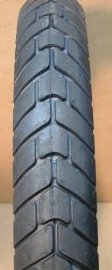
Neither of these Avon tires would be my choice for a bit deeper or rougher off-road dual-sport work. Both the Gripster & Distanzia are primarily paved road tires, with modest to OK off-road capability, the Distanzia having the edge for the street & life, at maybe 1/3rd more cost. The Gripster is a quite decent tire for the person who is primarily a paved-road-rider, yet ventures off the road now & then, who may even be a bit aggressive off-road. The AM24 is a good all-around tire & works well in anything but mud; keep in mind that usually only very aggressive tires work in mud. See the Continental TKC80, below.
S-11 Spitfire:
Tested was the 110/90-18 rear, both 90/90-19 and 100/90-19 fronts. One of my old favorite road tires, all things, including price, considered. They are quite predictable & quite good for the $; but, see the Dunlop D404. I first tried these many years ago on a SWB R75/5, & liked them immediately. Predictable decent handling in all conditions, although like any true road tire, they are not for deeper soft stuff or mud. One of the first dual tread compound construction tires. That is part of how they get the performance & mileage. Note ...it is my belief that these tires age a bit more rapidly than many others. The result is that they tend to get a bit slippery or skittery, more noticeable on wet roads, but only when they get quite old. While this could be said for most all tires, these seemed a bit moreso. I don't recommend these tires if you don't put on some miles every year ...although they are "OK". Not particularly great if you are a truly aggressive rider, especially considering the newer higher performance road tires, such as the new type classic radials, but hard to beat the price and performance. My recommendation includes: "all things considered". That means all things. If you want a bit better handling in the wet, & perhaps a bit less aging, then consider the higher priced BT45. In the last dozen years or so, even better tires have been available, but at some $$$ increase. I used my extensive experience on these S-11 tires as a comparison guide. For mostly dry roads, for distance or local touring/cruising, these tires do fine, although I'd avoid being truly very aggressively pushing them to hard limits in slippery turns.
BT-45:
Another Bridgestone dual-compound tire. Better than the above S-11 in wet conditions, maybe somewhat better in all conditions, but at a large $$ increase for the small improvement you get, so I do not think them worth the substantial extra cost over the S-11. You might. Perform well, under all paved road conditions. A bit better off-road, than the S-11. They do not feel the same as the S-11, probably due to the tread design & possibly an internal carcass difference. Good, over-all. There are better tires today for the aggressive rider.
Accolade:
Part of Bridgestone's new Heritage line of tires. The front is ribbed. I do not have any experience with these tires. Supposedly these can produce a more classic original type early BMW ride.
Cheng Shin:
Chinese-made. This brand used to have a poor reputation for problems; that is now so now. These are now decent tires delivering OK performance, at a low price. The 906 model is similar to the Metzeler Laser ME33. It matches well with the 907. Decent tire in both wet & dry. I have not tested any other Cheng Shin tires.Continental:
TK 16, TK17:
Not recommended. Stiff. For heavily loaded big and heavy cruiser bikes. Just because some might fit Airheads is not a reason to purchase these. Especially n.r. is the 120 size, which is much too wide for any dual-shock Airhead, even with the wider right side rear spacer. Listed here only for those comments.
TKH23 front & TKH24 rear:
Are also called Continental Blitz, are bias ply rayon construction, long life tires, available in 3.25H-19 front & 120/90H-18 rear. I cannot remember if that rear can be fit, it might have the too-wide fit problem as the TK17. But they make this tire in a 4.00-18 rear ...and it does fit. Otherwise, decent tires, reasonably priced, can be run with or without tubes, and are rated tubeless.
TKC70:
More paved-road than off-road. Probably similar to the Metzeler Tourance, over-all. If your riding is more off-road than paved, try the TKC80. I personally have not ridden on the TKC70.
TKC80:
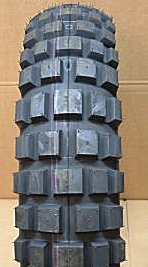
This tire has been around for some time. It is for dual-sport use & good on pavement besides off-road. OK even in rather aggressive riding, although feels a bit squirrely to me, even considering the tread. That is confirmed by others, including the somewhat limited mileage you will get from the TKC80. Read the following which includes the TKC80:
https://www.airheads.org/tech-tips/wheels-tires/r100gs-avon-am24-gripster-tires/
Limited sizes available(?). Grips OK on pavement, on sand & gravel, dirt, even reasonable on mud! A GOOD choice for those going off-road more often ...yet retains good performance on the street, fair to OK when wet, even "OK" on snow. One of my favorite all-around dual-sport tires. It, perhaps surprisingly, corners good. Does not last as long as the Metzeler Tourance nor the Avon Gripster. The TKC80 is not a great mileage tire for mixed use ...but you may like it for heavy adventure bikes, like the BMW GS line. Tossup as to whether you'd like it over the Avon AM24 Gripsters, but I do, but, yes it is a bit more squirrely. The TKC 80 is fairly quiet, inspires confidence in how it feels, perhaps a caveat or two about the squirrely-ness. I think most riders, no matter the model of BMW, will like this tire, even if you are a street rider, but do maybe half your riding truly off-road. If you want all-around performance in a tire that will be 'capable of any surface', even some mud, then this is the one. Original equipment on some BMW models. If you like the TKC80, you might also want to try the TrailAttack. You also may want to look at what I say about the Kenda K784. I have no personal experience on the TrailAttack, & welcome comments. For sure, try the Avon AM24 Gripster, to compare to the Continental TKC 80. You might prefer the Michelin Anakee-Wild tire.
Drawbacks: Expensive. Tread too aggressive for "mostly" street riding. Tread blocks wear weirdly sometimes. See Mitas tires, below.
RB2/K112 (also TK22):
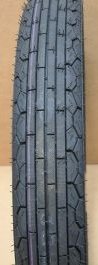
These model numbers were used on the oldest Airheads as original equipment. I have not ridden on any in many years; I always disliked the way they followed rain grooves ...but they do ...or at least did ...offer the classic BMW soft ride. Mileage and handling was good if used with original 'high-speeds, two-up' tire pressure settings. I might try testing some of these new modern versions as I have heard the rubber compound is improved since Continental re-started production some time ago on these, but don't know for sure. Owners of early Airheads that came with the 3.25-19 front & 4.00-18 rear tires as stock sizes, should try a set of these Continental tires if they want close to the classic ride and look. You won't get exactly that classic ride if you have a modified suspension or these tires are not exactly the same. The originals were "OK" but not for true performance riders, especially if you are very aggressive, and considering the newer designs available now. Note: I don't purchase Continental tires myself due to how they treated my shop when Continental had a bad batch of tires, decades ago. But, I do not, in the slightest, want to discourage you from trying these tires, as you may love them. If you intend to ride on classic tires, I also suggest the Metzeler tires like the ME11, etc. Accolade tires?? BMW installed Metzelers in the old models/sizes, besides Continental's. I do not know about specific changes between the original tires and these various classic tires.
This is the Continental RB2:
Classic Attack Radial (Conti Attack Classic Radial):
This is a newer design from Continental. Continental says that they specifically designed this tire, a 0° radial, front and rear, to give a fast break-in, and then to enhance & sharpen the handling of older classic bikes which were originally designed for bias-ply tires. They advertise that they improve handling to the "level of a modern radial tire bike" (not so, but there is certainly an improvement in handling being reported). From a look at the tread pattern, I thought the tires might not track rain grooves, & should feel fine; but have had one report that the tires do track rain grooves, and weave from it. I'm taking that report as possibly not the whole truth, and that perhaps the rain grooves were irregular/wavy...no info. The tire is supposedly fairly high mileage with excellent grip and good for all-weather. The tire is available in various metric sizes to fit Airheads. NOTE the load rating on these tires, compare to your previous and other tires. They are tubeless construction. If used with tubes, you should reduce the speed rating by one step. That's OK for Airheads, who usually hardly need more than an H rating, let alone an S or V. Some riders who have tried these love them. No personal testing yet. Tom Cutter reported that these type tires were easy to R/R, provided a comfortable ride, were stable, and had a nice feeling. They are somewhat expensive. I am looking forward to comparing these tires to the Michelin Pilot Activ & the Avon RoadRider.
I have had, since I initially wrote the above paragraph (it's been edited three times), numerous reports on these tires, as mounted to older Airheads. Some reports, not all, indicate that even higher than most modern tire pressures, are needed. That is, peak performance is being seen with front pressures of 38 psi, and reports of 42 psi rear are common; and front pressures of under 36 are leading to handling problems. The tires are reportedly sensitive to steering head preload. They reportedly do track rain grooves disturbingly. From the various reports, only a bit over half a dozen at this time, I am not yet recommending these tires, but I am not recommending against them either. Right now, I am recommending 36 to as high as 38 (depending on load and speed) for the FRONT.
Classic Attack2 Radial:
Nothing to say about testing, so far. These are for adventure touring and dual-sport riding per Continental, yet the tread pattern looks like road use. 0° steel belted radial, Continental describes the tires as good for high speeds and high loads, and the ratings are 57H for the 100/90 in 19". Tubeless rated. There is a 90/90/21 available (rated at 54V though). There are quite a few 17" tires available. At the time I wrote this, I did not see an appropriate 18" tire for front or rear use on Airheads.
Dunlop:
Vintage K70 front, 3.25H-19; K70 rear, 4.00H18:Somewhat similar in some respects, the Dunlop F11 front 100/90H-19; use it with a K627 rear 110-90H-18. Reasonably OK, obsolete now.
K491-Elite II:TrailMax Dual-Sport:
I can't recommend these; I think they were relatively lousy off-road.
Heidenau:
K60 Scout:
These are dual-sport tires, and they do a pretty nice job at it, and last for quite awhile too. I LIKE THEM. In fact, I tend to like Heidenau tires as they all seem to be quality, with good engineering & performance. I don't think they were all that well-known in the USA, up until a few years ago anyway.
Nearly as aggressive as the Continental TKC80, but cost considerably less. You may really like them, over-all. Limited experience. The Heindenau off-road and mixed-use tires seem to be longer lasting, harder material, but not as good, in my limited testing, as the TKC80, and probably not at all compared to the new Michelin Anakee-Wild. I'd be OK taking a K60 for a fairly long road trip too. Available in a lot of sizes, that fit Airheads.
K44:
Kenda:
K784 Big Block:
So-so on pavement, pretty good off-road, even good in mud. Wears relatively fast ...to be expected for good off-road and even usable in mud type tire. NO personal experience.
Maxxis:
C6011:
Good, but not sure if it is available in the 18 inch now. See Cheng Shin comments. I have not kept up with Maxxis tires.
Metzeler:
See Continental, RB2/K112, for additional comments regarding the Metzeler ME11, and Heritage tires. Metzeler has moved some of its existing tires & some new versions of old types, into a new category, called the Heritage series. While this includes the Lasertec, it also includes some classic Metzeler tires, mostly updated with newer compounds and manufacturing. This should bring better handling & longer life, but I have no testing experience on them. The tires will mostly have the original tread profiles & appearance. These tires are the Perfect ME11 front; Perfect ME77; Block C, and perhaps Metzeler will add more to the list.
ME33 Laser:
Both standard & the low profile metric. I recommend the 3.25 for the front of your old Airhead. A 3.50 is available. If you have gone to an oversize rear, use the oversize front. This tire will seem to follow some types of rain grooves, but not as badly as a ribbed front tire. You can use this front tire with many other rear types. Decent in the rain, good dry grip (likely way beyond our bike's capabilities). For mileage, you can expect decent, if not
outstanding numbers. Some tendency, sometimes, to cupping. The ME33 tread design was unique when introduced & has been copied by others. It has a lighter faster turning 'feel'. There was a K compound version that was for racing. Both NLA, I think. This tire tended to scallop if shocks are poor, but still handled OK.
Lasertec:
I did not like this tire. Not for the less-aggressive rider and is twitchy, giving an unstable feeling. Aggressive riders might want to try it. This tire does not feel like the ME33 Laser to me. The tires have been reported as inconsistent in manufacture. That may be so. They tended to follow rain grooves ...likely due to its single circumference groove or multiple wiggle type grooves in the center of the tire. If you don't have, or mind grooved highways, or don't mind the not awful instability, then you might like this tire. I was surprised by the twitchiness, & while different, I compared its twitchy feeling to the Avon RoadRider. The twitchiness may be partly a "less-rubber-on-the-road" feeling. I did not do tire pressure testing. Note that many modern tires have some light handling qualities, which I call twitchiness. It does stick "OK", corners nicely; gives "some" confidence in tight twisties. This tire should match up with many of Metzeler's other tires. I just did not like the tire much.
ME55:
An old favorite for some. I never liked this tire, although it gave a reasonable compromise on handling & mileage. I preferred the ME88 for the rear.
ME88:
Front & rear versions. A mileage tire, reasonably good handling; one of my old favorites for use front & rear for touring. This tire also worked well as a rear with ME 33 Laser front, for more aggressive paved road riding. I have tested only those made in Germany. AFAIK, discontinued ...unfortunately.
ME880:
No personal tests yet; no trustworthy reports yet either.
Tourance:
OK on the street, "fair" on gravel and hard-pack dirt. The Michelin Anakee is probably better all-around, by a bit, wet and dry, for dual-sport. The Continental TKC70 is roughly the same, performance-wise, as the Tourance. Tourances are not good in any sort of mud.
Enduro tires:
Metzeler has a selection of these tube type tires to fit older Airheads. The Enduro 3 (Sahara or Sahara 3) is a good one for mixed on-off road. It is pricey. Watch the width ...Enduro tires may be vastly wider than their sidewall-printed size might lead you to believe; thus may not fit on twin-shock models, due to swing arm clearance problems. I used the Sahara 3 for my rear tire on the sidecar rig in the Winter; mainly because I got several cheaply. Nearly every motorcycle tire manufacturer has its own enduro tires, usually having a brand name. In Metzeler's case, some are named dually.
MCE Karoo:
These are good GS type tires for off-road, fairly decent on pavement. I suggest you don't mix other types on the same bike. For pavement use, especially if the weather is cold, let them warm up before getting aggressive with them. Many equate these tires with the Continental TKC80, I think them only somewhat similar. There is now a Karoo 3 ...no information nor testing by me.
Sportec Klassic:
These are belted tires, designed by Metzeler to work well and sharpen the handling and increase the comfort and improve wet handling too, yet still deliver higher mileage; compared to the old classic/vintage tires your older Airhead came with. Inch sizes are available in the original 3.25 x 19 front and 4.00 x 18 rear, in V speed rating only (I would prefer the H rating of some of the metric offerings, as they might give even longer life if they had the deeper tread typical of an H, but N.A.). One report, skimpy so far, says the rear will last 9000 miles, the front probably will go twice that, and he uses F33 and R40, and the report is for mostly 2 lane chip-sealed asphalt roads, with a few hundred miles of gravel roads too. The reported mileage is good for chip-sealed roads. The price on these tires seems good to me.
Michelin:
All of Michelin's tires seem well-made, well-balanced, of high quality.Macadam 50 & 50e:
100/90-19 & 3.25-19 front; 110/90-18; 4.00-18; 120/90-18. Some really liked these. I don't have enough miles on them to say much.
I initially had a miserable time trying to mount the Pilot Activ 4.00H18 to my 1984 R100RT rear snowflake wheel. One side went to the rim bead area OK, the other side was very difficult to install properly. I am not the only person to have had this problem. Because of this, I experimented with installing the Activ's, which ended up by me modifying my air equipment once again. After the modifications, the tires would install OK, without excessive pressure being required (I deem excessive pressures dangerous). I found it critical for the rim/bead area to be exceptionally clean & smooth, I even polished it with various grades of sandpaper. As always, I continued to use lots of real tire lube. I added my new inflating information to my tire repair article, which consisted primarily of an opening-up of the chuck, removing the valve in the tube, etc., to increase flow rate, etc. See: https://bmwmotorcycletech.info/TireRepair.htm. This tire is very stiff in the sidewalls, even the tread. Do not be discouraged by these remarks, as I think you will really like this tire. Note that it remains to be seen what the situation will be if you should have to repair a puncture when using an innertube. NOTE: These tires are often difficult to mount onto BMW Snowflake rims. Consider that, when using tubes with these tires, and having to deal with them when not near a motorcycle repair place.
Note: This tire has a very well-made bead edge, which should offer better sealing on a tubeless rim than many others ...but a tubeless rim & a tube type rim do not have the same shape for the bead area ...the angle can be 9° different in some cases (and I am not mentioning the safety bead or other added area in a tubeless rim). For those who use a tube type rim as tubeless, I think this tire will do better than many others in the instance of either fast or slow air leak. This is speculation on my part. Such usage is not recommended by many. There is an article on this website about such usage, all pros and cons are considered, and many photos included. https://bmwmotorcycletech.info/section6.htm
Standard Michelin Butyl innertubes for my personal testing, except for the last two.
Road Classics:
I did not like these tires in harder turns. Seemed to have somewhat of a mind of their own.
Anakee 3:
The Anakee 3 is different from the Anakee 2. The 3 is for mixed on and off road, seems pretty good all-around until you get into mud, where it's poor. Emphasis is on pavement riding. Expensive. May be difficult to mount? Competition for these tires are the Continental Trail Attack, the Avon Distanzia, and Metzeler Tourance. In general, the Anakee line of tires is competent. Some think these are the best on/off road tires available ...with good mileage too. But, they make noise. The rear tire on these seems unique in tread design, and seems to work well.
Anakee Wild. Available in sizes to fit Airheads, front and rear, in 18, 19, and 21 inch, and good profile width, etc., these tires are mostly for off-road, but handle OK on paved too, and seem to last a fairly long time.
T-63:
Seldom hear anything about this tire, which I think is too bad; and, more should try these. For more aggressive off-road riders, handle decently on dry pavement (not too bad on wet roads either); probably one of the best buys for mixed use (dual-sport, with a fair amount of emphasis towards off-road). The T63 is a good tire. A trusted friend told me about this tire, & how he, on a bike loaded with luggage & his girlfriend on the rear of the seat, practically melted the tire from very high speeds, in Arizona, in exceptionally hot weather on a very hot black asphalt road. I went out of my way to test this tire on someone's bike. It is less expensive than much of its competition. This tire has an aggressive enduro tread, so unless you do some off-roading, don't get it. This is not the tire for quite heavy loads at quite high speeds, coupled with very hot asphalt. In fact, I can't recommend any Enduro or knobby tire for that. I have ridden 78 miles on an Airhead equipped with these. My opinion matches someone else's, who rides aggressively. While the tread does look quite aggressive, the tire is somewhat milder than it looks. I do not know about expected mileage life, but I think the tire worth its modest cost.
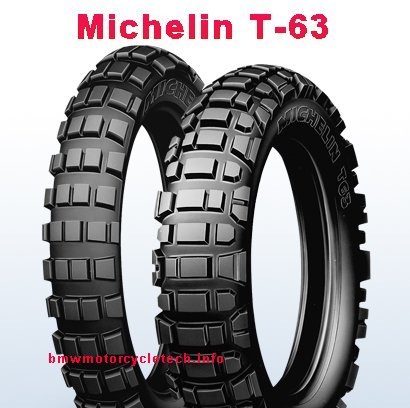
I am impressed with the Michelin brand of tires. (even for my SUV!)
Mitas:
Interesting model E07 (rated 50-50) tires. Reportedly very long lasting, but not all that many sizes fit Airheads. Mitas has a version of that tire called the Dakar, which holds up to even heavier loads and high mileage for such a tire. You can use the Dakar version on the rear, and front, or non-Dakar version on the front. Only have hearsay information so far, but reports are excellent for high mileage, yet good in softer conditions and also hard-pack, as well as on paved roads. I have no further information, but these tires may well be ones to try over the TKC80.
Pirelli:
Scorpion:
Not recommended for GS. I have no testing miles on them. Some reports say they exhibit wobbling if mixed with other tires, but I have no definitive information.
Shinko:
No personal aggressive testing yet. One report, from someone whose riding skills are good & can ride hard enough to test tires reasonably well, likes these, & he compares them to vastly more expensive tires.
Numbered items:
1A. Tires sizes:
On metric tires the first number is the width in mm on a "nominal" width rim, the second number is the aspect ratio of the sidewall to tire height. Metric sizes and inch sizes are not exact equivalents. Usually a 3.25" size as originally specified can be substituted by a 90 metric (often coded as MJ); a 3.50" by a 100 metric (MM); a 3.75 or 4.00 by a 110 metric (MN or MP); and a 4.25 or 4.50 by a 120 (or MR).
There will be handling differences if you do not use the originally specified size of tires. Those that have heavy loads may want one size oversize tires. It may behoove you to look into the load carrying capability of your proposed new tires ...usually molded/printed on the sidewall. Sometimes a larger tire is rated for a lower load. Using a stock rear tire, let us say 4.00-18, with a substantially oversize front tire, is not the best combination, as the bike will probably have a tendency to fall into turns a bit; but I have not found that excessive if not going too big. One of the problems is not just that the oversize tire is wider, measured sidewall to sidewall ....but, that the profile of the round tread area is different, and handling is affected.
I have very limited information on using 80 profile tires on Airheads. Some seem very usable on Monolever or Paralever bikes. Aspect ratios of 80% will not always work on early twin-shock Airheads. It is often a matter of the sidewall width, not just other fitment problems. The fitting problem is almost always only with the twin rear shock models, due to swing arm clearance, and also sometimes with disc brake stay arm interference (RS, RT, some S). Brake stay interference also happens with twin shock Airheads. Both swing arm clearance and brake stay clearance problems are usually easy to deal with.
Most early Airheads came with inch size tires; 3.25 x 19 inch front tire and 4.00 x 18 inch rear tire. For some time, few different brands and models of tires were made in those sizes, but availability has now very considerably improved. In general, these old sizes were 90 profile. The old Airheads (except G/S) did not come with enduro tires, and I mention this because most enduro tires in 4.00 x 18 will be vastly wider than a 4.00 x 18 paved road type of tire. An enduro tire may well not fit on twin shock Airheads, there not being enough room between tire and driveshaft housing. This is particularly so on those before 1981. These can have a wider right side of rear wheel spacer installed, and BMW even sells such, but that may not help enough. Very early Airheads could even have fitment problems with 110 size in the rear. Some 120 will fit the later years rear. Sometimes (pre-1981 for instance) one has to get the wider 10.7 mm spacer for the right side of the rear hub ...BMW part number 36-31-2-301-737. That spacer change has been needed sometimes for 110, but not often; more often for 120 (even for early eighties twin shock models). Stock was 9.2 mm, 36-31-4-038-142. The spacers are very easy to install, and do not affect bearing preload. A few 120 rear tires fit rather tightly on drum brake models; that is, the wheel with tire mounted to it is a bit difficult to install, and deflating it is needed. BMW uses 'top hat spacers', or call them brimmed spacers, at various places in the bikes. You will find them at the swing arm sides, and the wheels. One top hat spacer, 36-31-230-322, 12.9 mm wide, 32 mm hat, has been sometimes used to space the rear wheel to the left even more than the 10.7 mm one that BMW sells specifically for that purpose. The 12.9 mm wide spacer has a hat of nearly 32 mm diameter. I would not try to move the wheel too far to the left to accommodate a wide rear tire ...this is especially so on the earliest Airheads (/5 era) where the splines are narrower.
1B. Spacers, tire sizes, and also rear spoked wheel changes:
For the front tire, which came as a 3.25 x 19 (and in some cases, like the R65, 18"), you can use a 90/90 metric tire and also usually go to 3.50 x 19 or metric 100/90, but you might have to use a later seventies fender mount. More much later in this article on that. A 90/90 or even 100/90 on the front, and a 110/90 on the rear is very common and usually works well on Airheads, keeping good handling.
The part number used by BMW for some of the top hat spacers at the swing arm bearings is different than the almost exactly the same 9.2 mm part used at the wheel bearings. They are interchangeably usable!
BMW modified the rear wire-spoked wheels for extra clearance, and this was done in the /5 days, as well as the ST and G/S days, and it was done by offsetting the spokes-to-hub; details elsewhere's on this site. While many think that the ST and G/S 3 mm offset change came when the rear wheel went to a 2.50 from a 1.85 size, this is not so, it was later on ...after that change.
2. The rear fender can be modified, hardly shows, making tire changes easier. htttp://bmwmotorcycletech.info/RearFenderMod.jpg for a photo.
3. The BMW tube-type snowflake wheels use "WM2" rim shape. An article of mine treats the use of tubeless tires without tubes. https://bmwmotorcycletech.info/section6.htm. It is almost always OK to install a tube into a tubeless tire onto a tubeless wheel ...but mentally reduce the speed rating by one actual speed level grade, due to heat buildup with tube use. The H rating is an anomaly, so don't just reduce by one letter. See 16, 17A, 17B.
4. Try not to purchase tires more than three years old. Date codes are on the sidewall, showing week of the year & the year.
5. The inflation pressure shown on the tire sidewall is for normal use as a maximum riding pressure. It is not the recommended riding pressure, nor is it the inflation needed to seat a bead, which is quite often higher, just how much higher is subject to safety concerns. For installing tires I don't go over 60 psi & and I use lots of real tire lube. Generally the manufacturers will allow up to 50% over the sidewall printed pressure for mounting. Be cautious because if a rim explodes you can be very seriously injured. The secrets to seating a tire bead properly are to have the rim edge and bead area clean and very smooth, use lots of real tire lubricant, and have the tire and wheel (and tube if used ) truly hot from being in the sun. Remove the valve core, and also remove the tip in the air compressor's hose chuck. Use 125(+) psi in a minimum 3 gallon tank on the compressore, and use large inner bore size fittings & hose. Be ready to quickly open any valve (also large bore) in the compressor-to-tire circuit. All this is doen so the inrush of air is fast. The speed of the air inflation is a big secret! Even so, an occasional tire will prove to be difficult.
6. New tires can be very slippery! Allow 20-50 miles to scrub them off. Before riding on them I first thoroughly brush the tires with a fairly strong detergent and hot water mixture and then flush. I use a stiff bristled old-fashioned floor scrubbing brush.
7. Continuous speed rating is marked on the tire, usually as part of the number/letters of the tire size. Tires with deeper tread from the same manufacturer and same model of tire may wear longer, sometimes they do not. Deeper tread tires are generally rated lower in speed, and usually are the better buy for touring. If you do not ride at warp speeds, an H rated tire may be a much better buy than a V rated, as an example. May is the operative word here. Sometimes the only difference is tread depth ....the higher speed-rated tire having a less deep tread. This is not universally so. A higher rated tire is not necessarily a better tire ...for you!
Below is a chart of what the letters mean. Remember, if you install a tube in a tire marked tubeless, reduce a true grade. That is easy to see on the chart (except for the H rated tire which should be considered to be in-between U and V, and one step in practicality is a drop to S or T ratings). Motorcycle tires have had for some time a load index coding, something like 81H or 57H, etc. Motorcycle tires may all eventually get the standard car tire coding of alphabet letters for wear and heat. If you pack heavily, perhaps you weigh a lot, and you have a passenger ...pay attention to the manufacturer's published information on loading allowed. Load carrying ratings for the tire are not the same as the motorcycle manufacturer's motorcycle load carrying rating. Consider both.
TL means tubeless. It does not mean you must run it tubeless. - means bias ply. R means radial; B means bias belted. A few tires marked tubeless should not be used with tubes. Ask, and look at the sidewall printing too.
| LETTER | Km/hr | Mph |
| B | 50 | 31 |
| C | 60 | 37 |
| D | 65 | 40 |
| E | 70 | 44 |
| F | 80 | 50 |
| G | 90 | 56 |
| H | 210 | 130 |
| J | 100 | 62 |
| K | 110 | 68 |
| L | 120 | 75 |
| M | 130 | 81 |
| N | 140 | 87 |
| P | 150 | 93 |
| Q | 160 | 100 |
| R | 170 | 106 |
| S | 180 | 112 |
| T | 190 | 118 |
| U | 200 | 124 |
| V | 240+ | 149 |
| W | 270 | 168 |
| Y | 300 | 186 |
|
Z & ZR group |
over 149 | |
|
Some V, VR, may be rated over 149 Mph. (W) is rated over 168 mph. |
8. Tire direction:
Sometimes motorcycle riders or sidecarists will use a tire designed for rear use, on the front. Some tires are bi-directional, & have markings for both directions, depending on if used for front or rear.
9. Warnings and information for sidecarists and motorcyclists about 15 and 16 inch tires and rims:
a. 16 inch rims can be used for passenger car tires or motorcycle tires if rim width and area to the safety bead, if any, is proper, or at least reasonable.
b. Do not, generally, use or try to install, a 15 inch m/c tire on a 15 inch car rim, nor 15 inch car tire on a 15 inch motorcycle rated rim. You may be able to use a 15" car tire if the motorcycle rim is safely skimmed on a lathe or the car tire is a quite small one. Please heed these warnings.....
15 inch car tires and 15 inch motorcycle rims are not the same diameter! 16 and 17 inch seem OK. If you insist on putting a 15" car tire onto a 15" motorcycle wheel, the smallest tires may work OK, the larger ones are definitely dangerous. You could have a catastrophic failure! Some sidecar manufacturer's use 15" car type rims. Note that tire rim bead area is wider, from inside rim edge to the safety bead (if any), for car wheels. This can create safety problems......
If you are using any combination of car rim with motorcycle tire, or motorcycle tire with car rim, there are some nerdy details you need to know; this link is a long read, but has some pearls of wisdom regarding use of those combinations:
https://www.goldwingfacts.com/threads/design-differences-between-car-and-motorcycle-rim-tire.400426/
10. There are reasons to not screw the tube type valve stem nut down to the outside of the rim. Doing so gives no allowance for tube movement if you have a puncture or other leak & if the tire rotates on the rim some. Conversely, if the tube seals to the rim too well, it can trap air from tube to rim, allowing tube chafing. Purpose of the tube nut is to help during installation of the tube; it can be discarded, or run up to the cap, after the mounting is done. These are not just my ideas! I can quote from tire manufacturer's manuals. BMW has bulletins on these valve nuts, & one SI gave an additional reason to have it up against the cap, that was that improper inflation could cause the tube to be weakened at the valve stem & if the nut was at the rim & not at the the cap, the stem could suddenly disastrously tear out. What BMW did not say, was that this comes from very low inflation and over-inflation during seating of the tire. My tire repair article https://bmwmotorcycletech.info/TireRepair.htm has a lot more information on using the nuts, concave washers, valve insertion tools, etc.
11. Inflation is usually in psi (pounds per square inch), but some tires and/or literature list pressures in Bars. Bar means Barometric pressure, one Bar is one atmospheric pressure, ~ 15 psi. Manufacturer's such as Metzeler used to have in their technical engineering books, information, that during mounting, the maximum inflation pressure (do use plenty of tire lube!!) was 150% of the tire sidewall printed value. Manufacturer's are getting increasingly lawsuit conscious for products sold in the USA ...and many now say not to exceed the sidewall printed value, or 20% or some such. Because 150% can be interpreted by some idiots to be 150% on top of the original pressure, some manufacturer's changed wording to say 50% increase over maximum sidewall-printed pressure. You are on your own. I do not go over 50 psi unless I am forced to, and it is very rare indeed that I go to 60 psi on a motorcycle type tire. This is not an OK nor a recommendation for you to do that! An exploding rim can kill you. However, I believe 50% over the maximum pressure as molded into the sidewall of the tire is a safe limit, assuming a good rim. Seating of modern stiff-sidewall-bead-area tires onto the rim is usually the problem seen. Prepare the rim by cleaning the rim, and if it is not very smooth, on the outer edge, and the side area, sandpaper it smooth. Be sure to use lots of real tire lube on the bead area of the rim and the tire bead area. Have the tube and tire hot from being in sunlight for a considerable time, almost too hot to touch with bare hands is nice. Mind the previous hints about using a modified chuck, no Schrader valve in the valve stem, & lots of lubricant, large bore hose, etc...these things really do help. Read: https://bmwmotorcycletech.info/TireRepair.htm ....completely.
An old "Rule of Thumb" says that after a considerable number of miles, the cold temperature pressure in a tire should have risen ~6 or even 10% higher when the tire is hot. That is generally true, but not all types of tires seem to conform, particularly some belted & radial types. Still, it can be a useful idea. Where this idea came from is actually the manufacturers of tires. If the pressure is too low, the tire will flex more, creating more heat; if pressure is too high, the tire will not heat enough. Proper tire temperature enables the tire to work as designed. Tires require the correct pressure for handling & life, etc. Sometimes someone will ask me about the actual tire temperature. Road tires are designed to run at ~130°C at the contact point. That is very hot. That was not a typo, it is degrees Centigrade. That contact point cools off very rapidly when you come to a stop, so you can pretty much forget about trying to measure it; particularly with those non-contact meters that many seem to own. They do not respond well/accurately to black tires, and measuring at the contact point is extremely difficult. A real nerd would get the temperature specification from the manufacturer, and affix a special temperature meter to the bike, and very likely still not get accurate measurements. One could, if super-nerdy, put a sensor into the tread, with a teensy little transmitter.
Many (but not all) tire manufacturer's used to publish the real tire pressure to use or try with their tires. Later, lawyers probably got involved. Most literature now just shows the motorcycle manufacturer's recommendation ...which may be too low for old Airheads with modern tires. Generally BMW owner's booklet recommendations are somewhat more correct on the single sided rear end Airheads known as Monoshock and Paralever models, with some caution for the ST and G/S. Generally the pressures shown are closer to being correct for any BMW motorcycle from after the late 1980's, but not always. BMW has recommended tire pressures on a label someplace under the seat or on the rear fender top, & in the owner's manual. Some later BMW literature upped some of the old pressures to Solo 32-34 psi, both front & rear. Those pressures are still unlikely to be correct for your riding, tires, & conditions. I have found almost no tires that should have 32 psi in the rear! Modern tires must have higher pressures, and generally this means 33-36 front; 38-42 rear.
12. Airheads came with a number of different rim widths and two general rim shapes, & one special shape. BMW used the WM2 rim up until they installed tubeless tires. Many arguments abound about using combinations of various rims and tube type and tubeless type tires. The WM2 rim does not have the 5 degree increased angle of the flat area inside and the side area ...all of which the tire bead rest against. You are on your own if you fit without a tube in a snowflake wheel designed for tubes. Rim width and tire size fitted must be within a range of values in order to fit into the fender/brace/etc; and swing arm on the twin shock models. If a tire is considerably too wide for the rim, the tire will tend to roll sideways on the rim itself in turns, making for poor handling. Every tire manufacturer has a recommended range of rim sizes for each model and size of tire. Those recommendations are correct.
Early /5 rims were 1.85" width on front & rear. Later /5 bikes had 2.15" width rear rims. The 1.85" width front rim continued up to 1984 on most models. The R80G/S had a narrow 1.85" front rim, and early ones the 2.15" rear, then came a 2.50" rear. Some of the bikes came with a 2.75" rear rim ...this was on the 1978-84 RS, R100S; and 79-84 RT with disc brake rears; the drum brake rear bikes in these groups were generally 2.50". With the Monolever and Paralever bikes, things changed with the rims again, with a new rim design for tubeless tires without tubes, etc. For an extensive article on using various rims as tubeless, etc.: https://bmwmotorcycletech.info/section6.htm
13. Some have a hard time getting a pressure gauge onto the valve stems used on the snowflake rims. There is a 90 degree stem adapter available from BMW, but I don't recommend its permanent use though. I don't use them at any time, my air chucks all are angled. I think the 90° adapters add to valve stem deterioration from extra vibration due to the added weight, and are possibly 'catchable' by 'things'.
FYI, the number is 71-11-1-239-258. Any of the stock type, 45° or 90° pressure gauges are OK ....consider checking their calibration once in awhile.For other purposes than difficulty using a gauge, BMW has a steel, chromed, straight valve stem, for use with tubeless (and for snowflake conversions, but this is not officially approved), it is about $4 from BMW ...and is available elsewhere's cheaper. You cannot get a good seal with the stem, unless the inside of the rim has a relatively flat milled place for that valve stem. The BMW number is 36-32-1-452-748 ...and this part is vastly nicer than a typical small car or yard vehicle rubber stems.
14. Most flats/punctures are on rear tires. Some, if not many can be avoided ...by simply putting a wide and fairly tall mudflap onto the front fender, the closer to the ground the better. Nice looking ones are available. You may have to drill some holes, use screws, washers, nuts. What this flap helps to do (theory anyway) is to deflect road garbage that would otherwise being thrown backwards, perhaps standing the debris upright ...and into the path of the rear tire. Hence, the type that hangs down the furthest is desirable. The truth is a mixture of that, and the fact that the rear tire provides the tread-distortion of acceleration and engine braking and thus has much higher contact forces with anything laying on the road.
15. Tire markings:
Tire sidewalls have a lot of information. One area shows the manufacturing date. On earlier tires, prior to year 2000, there were three digits... first two digits meaning the week of the year, and a third digit for the year. In the 1990's, there was a small triangle to identify that it was made in the 1990's. Sometime during the 2000 year all manufacturer's changed to the 4 digit system, the first two digits being the week of the year, and the last two digits being the year. If the tire code was 0455 or 455, you know the tire was manufactured in the 45th week of a year ending in 5 (but it had to be 1995, if the triangle preceded). The reason only three digits was originally used was that the bureaucrats thought that tires would not likely be in service for over 10 years.
There is additional coding. There will be something like this: DOT ENYO VLK 1704. What you may be interested in is the two letters after DOT, in this example, EN. These can be looked up at http://www.harriger.com to find out what factory (China?) they were made in. I have purposely not listed the exact URL for the specific page in that website, as internal links do not properly relate to outside full URL's.
There is a longer DOT code in use now. The DOT coding begins by some letters and numbers. The first two letters identify the factory. The list is at: www.harriger.com/tires.htm. The last 4 digits are the week and year, as before. Note that while DOT regulations mandate information on both sides of the sidewalls, you may have to look in two places and on both sides for the entire identification numbers & letters. The original reason this was done was, supposedly, to reduce problems with the manufacturing and mould interference.
16. Nitrogen:
There is bad information, or just plain hype, on the use of nitrogen in any type of tire for road & off-road use. The facts are, that while there are benefits, use of nitrogen to fill tires is usually not practical for anything but racing, as far as motorcycles are concerned.
On the plus side, molecules of nitrogen are said to be larger than average air molecules. These larger molecules do not pass through the rubber used in tires and tubes quite as easily as common air molecules (which are 78% nitrogen). Thus, pressure loss over time can be lower, this is particularly so with higher percentage natural rubber tubes, as opposed to the lower percentage natural rubber, often just called plastic tubes. On a practical basis, the slower loss is not a big difference. One factor not discussed is the over-all 'thickness' of air, not just oxygen as often spoken about with regards to nitrogen use. Average atmospheric air is 78% nitrogen, 21% oxygen, then comes water molecules, carbon dioxide (CO2), and rare gases. Thus, the oxygen often talked about is actually only about a fourth of what the nitrogen is ...so the oxygen has even less effect than nerdy so-called scientific papers you may find on the internet, regarding tire pressure loss over time, etc. Another factor is that nitrogen is sold in pressurized metal containers, similar to welding containers, and the nitrogen can be relatively dry and pure ...or, rather not-so. If using nitrogen to fill tires from empty (just residual air), the highest percentage of dry nitrogen would obviously be best. CostCo, which does not sell motorcycle tires, does use premium nitrogen.
Another plus factor for nitrogen is that it is less prone to accumulate water vapor and is usually very dry when installed into the tire, not so the 'outside air' from your average compressor setup, nor a gas station. Water vapor in common compressed air can lead to rather wild fluctuations in pressure as the tire heats up & cools down. Obviously, this is minimized by using clean, dry, air.
Nitrogen, due to its lack of extra affinity for water vapor, delivers a safer, more stable tire pressure, which can be somewhat important for very high speed driving (more so at racing speeds). The final good point about nitrogen is that it does not contain oxygen, which tends to degrade rubber compounds over long periods of time.The problems with nitrogen are cost, not easily available, and if you top off the tire with too much compressed air, especially if the air is not dry, some advantages of the nitrogen are lost. This is less so if the nitrogen that was used is a very high percentage type, and you add little air. Nitrogen's good effects work with tubeless & tubes. If you are interested in a nerdy technical scientific answer to nitrogen versus oxygen in tires and tubes:
http://www.getnitrogen.org/pdf/graham.pdf
When you have assimilated that, above, how about a more practical approach? ...easy to read, and basically correct, and fills in some things you did not get from the above link: http://www.pedrosgarage.com/Site_5/Nitrogen_or_Air.html
Neither of those two articles covers what I have, in the above paragraphs. Neither tells the full story, and I have.
17A. There are instances where someone uses a tube-rated tire without a tube. In some instances this is done with various motorcycle tires, but also done with two specialized sidecar type tires. There are only two types of these square-profile sidecar tires available, as far as I know. One in 18" & one in 19". The 19" is from Avon & is called the Triple Duty; the 18" is from Metzeler & is called the Block K. I have tried nitrogen in these tires, & it appears that tire pressure loss really is slower. Since the pressure loss from these particular two tires can be more rapid than with these tires when using tubes, this is something to consider.
17B. Another usage is a tubeless tire used on tube-rated rims. That brings up a whole story in itself & has its own article on this website: https://bmwmotorcycletech.info/section6.htm. I have done preliminary testing; leakage does seem less with nitrogen. The bottom line is that few of you are going to buy or lease nitrogen tanks for use at home ...but some bike dealerships may be using nitrogen. I do not know if CostCo, or anyone else, has nitrogen available for motorcyclists ...maybe some BMW places do?
18. Tire wear:
The reasons for various strange tire wear & why one side of a front motorcycle tire wears so much faster than the other side ...& why downshifting for braking lowers tire mileage, as opposed to just using the brakes; & a lot more, is in the following article, which is so good that I never wrote such a complete article myself: http://www.rattlebars.com/tirewear/index.html. The only thing not well-explained, is why people with identical makes, models, & year of motorcycles; and, same for the tires, & identical pressure in those tires; and, the same riding habits, loading, & styles, will, or can, have such different tire wear. I'm not going to get into that, HERE, preferring to have some fun around the campfire some time. You can start the conversation by using the words "Chip sealing".
19. Hydroplaning:
There are several types. All are scary if they happen to you. The two types of hydroplaning you are most likely to be concerned about are Dynamic Hydroplaning; and Viscous Hydroplaning. Both occur on wet roads, although the viscous type might be said to also occur on ice.
Dynamic Hydroplaning occurs when the water in front of the tire can not be moved away from the contact surface fast enough. The actual science deals with the water 'being rolled up'. That water pressure is opposing the pressure the tire places on the wet surface (the weight of the motorcycle normally on that tire contact with the surface). Various things have an effect on just when hydroplaning will occur. Softness & other factors of the rubber compound; road surface; tire profile; type of rubber; tread depth. All those things would seem to be 'common sense'; and, yes, they are; but not to the degree you may think. NASA did a lot of testing; their testing has since been re-proven by motorcycle & car tire manufacturers, & the results are that a major variable in dynamic hydroplaning is from the pressure in the tire. Surprised? The depth of the road surface water need not be very much at all. If you are going too fast, you can and will risk hydroplaning ...and complete loss of control.
Hydroplaning certainly can occur with quite deep tire treads ...at a speed, in miles per hour, as low as 9.9 times the square root of the pressure in psi. The factor for nautical miles per hour is 8.6 times the square root of the pressure in psi. This is usually what is seen in various publications, usually not mentioning that it is nautical, nor that this is "static speed" ...and with no explanation). If you are moving, the speed at which hydroplaning starts is lower! These points are almost never in any articles about hydroplaning; nor, is it explained.
Welcome to Snowbum's anality, verboseness ....and propensity for providing too many facts (or, too much information?)!:
Once hydroplaning starts, it can, and usually does, remain for much lower speeds. You are in danger of suddenly loosing control, from just hydroplaning on a wet road, even with really good & deep tire treads on good quality tires, at fairly low speeds. If standing water is fairly thick, these speeds are much reduced, although some say there is no difference ...the reason is that they are talking about car tires, or reciting from literature meaning car tires. In any case, note that the speed at which hydroplaning occurs will rise ...a good thing ...as pressures rise. This is exactly backwards to what most riders believe. They think that higher pressures mean less rubber on the road, more twitchy handling, etc. They think that in rain, they should lower the pressures. In one way, they are correct! ...the bike will feel less jittery, more planted with lower pressures. Since the front tire is usually the critical tire, & almost always has the lowest pressure, beware of excessive speed in the wet! ...you may lose control without using the brakes & much more likely to lose control if using the brakes, even gently. Using brakes uses up traction. Keep in mind that hydroplaning is just one factor; you can easily loose control due to insufficient tread depth, oil on the road or floating on the water, irregularities in the road, wind from the side; a host of other factors. What all means is that you can loose control at a very much lower speed than that for just the published hydroplaning speeds.
Viscous hydroplaning is the type, at least on your motorcycle, that you might encounter if the road was rather smooth & the tire getting rather bald; that is, not much tread is left. This can occur at very low speeds and very low amounts of water on the road. Less tread depth, more propensity to hydroplane.
If you are hydroplaning ...or beginning to hydroplane, ...it will be like riding on ice. It is my opinion that on modern motorcycle tires if your tread depth is at least 3 or 4 mm, then the main influence on the speed at which hydroplaning will occur, is the tire pressure and the thickness of the water on the road. If you never ride in the rain, you do not likely think about hydroplaning. It is also true that there are very soft special rubber rain tires available for racing. They have special treads, and a lot more, and are not part of my discussion, beyond just this mention.
The safest thing to do if in the rain is to greatly reduce your speed and to do this by being gentle with leaning and brakes. It should go without mention that you should have good tread on your tires and normal and proper tire pressures.
Some street type tires are better than others in rain or just mildly wet roads. Manufacturer's literature may ...or may not ...be helpful in this regard. I can say the same for anecdotal 'evidence' ...that is, can you believe what fellow riders say about a tire? If a lot of your fellow riders have run the same tire, and nearly the same pressures, and they live in really rainy areas ...well, I'd tend to take their word about the best street tires for rain ...over the manufacturer's claims, or from someone who rides gently once in a great while on damp roads. With many tires, a visual look-see at the tread design will tell you a lot about how the tire displaces water. You want a tread grooving design that moves the water out of the way of the tire rubber that is contacting the road. Especially outwards. Obviously, there is a limit to what such can do for you, particularly if the water is rather high/thick, or you are going too fast.
The longest wearing street tires are usually thought of as the worst for rain. This is not universally so. Some premium long-lasting street tires are quite good when it is raining.
Hydroplaning does not have to be on water. You are unlikely to be much concerned with other types of hydroplaning, one of which I will mention briefly. If the brakes are used hard enough to stop a wheel from rotating (and you are still moving), you might heat up the rubber at the contact point to where the rubber referts to its pre-cured condition; then it just plain slides, like on ice.
20. Tire sizes; changing front fender brace for clearance, rear swingarm clearance, etc :
Much of this information is also posted elsewhere's in this website. It is shown here on purpose ...and expanded upon.
The original front tire size for all the early Airheads was 3.25 x 19. For those wanting to go to metric-sized rubber, the 90-90/19 fits the 19 inch front wheels, and the 100-90/19 will fit the early models for the front if the fender support brace is changed to the later wider type. The later wider fender brace you would want is the 1977-1980 used on the /7 bikes. The BMW part number is 46-61-1-234-907.
The original rear tire size for all the Airheads until well into the eighties was 4.00 x 18. For those wanting to go to metric sized rubber, the 110 size usually fits the wheels and into the motorcycle OK. Sometimes there are problems with the tire sidewall to swingarm area and possibly the tire sidewall to the disc brake stay (long flat-ish metal support piece). The 110 size usually fits without any spacer or brake stay changes, particularly after the 1970's. Either the 110 or the 120 will do for the rear; but I recommend you not get the 120, unless you have specific reasons, such as the particular selected tire is rated for a heavier load. You can also increase the front tire size to 100/90, which also works well if changing the rear to 120/90. You might have to go to the slightly wider right side top hat spacer for the rear wheel, which is 36-31-2-301-737.
Some 4.00 rear tires may be too wide (especially Enduro types). If your rear tire is touching either the swing arm or the disc brake stay at rest; or, at high speeds, then you almost surely will have to use a wider spacer on the right side of the rear wheel on your twin rear shock Airhead. The wider spacer here means the tophat spacer located in the right side of the rear wheel of twin-shock absorber bikes & is easily removed & changed. The wider spacer may not be needed on 1981 & later, but I have seen it required. There is a much wider spacer available too, see earlier in this article. The stock spacer is 9.2 mm wide, the 36-31-2-301-737 is 10.7 mm wide. On some bikes, with some tires, the tire will rub the swing arm at high speeds (~80+), & the spacer is a must ...unless you like the rubber smell, etc. Usually most 110 tires fit without needing the spacer, say on an early eighties RS/RT. On some rear disc brake bikes with the rear tire being a 120, I have had to additionally put a spacer on the left, a common very large diameter washer called a Fender Washer, available at most hardware stores. Strangely (or not) that has mostly been when using an earlier snowflake wheel. The snowflake wheels can look the same, but are not. That fender washer spacer moves the brake stay slightly ...avoiding any possibility of tire rubbing at speed. The swing arms also vary a bit, BMW has made several changes in the width between the arms, the sidewall depression in the right side driveshaft tube, and more width changes in the 1980-1984 era, another reason for sometimes needing the spacer(s).
When you change the rear wheel right side tophat spacer to the longer (wider) one from BMW, that moves the wheel-spline-engagement very slightly to the left ...by about 1.5 mm. There are naysayers that think the wear on the rear splines will be such that you cannot go back, and that is not really so, nor does the tiny shortening of the spline engagement have any large bad effect on spline life. Changing the spacers does not affect bearing preload.
The snowflake rear wheels on the RS and RT are slightly wider in rim width than the drum brake models. The disc brake snowflakes are 2.75" rim width (measured at the official point for tire contacting the rim); and the drum brake snowflake rims are 2.5". This slight 1/4" difference also makes the RS/RT disc braked bikes rear tires a bit wider ...and puts a bit more rubber on the road too ...and makes them a bit more suitable if using 120 size tires. Rim width is stamped into the metal of the wheels at the factory.
Don't forget that the under-seat and owner's booklet tire pressure values (except perhaps the very last years, late eighties to certainly the nineties) for tire pressures are too low for modern tires. Try about 33-34 psi front and 38-42 psi rear on all years of all Airheads.
21. Bridgestone tubes are of good quality. I've also had no problem with standard thickness tubes from Michelin.
22. For tubeless tires being used on tube type rims, the rim hole is 8 mm. If you do not wish to enlarge the rim hole for a standard pull-in type of stem as used for tubeless tires, and that often is not possible to do correctly, then there is a special valve stem that is available, even from BMW, that seals at the inside of the rim by means of an O-ring built into a recess of the stem unit. The stem area of the rim, inside, must be machined relatively flat for this to work well. It is best to do some machining on both sides for a small pull-in rubber stem. Be cautious when considering this. In some instances, due to rim curvature, you may have to consider curved plates like use with some tubes, and some rubber pieces.
This un-named section (followed by a section on Tire Facts) was added to try to explain things often poorly understood ...if at all ...about such as tire profiles, sizes, differences in construction, warming-up effects, differences between road, track, and racing tires, etc. A small amount of the information in this first section came from Harriet Ridley, a moto-writer in U.K., but I added a huge amount of information, deleted much, subtracted-from, edited, etc. So, if you see some short familiar wording or even a part sentence, it might/could be attributed to Harriet. Some of what you read below is very basic, but there are also some real gems of information.
Tires work with your motorcycle to determine how hard you can brake, how fast you can accelerate and brake ...and how much you can lean ...and how well they keep you from loosing control. Tires determine much of the comfort and pleasure of riding the motorcycle. Tires are part of the suspension. The tires and how you use them includes inflation amount & how far you can travel before they wear out ....and, let's face it, tires aren't cheap for motorcycles. There's almost never an 100% optimum tire to cover every situation. Each tire is a complex trade-off between grip, longevity and handling. Tire manufacturer's budgets for R&D is pointed & poured into finding the most perfect compromise for a given situation. Three aspects are mostly responsible for a tire's characteristics: compounds, carcass, and profile; ...besides, of course, inflation pressure and road conditions including surface and temperatures; so there's a lot for engineer's to work with. In some situations, a tire manufacturer will consider the type of motorcycle, and likely suspension the motorcycle has. The tread design is important, but not quite to the extent that the sales department of the tire company would have you believe.
If a tire were made from pure rubber it would wear extremely quickly and would never take the required vehicle weight. Instead, the 'rubber' (often a synthetic equivalent) is mixed with carbon black to make it tough and resilient, and what could be dozens of chemicals and even silica/sand of specific fineness. It is then baked ('cured') at high temperatures, where the temperature and time also have a large effect on the final product. Varying quantities and types of these things determine the compound's softness and its optimum operating temperature and its wear. Many modern road tires have tire compounds that are longer lasting located in the center of the tread area ...that is, they have dual compounds ...the compound away from the center of the tread is more grippy, or has other desirable characteristics. This can make for a longer lasting tire, that handles well, in all normal conditions.
The tire grips the surface you are riding on by pushing itself against the surface so the softer the compound, the more it will grip. The softer compound will also be more abraded by the road, wear faster, as well as generate more heat by flexing more.
For every tire there's a temperature at which it operate best for the purpose it was specifically designed for. Unless a tire reaches its optimum temperature at the contact point ...the compound won't soften enough to provide the intended grip - hence the use of silica in road compounds to ensure a certain level of grip in cold and/or damp conditions, & why it is important to warm up your tires carefully before high performance riding. Silica can increase tire tread life.
There is a temperature at which tires will overheat; & many have found that point with heavy loads, high speeds, etc. During its manufacture a tire is "cured" in an oven at a certain temperature, no higher, no lower, so that everything sticks together and, especially, the "rubber" obtains its basic desired characteristics. If you are riding your motorcycle and that tire goes over that same temperature for too long, it will de-cure. At first it squirms and loses traction as it breaks down chemically, then it delaminates as it breaks down physically. So each tire is carefully tailored to suit its intended purpose.
For any given tire construction, including compound type, the depth of the tread has a very considerable effect on performance, hardly just on tread life. Common sense tells you that a deeper tread will last longer (partially true, but not always true), and will work better for you in rain, etc. (mostly true). But, a deeper tread also squirms or distorts more during riding, and thus produces more heat, which wears the tread faster. Obviously there are limits, and obviously there is an optimum tread depth and design.
Track-Oriented-Compound:
This compound is designed for plenty of grip at nearly constant high temperatures reached by the extreme pace maintained on a track of hard acceleration, hard braking and high cornering speeds. Because it is designed to live at high temperatures the race compound will also take longer to reach its peak. That is why tire warmers are used in the pits. If you use these tires on the road and even if you ride quite hard, you'll be forced to slow down for traffic and stops, etc., and every time you do so the tires will cool off and take a long time afterwards to even approach their required temperature again. Keep this up and the tires will wear fast and shed rubber through cold tearing; so they may look like they're being used hard, but in fact they are disintegrating from misuse.
Heat Cycles:
Each time a tire goes from hot to cold it is somewhat re-curing itself and it becomes harder, as chemical oils used in the tread to maintain compound are released (hence, in some cases, the bluish color you sometimes see on a tire's tread after hard use). While this is minimal on a road tire, it becomes more extreme on race compounds. Specialized race tires are designed to go through only one heat cycle before compound deterioration. Track-focused tires are a lot more sensitive to heat cycles than their road equivalent. Hence tire warmers not only bring tires up to their required temperature, they also maintain a constant temperature between races or sessions to minimize heat cycles. Road tires are designed for all the heat cycles you might need.
Carcass:
The carcass gives the tire its required strength; it's more resilient on a road tire & how much the carcass allows the compound to flex affects heat generation & its rounded shape. Because the tire's contact patch is flat the tire has to compress & distort where it meets the ground. This shape-changing means some of the rubber has to slide across the road to achieve the new shape, causing wear, ....while the constant flexing of compound & carcass at this point generates heat.
The old-style cross-ply tires used many layers of plies molded at an angle to give the tire strength. But the amount of material used made them such that they generated a lot of heat, so harder compounds had to be used to maintain the right temperature. Another compromise had to be made with tread depth, because increasing tread depth increased the heat generated.
As bikes became faster (and many became more powerful); and some became lighter and some became more agile, ...tires had to improve. Bias-belted tires appeared as a step on the path to radial heaven, and bias belted tires are still in use on big heavy bikes where sidewall stiffness is more important. But radials broke new ground thanks to clever layering of fabric. A radial tire is not only lighter and more responsive, it also runs cooler as the tire distorts more easily, a special type of distortion and angle that seems to be opposite the flexing increasing heat that I have previously described (and moreso with running tubes). Running cooler means you can use a softer tread for better grip with no increase in wear. Consider also that silica can be added, and that dual-compound tires were introduced.
Profile:
An example: On a 100/90-19 front tire, 19 is the diameter of the wheel rim in inches, measured at a particular point of the sidewall area of the wheel; 100 is the width of the tire in millimeters, and 90 is the percentage height of the sidewall compared to the tire width. The higher the sidewall, the more slower steering but better stability. Lowering the sidewall by 10mm means the tire acquires a steeper profile - it is more 'triangulated'. The results are quicker steering and more grip when leaned over, but anywhere in-between straight line and transitioning from upright to lean angle, it is less stable. This explains why the multi-cylinder crotch-rockets have such wide rear tires. The carcass crown radius also shapes the profile. The shape of the carcass's crown radius also dictates the way a tire handles, which together with the sidewall determines profile.
The sidewall also acts as suspension for the tire (and motorcycle itself!) and comes in varying degrees of stiffness: a big heavy touring tire needs the thick bead filler found in the sidewall of touring tires for added strength and stability. If reducing the height of the sidewall, the tire is less capable of absorbing surface irregularities and tends to hop when cranked over, causing the bike to understeer.
Rear tire size also affects performance: a narrower section tire will steer quicker, while a wider section tire will last longer by coping better with power battering. A result of this is that as engine horsepower and torque is increased, the rear tire works best by being wider. In some instances, even with same or even a bit less horsepower and torque, the rear tire size section is increased, especially if the motorcycle is intended to be used more aggressively in a variety of conditions. Even more unfortunately, some rear tires are far wider than they should be, strictly for sales-appeal.
These various explanations can explain why the R80ST and later GS had a 120 rear tire ...yet the R80G/S had a skinny and larger diameter front tire.
A road tire will greatly outperform a race tire in terms of acceleration, cornering speed, braking, durability and stability ...over the course of a road tour. You will have to do some thinking to understand that. You may need to re-read quite a few paragraphs. A hint might be to consider non-constant tire temperatures.
Radial Tires:
A tire's compound (tread) is molded onto (and somewhat into) the carcass. On a radial tire the carcass is typically made of two plies with strands usually of steel, aramid (that's Kevlar), or some other material. The first ply is usually a radial ply that runs at 90° to the tire's rotation (folded under the steel bead), while the second usually runs in the direction of the tire's rotation to minimize expansion at speed. The top two plies are cross-plies (with usually Nylon strands) placed at an angle to add strength. Some new tires now becoming available for Classic Bikes (to improve handling) have different ply angles (even zero). The bead that you'll find on all types of tires holds the tire to the wheel rim with a 'rubber' bead filler to strengthen the sidewall. I need to get some photos of these things to put here, as they are hard to visualize properly.
TIRE FACTS:
• Low pressures cause tires to move around and generate too much heat, while high pressures will reduce the contact patch and the tire will struggle to warm up. Check your pressures when cool to baby bottle temperature. Many tire manufacturers, due to lawyers and threat of lawsuits, will simply repeat the motorcycle manufacturer's recommended tire pressures. Those pressures can be very wrong for your tires and riding. Typically and generally, the real tire pressures you should use for street riding on old bikes with modern tires will be higher than the motorcycle manufacturer said for your bike when they built it. Early Airheads used old soft and ribbed tires with rubber compounds designed for lower pressures, such as the old Metzeler tires and the Continental RB2/K112. For modern tires, such old pressures under 30 or slightly over 30, will be quite wrong for handling and tire life. You will probably find that your bike, when equipped with modern tires, is best, overall, with 33-36 psi front, 38-42 psi rear, depending on speed, aggressiveness, and loading.
• New tires need careful scrubbing-in to get rid of the slippery mold release agent left at the end of the production process. Some say up to 200 miles. My experience is that 50 miles is good enough if you scrub the tire after it is mounted and inflated, with soap and water, then flush the soap off. Just be particularly careful during initial 20 miles, and be sure your break-in miles include some steeper turns ...head into them gently until the tires are scrubbed in. Breaking-in a new tire is not just scrubbing & abrasion, but the tire compound itself is breaking-in (this is hardly ever mentioned); ....so, until you have accumulated a hundred or so miles, avoid any quite aggressive riding style. Failure to properly break-in tires will result in distinctly poorer performance ...and tire life!
• A slick's uninterrupted compound (or tread) optimizes dry grip, but it is unable to clear standing water and some types of debris. Hence a pattern is molded into a road tire's tread. A tread pattern also generates heat by flexing ('block movement') and is usually no more than 8 mm deep to prevent weave and excessive heat build-up. Mind what I have said about depth and tire rating (V, H, S ...) much earlier in this article, ...........and about tire mileage.
• Race tires are available in different compounds and mix-matching can provide an ideal compromise between grip and longevity. A softer tread is used on the front for better grip while the rear gets a harder compound to cope with the power battering. The front is also sometimes fitted with a flatter more stable profile while the rear can be more triangular for quick steering. Manufacturers do all the work for you on road tires so don't mix-match on them, unless you know what you are doing.
• Specialized race tires get different compounds on either side of the same tire, so where a track has a predominance of right-hand corners the compound will be harder on the right but softer on the left. Similarly, Bridgestone's dual-compound road tires get softer edges for good corner grip with a harder middle to reduce tires squaring off with accumulation of non-cornering miles.
• Tire wear is a complicated subject. Everyone knows that over-inflation causes twitchy handling & faster center of tread wear; and, under-inflation causes sloppy handling and the wear pattern moves closer to the edge. Common knowledge is that tire grip, longevity, and rolling resistance cannot all three be optimized at the same time. THERE IS SOME TRUTH in this. It is also true that as time has gone on, tires have been improved on all items in the same tire, and that tread patterns have improved and have a lot to do with clearing of water, mud, etc., and also grippy-ness.
• Scalloping: Some have questioned why tires sometimes show scalloping of the tread. This is almost always seen, to any extent, only on the front tire. Very few seem to know why this really happens, and they blame it on a faulty tire or faulty tire design. Some tires are more susceptible to scalloping than others. A famous instance is the Metzeler ME33 front tire. This was nearly the first V tread pattern that performed really well for paved road bikes, but some had scalloping problems ....which seemed not to affect, much, actual handling, but looked bad. These tires tended to scallop from weak springs, poor shocks, sometimes excessive loads for the pressure used. There was nothing basically wrong with the tires. But, because the tires could, and often did scallop, they got a poor reputation. Funnily, the V-tread design got copied by some other makers, particularly Chinese makers. That the tires were particularly good on wet paved roads, and delivered a very prominent notification before slipping-out, seemed to escape the criticisms.
© Copyright 2024, R. Fleischer
Return to Technical Articles LIST PageLast check/edit: Saturday, June 15, 2024